
When Will I Meet My Soulmate Quiz
How the Scales are Structured
Who Usually Takes This Test?
See How You Compare
Below is a preview of how scores are typically distributed across each scale.
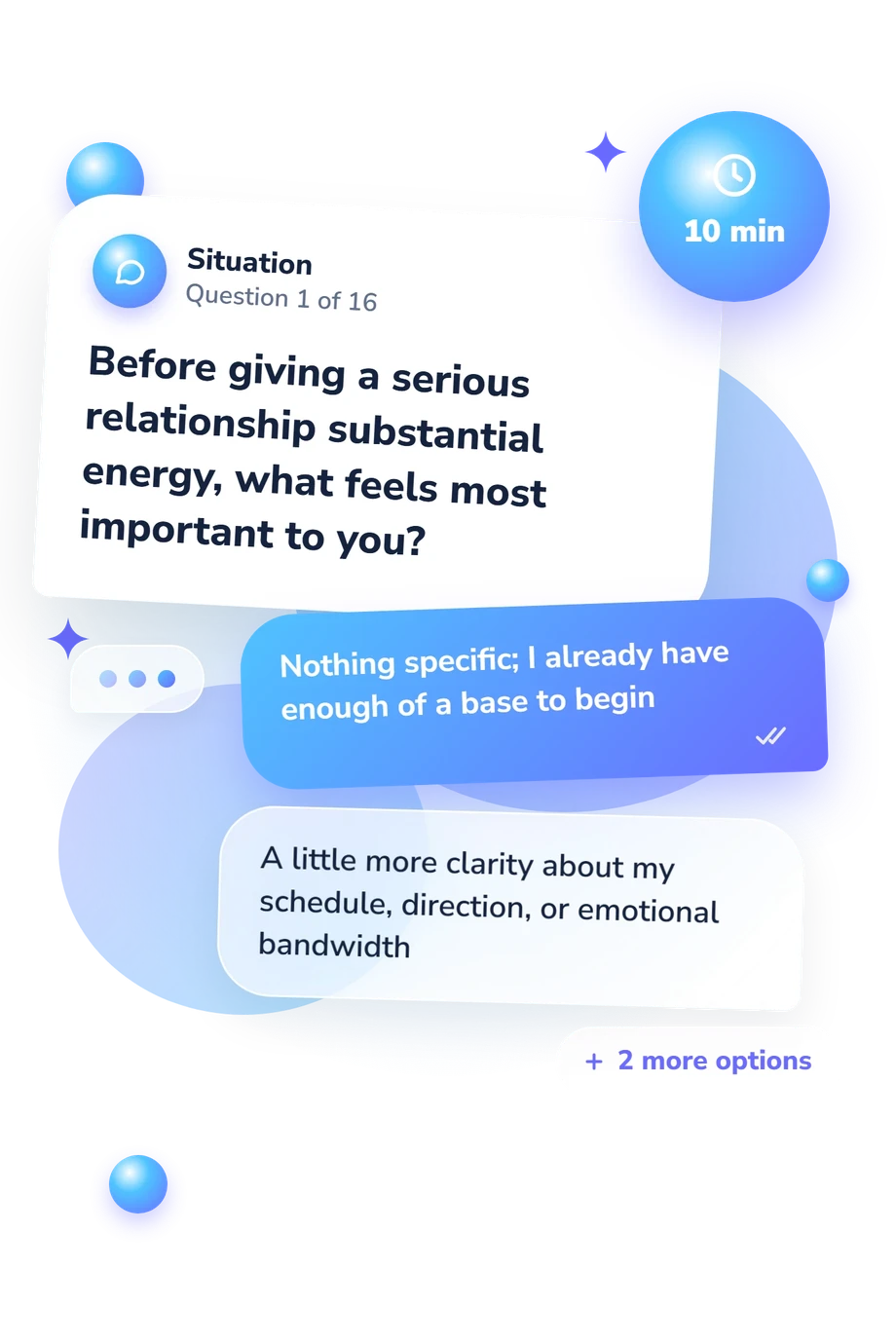
Example Questions From the Test
- Stick with familiar activities unless someone close joins me
- Sign up partly because I enjoy entering new communities
- Try a session and see whether the people and activity suit me
- Save the details, though I may not act on them soon
- I might go, but I would prefer to bring someone familiar
- I would be energized by the chance to start fresh and connect
- I would probably choose a familiar alternative instead
- I would try it if the activity itself mattered to me
- Rarely; my attention is directed elsewhere
- Occasionally, when motivation and circumstances line up
- Several times a month through dates, introductions, or events
- Most weeks, using one or more dating routes
When Will I Meet My Soulmate Quiz - Description and methodology of the test
People considering their relationship future can use this when will you meet your soulmate quiz to examine how readiness, opportunity, and beginnings shape expectations. The When Will I Meet My Soulmate Quiz treats the question of when I will find my soulmate as a prompt for self-reflection, not a promise about destiny. It suits readers who want a clearer sense of where meeting someone may feel possible and workable.
What This Assessment Explores
Four meeting storylines cover friendship, life transitions, personal foundations, and active dating. Its where will I meet my soulmate quiz framing treats location as a life-context pattern, not a guaranteed place.
The result shows:
- A Friendship That Deepens (0-12) shows the connection style that best fits current preferences; Romance Starts Clearly (0-4), Friendship Can Matter (5-8), and Strong Affinity (9-12).
- A New-Chapter Meeting (0-12) shows the storyline that best fits current routines or changes; Established Ground (0-4), Horizons Opening (5-8), and Strong Affinity (9-12).
- Foundation First, Love Later (0-12) shows the priority balance that best fits current circumstances; Room Alongside Life (0-4), Selective Timing (5-8), and Strong Affinity (9-12).
- Near-Term Through Active Dating (0-12) shows how active dating fits current activity; Not Your Current Route (0-4), A Possible Route (5-8), and Strong Affinity (9-12).
Methodology and Scientific Basis
Each item presents a situation with four options. They cover dating initiative, partnership room, new communities, friendship-to-romance, and routines. The when will you find your soulmate quiz uses structured self-report to ask readers to recognize patterns, not predict an event.
The result displays four scale scores. The highest is the strongest affinity; scores within one point form a blended result. It addresses when you will meet your soulmate by describing conditions that fit your responses, not by assigning a date.
Conceptually, the questionnaire aligns with Hadden et al. (2018) on relationship readiness and capacity. It also aligns with Stinson et al. (2022) on friendship-to-romance and Clark et al. (1999) on deliberate initiation; this when will i find my soulmate quiz is neither an adaptation nor a validated version of those studies.
Current circumstances, self-awareness, and socially desirable responding can influence self-report, so when will you find your soulmate remains an open question rather than a score-based date. The displayed bands are catalogue-defined interpretive categories, so read the profile as a time-sensitive reflection, not a diagnosis or fixed forecast.
- Hadden, Benjamin W., Christopher R. Agnew, and Kenneth Tan. “Commitment Readiness and Relationship Formation.” Personality and Social Psychology Bulletin, 44(8), 1242-1257, 2018. 10.1177/0146167218764668
- Stinson, Danu Anthony, Jessica J. Cameron, and Lisa B. Hoplock. “The Friends-to-Lovers Pathway to Romance: Prevalent, Preferred, and Overlooked by Science.” Social Psychological and Personality Science, 13(2), 562-571, 2022. 10.1177/19485506211026992
- Clark, Catherine L., Phillip R. Shaver, and Matthew F. Abrahams. “Strategic Behaviors in Romantic Relationship Initiation.” Personality and Social Psychology Bulletin, 25(6), 709-722, 1999. 10.1177/0146167299025006006
Updated: