
Male Reproductive System Quiz
How the Scales are Structured
Who Usually Takes This Test?
See How You Compare
Below is a preview of how scores are typically distributed across each scale.
Example Questions From the Test
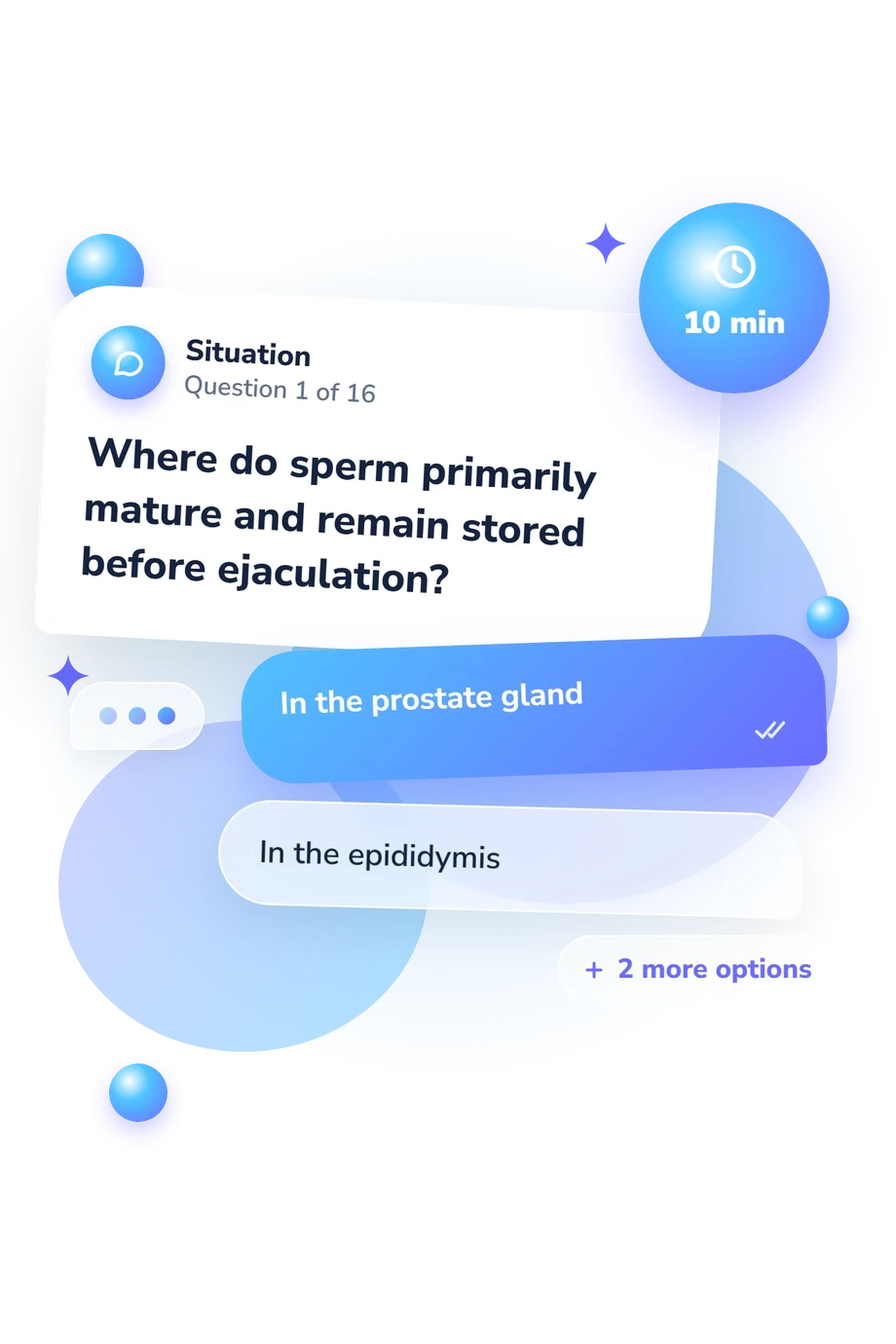
- In the prostate gland
- In the epididymis
- In the seminal vesicle
- In the bulbourethral gland
- The prostate gland
- The seminal vesicle
- The epididymis
- The pituitary gland
- The ureter
- The vas deferens
- The urethra
- The seminiferous tubule
Male Reproductive System Quiz - Description and methodology of the test
Students, educators, and curious readers can use this assessment as a male reproductive anatomy quiz that checks how accurately they recognize structures and explain their functions. The male reproductive system quiz is especially useful when reviewing anatomy, physiology, or foundational health science. It connects named organs with sperm production, transport, hormone regulation, ejaculation, and related functional relationships, so the result points to concepts worth revisiting.
What This Assessment Explores
Questions focus on whether the respondent can identify structures and connect them with functions, rather than simply recall isolated labels. The structure-identification items distinguish the testes, epididymis, ducts, urethra, and accessory glands, giving this male anatomy quiz a focus on structures in context.
The main themes are:
- Organ recognition links each structure to its location and role.
- Sperm production and maturation separates seminiferous tubules from the epididymis.
- Transport and ejaculation traces movement and explains the roles of the vas deferens, urethra, and bladder neck.
- Hormonal regulation connects GnRH, LH, FSH, Leydig cells, and Sertoli cells with reproductive function.
Results use one scale, Male Reproductive System Knowledge (0-16). Results appear as Building foundations (0-6), Developing knowledge (7-12), or Strong knowledge (13-16), describing educational progress from basic review needs to well-developed understanding.
Methodology and Scientific Basis
Each item uses a four-option multiple-choice format and asks for the most accurate anatomical or physiological explanation. Several prompts require recognition in context: the learner must distinguish nearby structures, follow a verbal sperm pathway, or connect a hormone with its target. Together, these questions make the assessment a male reproductive physiology quiz, testing applied understanding rather than disconnected recall.
The score is reported as a single total rather than separate subscores, with no stated weighting or penalty rule. Review should focus on the concepts represented by missed items. The displayed bands are educational summaries, not validated medical cutoffs, so the score cannot assess fertility or health.
Its content is conceptually consistent with the male-reproductive-system account by Betts and colleagues published in 2022. Cornwall’s 2009 work supports the treatment of epididymal maturation and function, while Smith and Walker’s 2014 review supports the hormone-androgen context of spermatogenesis. These sources support the subject matter; they do not make this online questionnaire an adaptation or validate its score. Use the knowledge result to decide whether to review organ locations, sperm pathways, hormonal control, or reproductive physiology.
- Betts, J. Gordon, Kelly A. Young, James A. Wise, Eddie Johnson, Brandon Poe, Dean H. Kruse, Oksana Korol, Jody E. Johnson, Mark Womble, and Peter DeSaix. Anatomy and Physiology 2e. Houston, TX: OpenStax, 2022. Chapter 27.1, “Anatomy and Physiology of the Male Reproductive System.”
- Cornwall, Gail A. “New Insights into Epididymal Biology and Function.” Human Reproduction Update, vol. 15, no. 2, 2009, pp. 213-227. 10.1093/humupd/dmn055.
- Smith, Lee B., and William H. Walker. “The Regulation of Spermatogenesis by Androgens.” Seminars in Cell & Developmental Biology, vol. 30, 2014, pp. 2-13. 10.1016/j.semcdb.2014.02.012.
Updated: