
90s Quiz
How the Scales are Structured
Who Usually Takes This Test?
See How You Compare
Below is a preview of how scores are typically distributed across each scale.
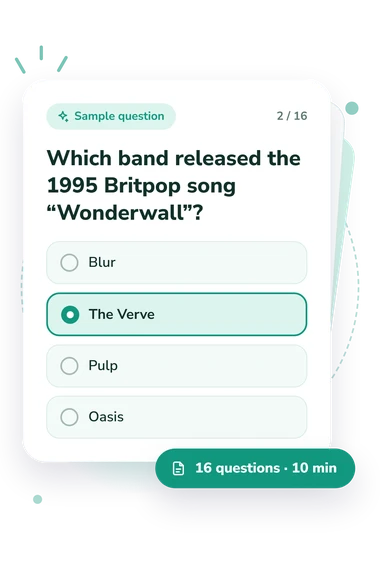
Example Questions From the Test
- Blur
- The Verve
- Pulp
- Oasis
- Launch
- Home
- Control
- Start
- A hyperlink
- A cookie
- A bookmark
- A search engine
90s Quiz - Description and methodology of the test
Readers who want to check how well they remember a formative decade can use this assessment as a compact cultural recall exercise. The 90s quiz suits people drawn to the music, films, television, technology, games, and everyday references that shaped 1990s life. Its mix of nostalgia and factual recall gives it the feel of an I Love the Nineties quiz while still producing a clearer profile of remembered cultural knowledge.
What This Assessment Explores
Rather than asking for opinions, the questionnaire measures recognition of shared cultural facts and references. Several prompts make it a 90s trivia quiz about a song, film, sitcom, console, toy, internet feature, or literary connection; together, these situations sample knowledge across entertainment, technology, and popular culture.
The main themes are:
- Music and audio references show whether artists, songs, and movements can be identified.
- Film and television recall indicates recognition of titles, characters, scenes, and creators.
- Technology and games reflect memory for devices, software, consoles, and digital habits.
- Toys and everyday culture capture objects and social touchstones.
These themes contribute to the 90s Culture Knowledge scale (0-16). Nineties Newcomer (0-6) indicates some recognized touchstones while major references remain unfamiliar; Culture Surfer (7-12) reflects developing knowledge with gaps; Nineties Expert (13-16) indicates strong, wide-ranging recall across 1990s entertainment, technology, and popular culture.
Methodology and Scientific Basis
Recognition-based prompts give this 90s pop culture quiz a knowledge test rather than a rating scale. Each item describes a brief cultural situation and offers four answer choices, so the result reflects the number of correct answers. The design tests recall of a reference, not confidence, personal preference, or agreement with a statement.
The conceptual frame is cultural knowledge: familiarity with shared references linking music, screen entertainment, technology, games, and everyday objects. Sullivan (2008) treats cultural knowledge as assessable knowledge, while Oxoby (2003) supplies historical context for American popular culture of the decade. Bittmann, Sari, and Goßmann (2023) demonstrate how structured items can measure cultural knowledge; this questionnaire is conceptually consistent with that work, not an adaptation of it.
Although the title can suggest a 1990 quiz, coverage spans the 1990s rather than one year. The result is a snapshot of cultural recall: performance can reflect exposure, age, region, media habits, and current memory rather than intelligence or cultural worth. With no stated norms or documented standardization, scores are best read against the supplied bands rather than as clinical classification.
- Sullivan, Alice. "Cultural Capital, Cultural Knowledge and Ability." Sociological Research Online 12, no. 6 (2008): 91-104. DOI 10.5153/sro.1596.
- Oxoby, Marc. The 1990s. American Popular Culture Through History. Westport, CT: Greenwood Press, 2003.
- Bittmann, Felix, Elif Sari, and Frank Goßmann. "A new instrument to measure cultural knowledge." Journal for Educational Research Online 15, no. 2 (2023): 226-249. DOI 10.31244/jero.2023.02.05.
Updated: