
Should I Go to Law School Quiz
How the Scales are Structured
Who Usually Takes This Test?
See How You Compare
Below is a preview of how scores are typically distributed across each scale.
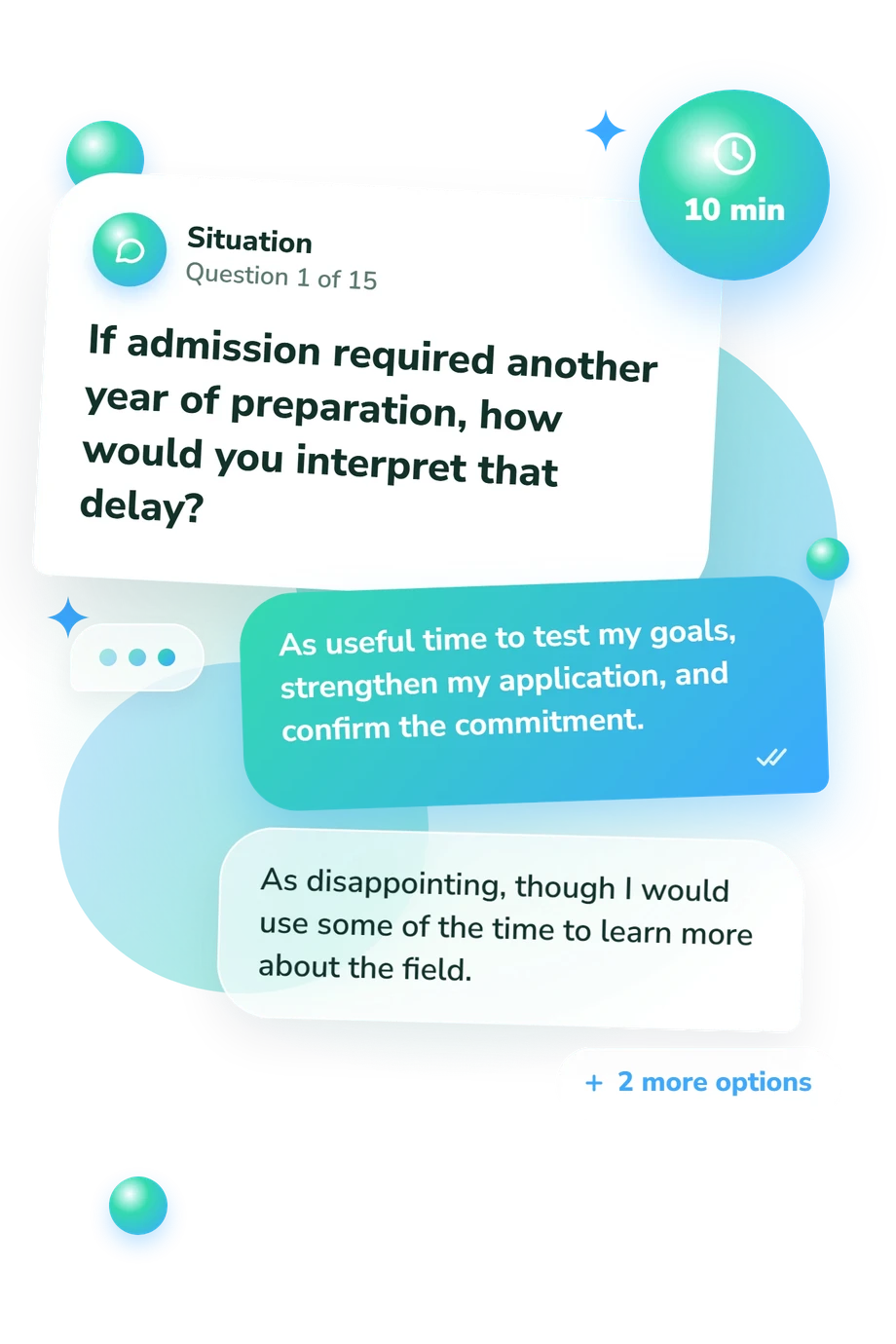
Example Questions From the Test
- As useful time to test my goals, strengthen my application, and confirm the commitment.
- As disappointing, though I would use some of the time to learn more about the field.
- As a reason to question the plan, because moving forward quickly is part of its appeal.
- As a sign to choose whichever graduate or professional option is available sooner.
- Evaluate skills, earnings, advancement, law-school cost, timing, and whether the job could clarify my goals.
- Accept whichever option feels more exciting when the deadline arrives.
- Compare salary with tuition and choose the option that looks better financially in the short term.
- List the major career and financial tradeoffs, while seeking more information about the less certain factors.
- I mainly rely on rankings and the careers highlighted in school marketing.
- I have reviewed some placement figures, though not how outcomes differ by job type or location.
- I compare school-reported and independent data on job types, locations, bar passage, and typical outcomes.
- I have looked at several outcome measures and plan to verify the details for my target path.
Should I Go to Law School Quiz - Description and methodology of the test
A law school quiz helps prospective students examine a demanding career choice without reducing it to prestige or outside expectations. It is intended for people deciding whether legal education matches their working preferences, goals, resources, and willingness to investigate alternatives. The Should I Go to Law School Quiz turns that reflection into a structured profile of fit, readiness, and purpose. It is most useful when the result leads to concrete questions.
What This Assessment Explores
Situations cover dense reading, precise writing, criticism, ambiguity, deadlines, costs, outcomes, motives, and alternatives. They show how someone weighs evidence and connects legal training with desired work. As an is law school for me quiz, it turns these themes into investigation areas.
Three displayed dimensions follow:
- Legal Study and Work Fit (0-15) measures fit with dense reading, precise writing, ambiguity, feedback, and sustained deadlines: Needs firsthand testing (0-5), Mixed fit (6-10), Strong working fit (11-15).
- Practical Decision Readiness (0-15) measures evidence gathered on admissions, costs, opportunity costs, outcomes, and constraints: Build the evidence (0-5), Planning in progress (6-10), Decision-ready plan (11-15).
- Purpose and Career Fit (0-15) measures links between legal training, desired work, and values: Explore the motive (0-5), Emerging direction (6-10), Grounded purpose (11-15).
Together, they distinguish fit, preparation, and purpose for an is law school right for me quiz.
Methodology and Evidence Base
Each item presents a situation with four answer options. The choices contrast evidence-led planning with assumptions, persistence with avoidance, and interest in daily legal work with prestige. They invite self-report judgment, not legal knowledge or one objectively correct response.
Responses are combined into three displayed profiles. Their bands point toward firsthand testing, better evidence, or clearer motives; the questionnaire does not publish a point value for each option, so its scoring should not be reverse-engineered.
Conceptually, it is consistent with the Law School Choice Survey (Ryan, 2020) on law-school selection. AALS and Gallup add context on undergraduate views; Chien and Daniels (2021) address career aspirations; Shultz and Zedeck (2011) broaden relevant capacities beyond conventional academic indicators. These sources support the themes, but the online questionnaire is not a standardized adaptation or validation of them.
That distinction matters for a do i want to be a lawyer quiz: results organize reflection on work, costs, evidence, and alternatives rather than measure intelligence or forecast admission, grades, earnings, or satisfaction. Current circumstances, honesty, and self-awareness can shape self-report answers, so use the profile to identify assumptions that need checking.
- Christopher J. Ryan, Jr., "Analyzing Law School Choice," University of Illinois Law Review, vol. 2020, no. 2, pp. 583-620, 2020.
- Shih-Chun Steven Chien and Stephen Daniels, "Who Wants to Be a Prosecutor? And Why Care? Law Students’ Career Aspirations and Reform Prosecutors’ Goals," Howard Law Journal, vol. 65, no. 2, pp. 173-223, 2021.
- Association of American Law Schools and Gallup, Before the JD: Undergraduate Views on Law School, Association of American Law Schools, 2018.
- Marjorie M. Shultz and Sheldon Zedeck, "Predicting Lawyer Effectiveness: Broadening the Basis for Law School Admission Decisions," Law & Social Inquiry, vol. 36, no. 3, pp. 620-661, 2011. 10.1111/j.1747-4469.2011.01245.x
Updated: