
JavaScript Quiz
How the Scales are Structured
Who Usually Takes This Test?
See How You Compare
Below is a preview of how scores are typically distributed across each scale.
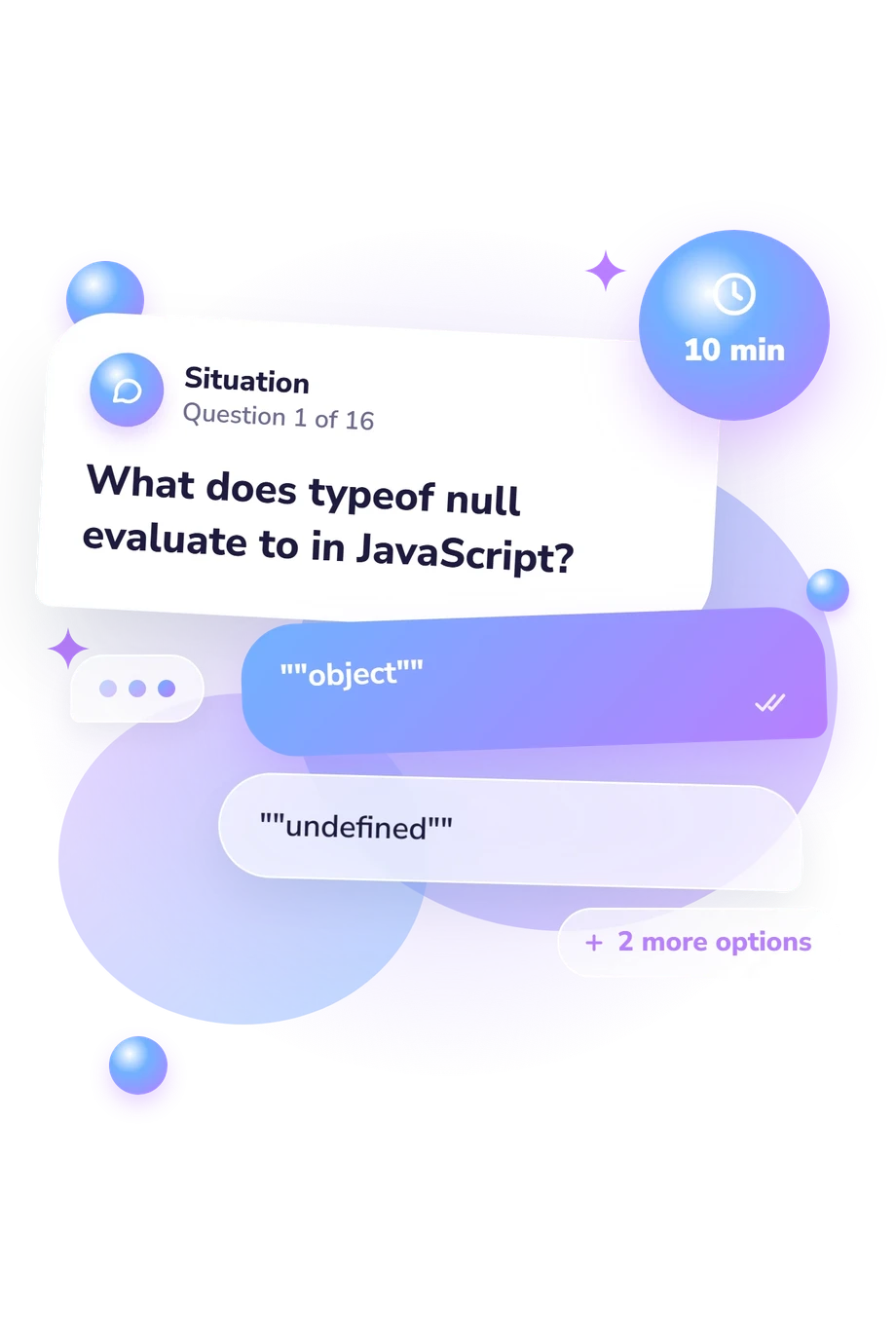
Example Questions From the Test
- ""object""
- ""undefined""
- ""null""
- ""boolean""
- A TypeError because profile does not exist
- null because optional chaining supplies a null value
- An empty string because name has not been assigned
- undefined because optional chaining stops at the missing property
- [2, 4]
- true, because at least one element is even
- 5, because that is the first element that fails the test
- false, because not every element is even
JavaScript Quiz - Description and methodology of the test
Readers deciding whether a focused code-reading assessment fits their goal can use this JavaScript quiz to see what kind of challenge it offers. As a JavaScript online quiz, it suits a quick check of language behavior before a study session, documentation review, or technical task. The result can help you decide whether this format matches the way you want to prepare.
What This Assessment Explores
This assessment examines practical JavaScript understanding across syntax, values, scope, functions, collections, operators, and execution order. Its short scenarios ask about block-scoped declarations, optional chaining, array methods, mutation, closures, equality, promises, timers, and microtasks. The result indicates how well a respondent recognizes and applies the tested concepts in short code situations.
The JavaScript Knowledge scale runs from 0-16 and groups performance into three result bands:
- Foundations to build (0-6) indicates that core syntax and language behavior need review.
- Developing knowledge (7-12) indicates solid coverage of common concepts, with subtler gaps possible.
- Strong knowledge (13-16) indicates a reliable grasp of core concepts in short examples.
For a learner, this assessment can therefore help choose a starting point, while a working developer may use the JavaScript code in this quiz to revisit overlooked details.
Methodology and Evidence Base
Each item presents a code fragment, language rule, or output question with answer choices. Selecting one option tests code reading and conceptual reasoning rather than free-form programming. The examples cover declarations, arrays, objects, promises, timers, and operators.
The questionnaire reports one knowledge result; it does not estimate professional seniority, framework expertise, or total programming ability. This JS quiz is a focused checkpoint for the concepts represented by its items.
The methodology follows language semantics rather than a published psychological scale. Its technical basis is ECMAScript language semantics, with David Flanagan providing practical explanations of JavaScript behavior. Timer and promise-scheduling questions are consistent with the browser execution model described by WHATWG. These technical sources explain JavaScript behavior; no psychometric validation or standardization is reported for this online questionnaire. The questionnaire is conceptually consistent with these sources, not an adaptation of a published instrument.
Results can vary with current familiarity, guessing, and test-taking context. They describe performance on short JavaScript examples, not the ability to design, debug, or maintain a complete application, so use the outcome to choose practice topics.
- Guo, Shu-yu; Ficarra, Michael; and Gibbons, Kevin, editors. ECMAScript 2026 Language Specification. 17th ed. Ecma International, June 2026. ECMA-262.
- Flanagan, David. JavaScript: The Definitive Guide. 7th ed. O'Reilly Media, May 2020. ISBN 9781491952016.
- WHATWG. HTML Living Standard. WHATWG, 2026.
- Wirfs-Brock, Allen, and Brendan Eich. JavaScript: The First 20 Years. Proceedings of the ACM on Programming Languages, 4(HOPL), Article 77, June 2020, 1-189. DOI 10.1145/3386327.
Updated: