
Fish Quiz
How the Scales are Structured
Who Usually Takes This Test?
See How You Compare
Below is a preview of how scores are typically distributed across each scale.
Example Questions From the Test
- The male
- Both parents in alternating stages
- The female alone
- Neither parent; the eggs develop on rocks
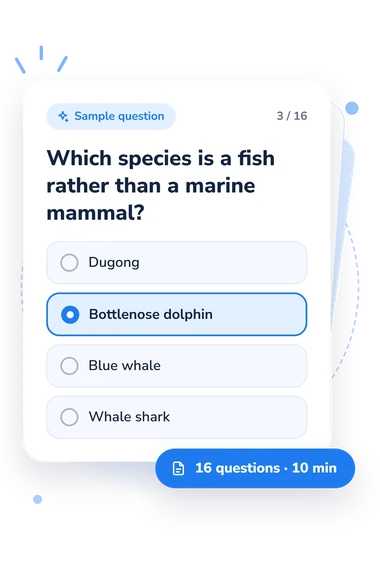
- Dugong
- Bottlenose dolphin
- Blue whale
- Whale shark
- A tall, disk-shaped body
- A boxlike body covered by rigid plates
- A streamlined body tapering toward a narrow tail base
- A broad body with a blunt tail
Fish Quiz - Description and methodology of the test
People who enjoy biology, aquariums, fishing, or nature study can use the fish quiz to examine how confidently they connect visible features with ecology and behavior. This fish identification quiz suits curious beginners and learners revisiting basic zoology. The result shows whether recognition rests on isolated facts or a broader understanding of how fish live, helping direct further reading and self-reflection.
What This Assessment Explores
These questions treat fish as animals rather than names to memorize. They connect anatomy, habitats, behavior, reproduction, migration, feeding, defense, and relationships. Seahorse brooding, archerfish hunting, ray body form, salmon migration, and clownfish-anemone protection require a feature or behavior to be linked with its function. A quiz about freshwater fish includes barbels, osmoregulation, and water balance, while a quiz on fish species asks for the plausible organism or process from a description.
The catalogue reports the Fish Knowledge scale (0-16) in these bands:
- Fresh Start (0-6) indicates recognition of some fish facts, with major groups, habitats, and adaptations needing review.
- Developing Knowledge (7-12) indicates a solid foundation for identifying species from characteristic features or behaviors.
- Strong Fish Knowledge (13-16) indicates consistent links among species, anatomy, ecology, reproduction, and survival strategies.
The profile helps learners identify strengths and choose study topics.
Methodology and Evidence Base
Methodologically, this structured multiple-choice assessment presents factual or scenario-based prompts with four choices. Respondents select the species, adaptation, behavior, or process that best fits. A quiz that asks you to name the fish draws on recognition, anatomical inference, and ecological interpretation, not recall alone.
The outcome is reported on the catalogue’s single scale. The item-to-point rule, standardized norms, and diagnostic cutoffs are not documented, so the result is a snapshot of selected fish knowledge. A band describes performance on these prompts, not a permanent level of ability.
Viewed as a quiz on fish species, its content is conceptually consistent with Horniaková and Píšová (2024) on vertebrate species-identification skill and with Gerl, Randler, and Neuhaus (2021) on species knowledge in biology. Helfman, Collette, Facey, and Bowen (2009) provide a framework for fish anatomy, ecology, evolution, and adaptation. These sources support its subject matter and coverage; they do not validate this online questionnaire or establish its norms.
Results can vary with prior exposure, attention, guessing, and current interest. A limited content range and self-report response patterns mean the outcome cannot represent every aspect of biological expertise.
- Horniaková, Michaela, and Markéta Píšová. (2024). Determinants of vertebrate species identification skills: A cross-age study. Natural Sciences Education, 53(2), e70001. 10.1002/nse2.70001
- Gerl, Thomas, Christoph Randler, and Birgit Jana Neuhaus. (2021). Vertebrate species knowledge: An important skill is threatened by extinction. International Journal of Science Education, 43(6), 928-948. 10.1080/09500693.2021.1892232
- Helfman, Gene S., Bruce B. Collette, Douglas E. Facey, and Brian W. Bowen. (2009). The Diversity of Fishes: Biology, Evolution, and Ecology (2nd ed.). Wiley-Blackwell.