
Is He the One Quiz
How the Scales are Structured
Who Usually Takes This Test?
See How You Compare
Below is a preview of how scores are typically distributed across each scale.
Example Questions From the Test
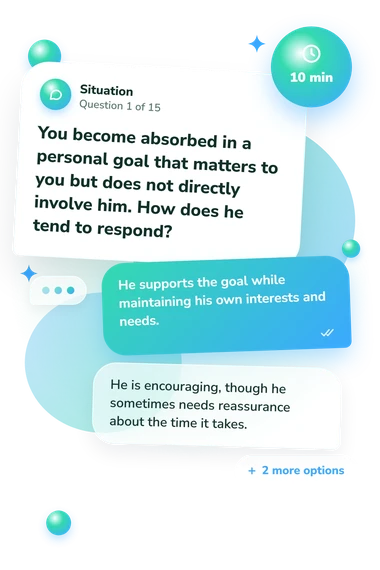
- He supports the goal while maintaining his own interests and needs.
- He is encouraging, though he sometimes needs reassurance about the time it takes.
- He accepts it but shows limited interest or becomes noticeably distant.
- I tend to reduce or hide my ambitions to prevent strain between us.
- We have discussed what commitment means and our expectations are closely aligned.
- We seem to want similar commitment, but much of that understanding is assumed.
- One or both of us tends to postpone defining what we expect.
- We want clearly different levels or forms of commitment.
- We are both still exploring these choices and can do so openly without forcing an answer.
- We know we want incompatible things on at least one non-negotiable family issue.
- We have compatible preferences and understand what they could require in practice.
- The topic has surfaced, but one or both of us avoids making our position clear.
Is He the One Quiz - Description and methodology of the test
People reflecting on a romantic relationship can use the Is He the One Quiz to examine whether daily patterns feel secure, balanced, and directed toward compatible goals. As an Is He the One for Me quiz, it turns a broad question into observable themes rather than a promise about the future. The result is meant for someone evaluating the relationship they are actually living.
What This Assessment Explores
Questions examine independence, commitment, conflict repair, vulnerability, dependability, boundaries, shared decisions, money, family, and future plans. An Is My Boyfriend the One quiz can identify strengths and useful conversations.
The three dimensions describe the relationship:
- Emotional Safety & Trust (0-15) reflects security, acceptance, and reliance: Needs attention (0-5) shows limited ease; Mixed foundation (6-10) combines trust with uncertainty; Strong foundation (11-15) suggests consistent acceptance.
- Reciprocity & Relationship Skills (0-15) reflects shared effort, strain handling, and mutual support: Imbalance to examine (0-5) shows one-sided repair; Uneven but workable (6-10) shows skills that may falter; Mutually supportive (11-15) suggests constructive cooperation.
- Values & Future Alignment (0-15) reflects fit among priorities, expectations, and futures: Major questions open (0-5) marks unresolved differences; Partial alignment (6-10) leaves areas to explore; Clear alignment (11-15) suggests compatible central values.
Methodology and Evidence Base
Each item presents a relationship situation with four response descriptions. Choose the option closest to your usual experience; the alternatives describe different degrees of security, cooperation, alignment, avoidance, or unresolved strain. This turns how to know if someone is the one into a quiz about lived patterns.
The assessment is conceptually consistent with C-SCORE (Carr et al., 2025), which examines couple functioning, connection, cooperation, and repair; it is not an adaptation of that scale. Reciprocity themes correspond with the Relationship Balance Assessment (Luttrell et al., 2018), values themes with Danioni et al. (2023), and trust themes with Rempel, Holmes, and Zanna (1985).
Scores form a profile rather than a pass-or-fail verdict. For someone asking how to know if he is the one, quiz results can highlight conversations worth having. The bands describe current self-report, not population norms or guaranteed compatibility; memory, context, self-awareness, and response bias can affect answers, while fear or pressure matters regardless of the total.
- Carr, A., Kieran, A., Sherbersky, H., Shepherd, M., Galbraith, M., Whittinger, N., Pomini, V., Yang Yang, K., Nearchou, F., & Stratton, P. (2025). Development and preliminary validation of the C-SCORE: A brief scale for use in systemic couple therapy. Journal of Family Therapy, 47(1), e12485. 10.1111/1467-6427.12485
- Luttrell, T. B., Distelberg, B., Wilson, C., Knudson-Martin, C., & Moline, M. (2018). Exploring the Relationship Balance Assessment. Contemporary Family Therapy, 40(1), 10-27. 10.1007/s10591-017-9421-2
- Danioni, F., Russo, C., Zagrean, I., Regalia, C., & Barni, D. (2023). “What matters to us”: The portrait values questionnaire to measure couple values. Personal Relationships, 30(2), 681-699. 10.1111/pere.12483
- Rempel, J. K., Holmes, J. G., & Zanna, M. P. (1985). Trust in Close Relationships. Journal of Personality and Social Psychology, 49(1), 95-112. 10.1037/0022-3514.49.1.95
Updated: