
Art Quiz
How the Scales are Structured
Who Usually Takes This Test?
See How You Compare
Below is a preview of how scores are typically distributed across each scale.
Example Questions From the Test
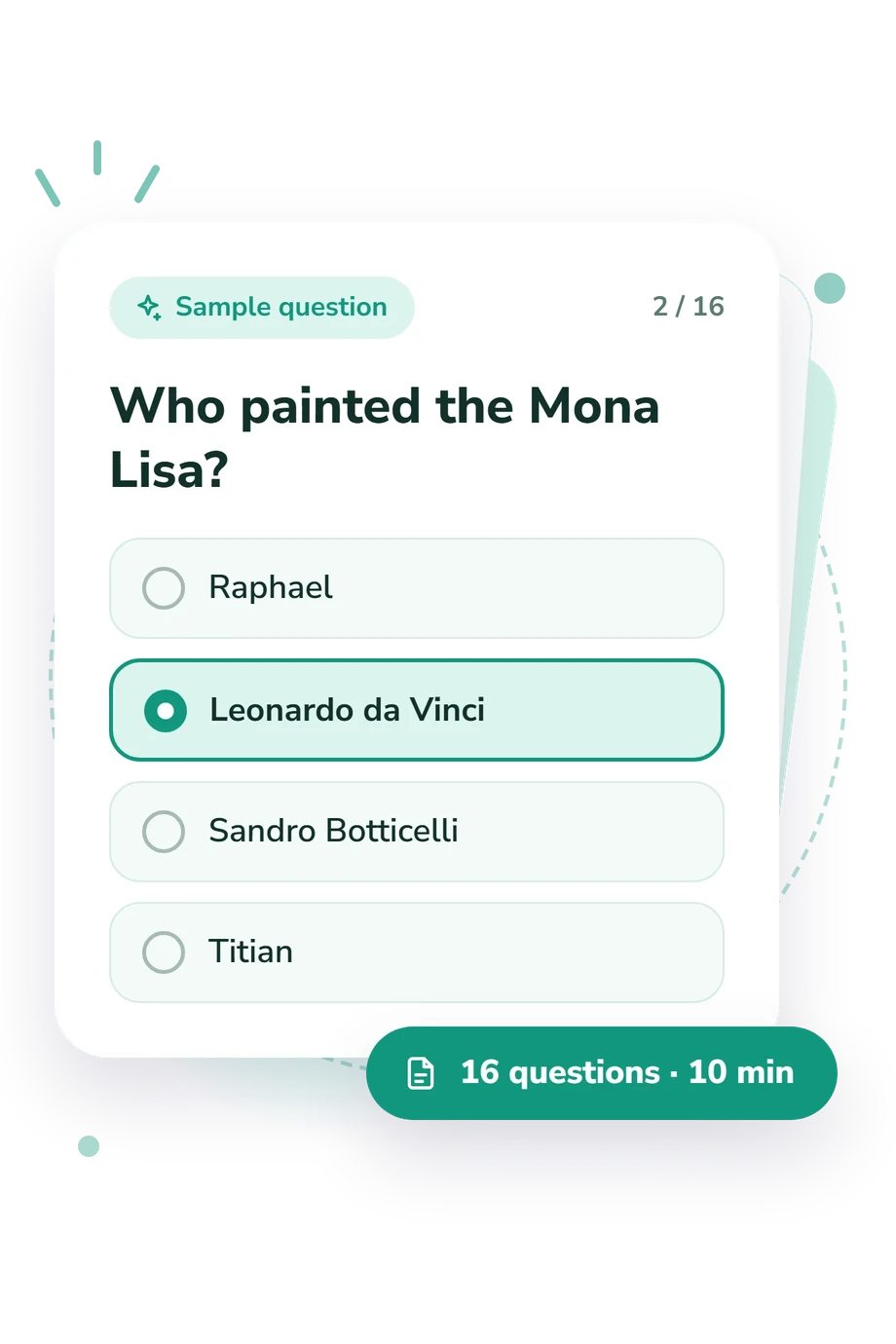
- Raphael
- Leonardo da Vinci
- Sandro Botticelli
- Titian
- José Clemente Orozco
- David Alfaro Siqueiros
- Diego Rivera
- Rufino Tamayo
- Vincent van Gogh
- Paul Gauguin
- Paul Cézanne
- Henri de Toulouse-Lautrec
Art Quiz - Description and methodology of the test
For learners, museum visitors, and students who want to gauge familiarity with major artists and visual traditions, this art quiz offers a focused way to test existing knowledge. Results from the painting quiz items give a practical snapshot of recognition across periods, movements, techniques, and cultural clues. Its format can help you choose subjects to revisit without requiring prior specialist training.
What This Assessment Explores
Several item types connect creators with works, movements with visual clues, and techniques with recognizable practices. Together, these prompts cover artists, works, movements, techniques, and contextual clues, making this an art challenge quiz. The format suits learners building a clearer mental map of art history. As a quiz about art, it tests artists, works, styles, and techniques.
The main knowledge areas are:
- Artist-work recognition matches creators with landmark titles and images.
- Movements and styles reveal whether visual clues point to Cubism, Impressionism, or Pop Art.
- Techniques and forms show how sfumato, dripping, pouring, and Calder’s mobiles aid recognition.
- Contextual knowledge links works with places, events, traditions, and history.
The Art Knowledge scale runs from 0-16, with one point for each correct answer. Foundations (0-6) marks emerging connections; Developing (7-12) indicates broad but incomplete recognition; Strong (13-16) reflects consistently strong knowledge of artists, works, movements, and techniques.
Methodology and Evidence Base
Each item presents an identification prompt with four answer choices. You select the best match for an artist, work, movement, or technique, and a correct response contributes one point to the score. The result is a count of recognized answers, not a weighted estimate of expertise.
The questionnaire is conceptually consistent with VAIAK (Specker et al., 2020), which treats art knowledge as distinct from art interest. It is not an adaptation or standardized administration of VAIAK; the online questionnaire has no documented standardization.
Belke and colleagues’ work is relevant to how viewers identify visual art, while AP Art History provides a reference point for coverage of artists, periods, movements, and landmark works.
As a quiz in fine art, it offers a learning snapshot rather than a map of cultural knowledge. Familiarity with museum canons, regional traditions, or classroom material can affect performance, and four-option items allow chance success. The works and names cannot represent every period, region, medium, or form of expertise. Read the band as guidance for topics to revisit, interpreting the result alongside interests and learning experience.
- Specker, Eva, Michael Forster, Hanna Brinkmann, Jane Boddy, Matthew Pelowski, Raphael Rosenberg, and Helmut Leder. “The Vienna Art Interest and Art Knowledge Questionnaire (VAIAK): A Unified and Validated Measure of Art Interest and Art Knowledge.” Psychology of Aesthetics, Creativity, and the Arts, 14(2), 172-185, 2020. 10.1037/aca0000205
- Belke, Benno, Helmut Leder, Geza Harsanyi, and Claus-Christian Carbon. “When a Picasso is a ‘Picasso’: The Entry Point in the Identification of Visual Art.” Acta Psychologica, 133(2), 191-202, 2010. 10.1016/j.actpsy.2009.11.007
- College Board. AP Art History Course and Exam Description. Effective Fall 2019. New York, NY: College Board, 2019.
Updated: