
Safety Quiz
How the Scales are Structured
Who Usually Takes This Test?
See How You Compare
Below is a preview of how scores are typically distributed across each scale.
Example Questions From the Test
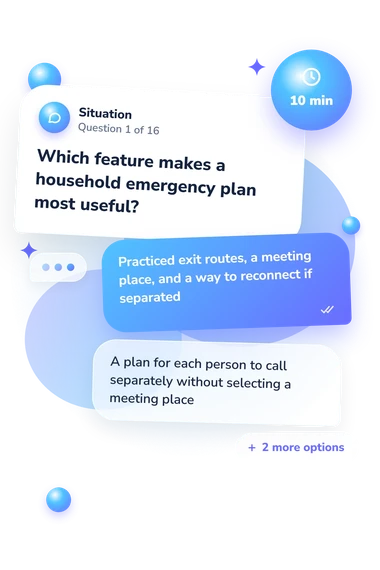
- Practiced exit routes, a meeting place, and a way to reconnect if separated
- A plan for each person to call separately without selecting a meeting place
- Emergency supplies stored somewhere known to only one household member
- One exit route that everyone uses in every type of emergency
- Disconnect it safely and stop using it until the cord and load are checked
- Move the cord away from your feet but continue using it
- Cover the warm section with electrical tape while it is plugged in
- Add a second extension cord to distribute the electricity
- Holding tools in both hands so the task can be finished quickly
- Maintaining three points of contact whenever possible
- Standing on the highest available step to extend your reach
- Leaning sideways rather than moving the ladder
Safety Quiz - Description and methodology of the test
People who want to refresh their responses to everyday hazards can use this assessment to check practical judgment. The safety quiz focuses on choices that prevent harm, support timely action, and follow established procedures. Its short questionnaire format presents practical safety questions with four choices, giving people a starting point for reviewing habits or identifying topics for further practice.
What This Assessment Measures
This questionnaire tests practical recognition across household, workplace, fire, first-aid, evacuation, and emergency situations, not personality or clinical symptoms. Emergency preparedness questions cover planning and reconnection; other items examine whether you choose actions that reduce exposure, protect injured people, and follow official instructions.
Safety Knowledge is reported on a 0-16 scale. The displayed bands are Foundation to build (0-6), Developing knowledge (7-12), and Strong knowledge (13-16). They indicate breadth of safer-action recognition; the score is educational, not certification or a guarantee of safety.
These themes summarize what the scenarios ask you to recognize:
- Planning and evacuation show whether you recognize routes, meeting places, and official instructions.
- First aid shows whether immediate actions limit harm during bleeding, burns, or unresponsiveness.
- Hazard prevention shows whether you select controls, labels, protective equipment, and stable movement.
Methodology and Evidence Base
As a self-report format, each item presents a concrete situation with four response options. Choosing the safest action measures recognition and applied judgment, not demonstrated performance of first aid or emergency procedures. The result is banded, but the questionnaire does not state how answers are weighted, so the total is not a hand-calculated rule.
The closest named evidence is Household Emergency Preparedness Instrument (Heagele et al., 2023), a published measure of household preparedness and emergency-response content. Heagele et al.’s 2022 Delphi study offers related expert consensus on preparedness domains. This questionnaire is conceptually consistent with both works, not an adaptation of either; it covers hazard-control and first-aid decisions.
The result directs review toward practice areas, including general safety questions and answers. The online questionnaire has no stated standardization, reliability, validity study, norms, or clinical cutoffs. Responses may vary with current stress, memory, self-awareness, and social desirability. An immediate red flag takes priority over the total; local procedures or emergency services should guide urgent action.
- Heagele, T. N., Adams, L. M., McNeill, C. C., & Alfred, D. M. (2023). Validation and Revision of the Household Emergency Preparedness Instrument (HEPI) by a Pilot Study in the City University of New York. Disaster Medicine and Public Health Preparedness, 17, e126. 10.1017/dmp.2022.35
- Heagele, T. N., McNeill, C. C., Adams, L. M., & Alfred, D. M. (2022). Household Emergency Preparedness Instrument Development: A Delphi Study. Disaster Medicine and Public Health Preparedness, 16(2), 570-582. 10.1017/dmp.2020.292