
Which Avenger Are You Quiz
How the Scales are Structured
Who Usually Takes This Test?
See How You Compare
Below is a preview of how scores are typically distributed across each scale.
Example Questions From the Test
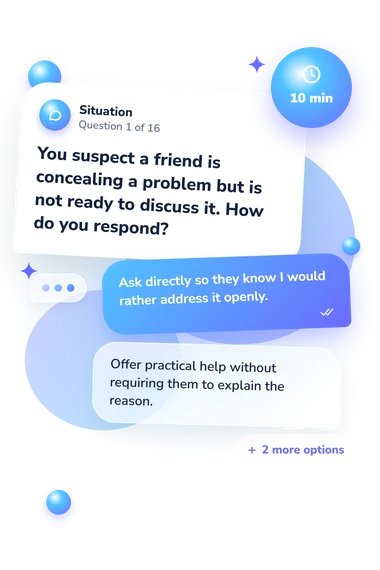
- Ask directly so they know I would rather address it openly.
- Offer practical help without requiring them to explain the reason.
- Stay nearby and let them choose when to begin the conversation.
- Watch for patterns, create a private opening, and signal that I already understand more than I am saying.
- Study the risks until I can reduce most of the uncertainty.
- Gather capable allies and develop a coordinated plan.
- Prepare carefully, then commit without second-guessing myself.
- Meet it head-on; the size of the challenge makes me more determined.
- Set it aside unless new evidence gives me a reason to revisit it.
- Ask other experienced people whether they see the same obstacles.
- Break the concept into smaller tests before deciding.
- Treat the objection as a design challenge and start prototyping.
Which Avenger Are You Quiz - Description and methodology of the test
For fans who want to connect fictional heroes with everyday choices, the Which Avenger Are You Quiz offers reflection on pressure, loyalty, uncertainty, and group responsibility. It suits readers who want a what Avenger am I quiz to compare their choices with recognizable heroic styles, rather than treating a fictional match as a fixed identity. The profile highlights a preferred decision pattern when values and demands collide.
What This Assessment Explores
Questions place respondents in social, ethical, and practical situations involving tension, unfairness, expertise, loyalty, group duty, and bold action. The result describes a character-linked style of reading rooms, handling uncertainty, protecting relationships, following principles, or inventing alternatives. For someone using a what Avenger are you quiz, it is a self-reflection prompt rather than a literal personality label.
The four displayed scales and their result bands are:
- Black Widow (0-12) reflects observant, adaptable loyalty: Open Navigator (0-4), Perceptive Adapter (5-8), and Strategic Observer (9-12).
- Captain America (0-12) reflects principled, duty-centered leadership: Independent Course (0-4), Steady Ally (5-8), and Principled Leader (9-12).
- Iron Man (0-12) reflects inventive, self-directed thinking: Grounded Approach (0-4), Resourceful Builder (5-8), and Bold Innovator (9-12).
- Thor (0-12) reflects courageous, openly loyal action: Measured Presence (0-4), Warm Protector (5-8), and Valiant Heart (9-12).
Methodology and Evidence Base
Each item presents an everyday dilemma with four response options. Alternatives distinguish how respondents read situations, handle uncertainty, use relationships, and act on values; there are no right answers, so the method depends on honest self-report.
The scoring compares all four affinity scores. The highest score marks the strongest character alignment, while another score within one point creates a blended result. The result gives an Avengers quiz- which character are you?- a comparison of response patterns rather than a fixed identity.
The questionnaire is conceptually consistent with Identification scale (Huang & Fung, 2024), Jonathan Cohen’s account of audience identification, and Broom, Chavez, and Wagner (2021), whose findings connect fictional-character identification with self-other neural overlap. It is not an adaptation or validation of those works, and has no stated normed standalone status.
Current mood, circumstances, self-awareness, and response bias can influence the profile, so read it as a snapshot of preferred tendencies and compare it with broader experience.
- Huang, Kate Y., and Helene H. Fung. "Measuring identification with narrative characters: the development and validation of a new scale." Current Psychology, vol. 43, 2024, pp. 24835-24849. 10.1007/s12144-024-06191-2
- Cohen, Jonathan. "Defining Identification: A Theoretical Look at the Identification of Audiences With Media Characters." Mass Communication and Society, vol. 4, no. 3, 2001, pp. 245-264. 10.1207/S15327825MCS0403_01
- Broom, Timothy W., Robert S. Chavez, and Dylan D. Wagner. "Becoming the King in the North: identification with fictional characters is associated with greater self-other neural overlap." Social Cognitive and Affective Neuroscience, vol. 16, no. 6, 2021, pp. 541-551. 10.1093/scan/nsab021
Updated: