
Birthday Quiz
How the Scales are Structured
Who Usually Takes This Test?
See How You Compare
Below is a preview of how scores are typically distributed across each scale.
Example Questions From the Test
- A school register dated April 23, 1564
- A royal census completed on May 1, 1564
- A letter written by Shakespeare’s father on April 21, 1564
- A parish record of his baptism on April 26, 1564
- A public coming-of-age ceremony
- The first day of a calendar month
- A birthday or founding anniversary
- A yearly memorial for a military victory
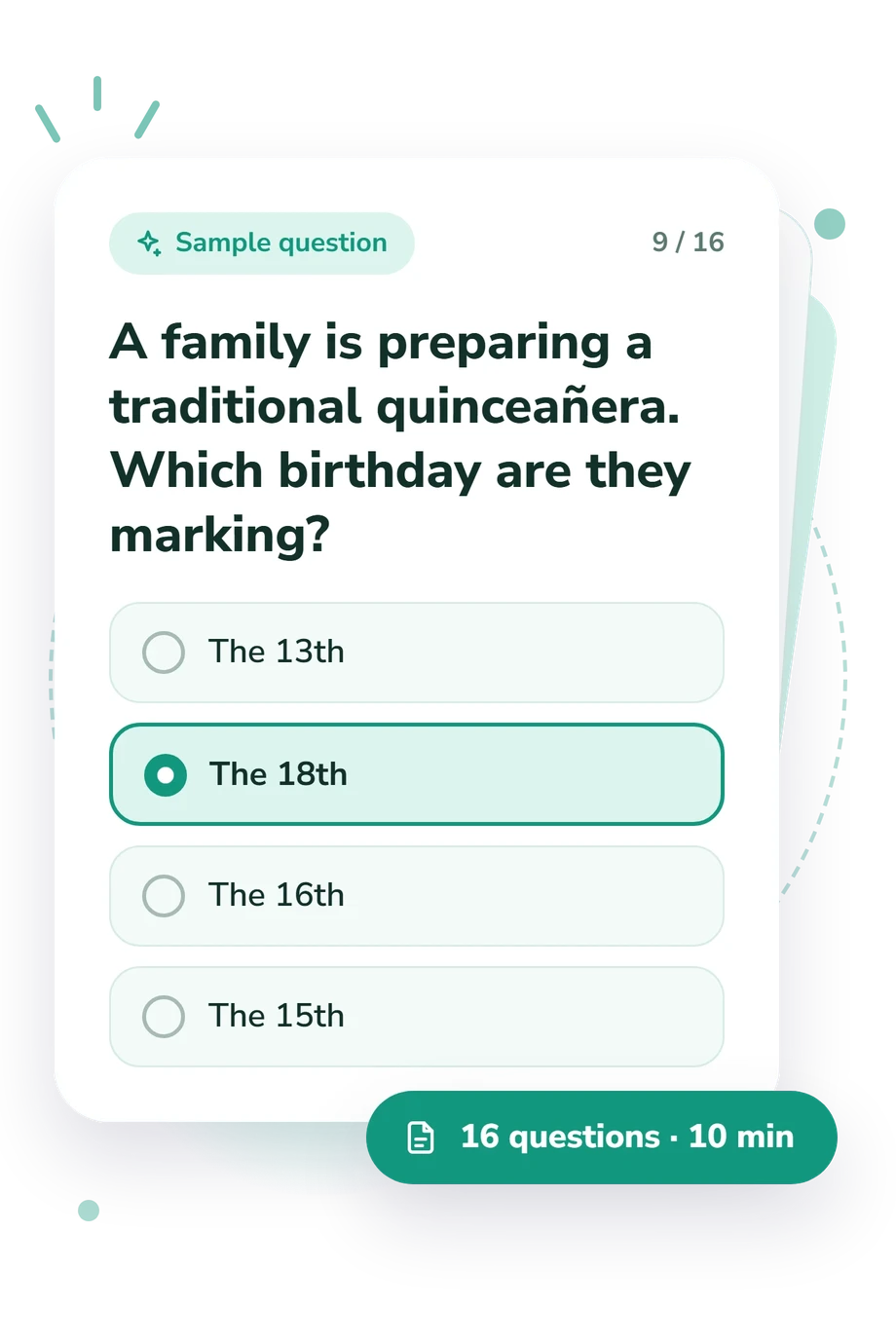
- The 13th
- The 18th
- The 16th
- The 15th
Birthday Quiz - Description and methodology of the test
For readers deciding whether a short knowledge assessment suits their interests, this birthday quiz offers a focused way to test recall and identify topics worth exploring. It suits curious learners, trivia fans, and anyone who wants a clear sense of their current grasp before studying further. This assessment can also serve as a birthday-themed quiz for friends, turning individual recall into a friendly conversation.
What This Assessment Explores
Birthday history joins calendar reasoning, documentary evidence, and cultural practice. It suits general readers testing knowledge, not a psychological trait. A higher result indicates stronger performance on selected facts; a lower result highlights subjects to explore.
Across the items, birthday-themed quiz questions involve leap-year rules, calendar changes, inferred dates, holidays, ceremonies, and traditions. Choices reward explanation over name recognition.
The questions cover these themes, while one displayed scale summarizes performance:
- Birthday History Knowledge (0-16) summarizes performance: Early Foundation (0-6) shows some recognition with room to explore; Developing Knowledge (7-12) reflects major customs and dates with subtler distinctions missed; Strong Knowledge (13-16) reflects well-developed historical and date-related reasoning.
- Calendar reasoning examines how you handle leap years and dating-system changes.
- Historical evidence asks whether you separate records, inferences, traditions, and later interpretations.
- Cultural context addresses recognition of ceremonies, holidays, anniversaries, and customs.
Methodology and Evidence Base
Each item presents a factual scenario or question with four answer choices. In these questions, you choose the best-supported answer. The result combines these responses into the displayed score for this questionnaire.
The content is conceptually consistent with Linton and Linton (1952), whose work supplies context for birthday traditions and commemorations. Shoham (2021) frames birthdays as social practices linked with time and identity. Cortina Borja and Haigh (2007) support the probability reasoning behind shared-birthday calculations, while Brauneis (2009) provides context for the familiar birthday song. These sources support the content domains; this questionnaire is not an adaptation of their studies.
As an online knowledge profile, the score describes performance on these items rather than a wider population. Familiarity, wording, guessing, and current interest can affect the outcome, so the result is a snapshot of responses to these questions.
Socially, these factual questions can support a light group discussion rather than competition. When used as a quiz for a birthday party, the assessment can prompt participants to compare reasoning and check an answer's historical background.
- Ralph Linton and Adelin Linton, The Lore of Birthdays. New York: H. Schuman, 1952, 116 pp.
- Hizky Shoham, “It is about time: Birthdays as modern rites of temporality.” Time & Society 30, no. 1 (2021): 78-99. 10.1177/0961463X20955094
- Mario Cortina Borja and John Haigh, “The birthday problem.” Significance 4, no. 3 (2007): 124-127. 10.1111/j.1740-9713.2007.00246.x
- Robert Brauneis, “Copyright and the World’s Most Popular Song.” Journal of the Copyright Society of the U.S.A. 56 (2009): 335-426.
Updated: