
Ser vs Estar Quiz
How the Scales are Structured
Who Usually Takes This Test?
See How You Compare
Below is a preview of how scores are typically distributed across each scale.
Example Questions From the Test
- Somos estudiantes.
- Es estudiantes.
- Estamos estudiantes.
- Son estudiante.
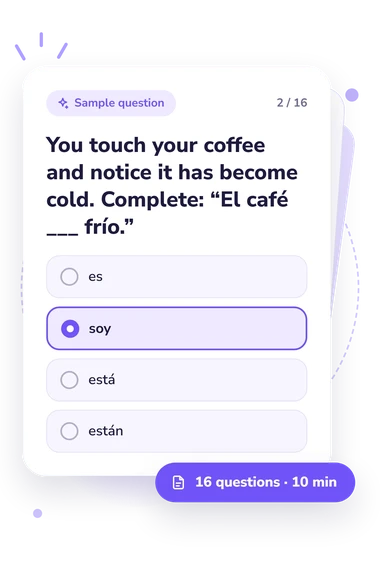
- es
- soy
- está
- están
- El animal es muerte.
- El animal es muerto.
- El animal está morir.
- El animal está muerto.
Ser vs Estar Quiz - Description and methodology of the test
Spanish learners who still hesitate over identity, states, locations, and common expressions can use the ser vs estar quiz to check the distinction in context. It is suitable for independent study, classroom review, or a quick refresher before writing and conversation. The ser and estar quiz turns those contrasts into a focused opportunity to identify which forms and situations deserve more deliberate practice.
What This Assessment Explores
Questions sample the ser/estar contrast through identity, origin, material, possession, dates, locations, temporary states, emotions, ongoing actions, passive forms, and fixed expressions. Context controls the choice: aburrido can describe a boring person or a current feeling, while a party uses ser for its venue and estar for physical location.
The score in this ser vs estar practice quiz summarizes the tested distinctions. If responses are reviewable, they can show whether a missed answer involves verb selection, conjugation, or context; the result is a learning summary, not a formal measure of Spanish proficiency.
Ser vs Estar Knowledge (0-16) is shown in three bands:
- Foundations to build (0-6) means core distinctions or forms need review.
- Developing command (7-12) means common rules are often applied correctly, but contrasts may still cause errors.
- Strong command (13-16) means the tested distinctions are recognized consistently.
Methodology and Evidence Base
Each prompt presents a sentence or short situation with four answer choices. The learner selects the form that fits agreement, tense, meaning, or context, so the task measures recognition rather than unrestricted translation. In this ser or estar quiz, individual responses can identify choices that need practice and clarify which context supports the correct form.
The displayed score summarizes responses. No separate weighting system, item-level profile, or external proficiency norm is defined, so the bands describe performance on this questionnaire. Unfamiliar vocabulary or a momentary lapse can affect an answer.
The closest published evidence is Winitz and Sagarna (2007), which examines explicit learning of ser and estar as a domain of grammatical knowledge. Sera (1992) addresses Spanish copulas, while Maienborn (2005) explains ser/estar through discourse and context. These works support the conceptual contrasts represented here, but do not establish this online questionnaire as a validated adaptation.
Learners can pair this ser and estar practice quiz with examples and feedback to review missed choices, compare the relevant contexts, and clarify why each alternative fits or fails.
- Winitz, Harris, and Blanca Sagarna. 2007. Acquiring explicit grammatical knowledge using the Spanish verbs ser and estar as examples. Journal of Psycholinguistic Research, 36(4), 319-339. 10.1007/s10936-006-9047-2
- Sera, Maria D. 1992. To be or to be: Use and acquisition of the Spanish copulas. Journal of Memory and Language, 31(3), 408-427. 10.1016/0749-596X(92)90021-O
- Maienborn, Claudia. 2005. A Discourse-Based Account of Spanish ser/estar. Linguistics, 43(1), 155-180. 10.1515/ling.2005.43.1.155