
Physics Quiz
How the Scales are Structured
Who Usually Takes This Test?
See How You Compare
Below is a preview of how scores are typically distributed across each scale.
Example Questions From the Test
- 33 A
- 4 A
- 3 A
- 48 A
- Removing the coil while keeping only the power source
- Replacing the insulated wire with a nonconducting cord
- Increasing the number of turns in the coil
- Reducing the coil to a single straight section of wire
- It becomes brighter because it receives all the current.
- It stays at the same brightness because the battery is unchanged.
- It goes out because the circuit is open.
- It flashes briefly and then remains dim.
Physics Quiz - Description and methodology of the test
Students reviewing classroom material can use this physics quiz to check how confidently they apply introductory principles rather than simply recall terms. It suits learners planning revision, refreshing earlier lessons, or identifying topics that deserve another look. A basic physics assessment like this can reveal where further practice may be useful.
What This Assessment Explores
Items focus on core ideas and short calculations involving motion, forces, pressure, density, energy, power, current, resistance, waves, thermal transfer, sound, and lenses. Questions testing physics concepts ask the learner to connect a situation with a law, quantity, unit, or relationship, so the result reflects more than vocabulary recall.
The central result is the Physics Knowledge scale, scored from 0-16. Its bands describe this educational result:
- Building Foundations (0-6) indicates recognition of some core ideas, while review of key quantities, laws, and relationships may help.
- Developing Knowledge (7-12) indicates a useful grasp of introductory physics, with room to strengthen application across topics.
- Strong Knowledge (13-16) indicates consistent understanding and application of core physics principles.
This profile is intended for learners who want a focused snapshot of introductory understanding and a starting point for revision. It does not represent intelligence, future achievement, or formal academic ability.
Methodology and Scientific Basis
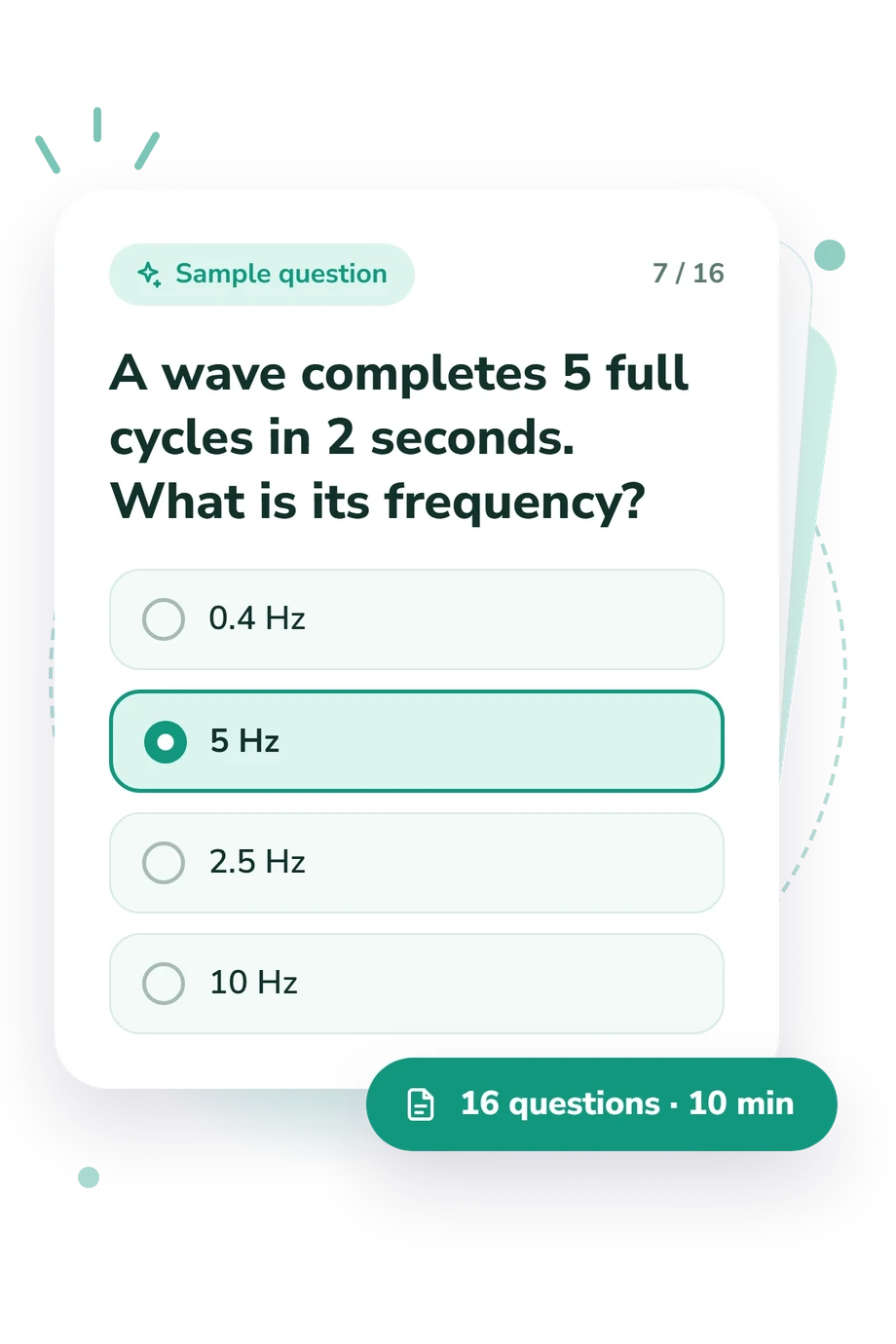
Each item presents a short scenario or calculation with four answer choices. One option is correct, and the score awards one point for each correct answer. The total summarizes performance across sampled concepts rather than separate subject grades.
The assessment is conceptually consistent with the Force Concept Inventory, a published mechanics instrument focused on conceptual understanding and common misconceptions; it is not an adaptation or administration of that instrument. Urone and Hinrichs provide a reference for the relationships represented here, while this remains a separate online questionnaire.
Reviewing physics questions and answers after completion can connect a missed choice with the relevant idea, unit, or equation. That process turns an error into a concrete study task. A quiz in physics can support targeted revision when mistakes are treated as prompts to revisit concepts, not as fixed judgments of ability.
Huffman and Heller caution that concept-focused items illuminate particular understandings without covering every dimension of physics knowledge. This questionnaire is not a normed administration, and results can reflect prior instruction, guessing, wording, and current concentration; read them as a snapshot of the concepts sampled.
- Hestenes, David, Malcolm Wells, and Gregg Swackhamer. "Force Concept Inventory." The Physics Teacher, vol. 30, no. 3, 1992, pp. 141-158. 10.1119/1.2343497
- Urone, Paul Peter, and Roger Hinrichs. College Physics 2e. OpenStax, 2022
- Huffman, Douglas, and Patricia Heller. "What Does the Force Concept Inventory Actually Measure?" The Physics Teacher, vol. 33, no. 3, 1995, pp. 138-143. 10.1119/1.2344171
Updated: