
Which Demon Slayer Character Are You Quiz
How the Scales are Structured
Who Usually Takes This Test?
See How You Compare
Below is a preview of how scores are typically distributed across each scale.
Example Questions From the Test
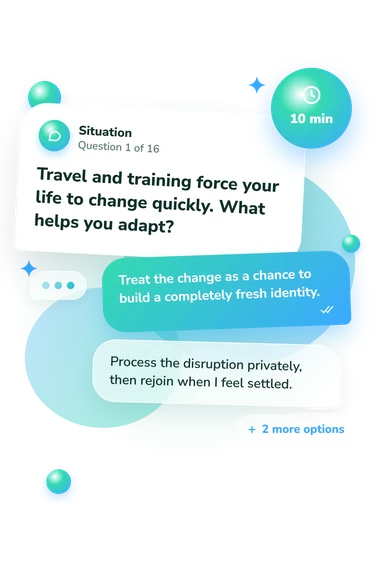
- Treat the change as a chance to build a completely fresh identity.
- Process the disruption privately, then rejoin when I feel settled.
- Create familiar routines that make the new situation manageable.
- Hold tightly to my core bonds while quietly adapting everything else.
- Trust their abilities while staying ready if they ask for support.
- Stay nearby and help them remain calm enough to respond.
- Call for assistance and coordinate a clear route away from danger.
- Move protectively between them and the threat while guiding them toward safety.
- I focus on moving others away from danger and avoid adding another person to the crisis.
- I create a distraction from a position where I can still retreat.
- I call for help and stay close enough to support my friend.
- Fear is still surging, but I step in before I have time to talk myself out of it.
Which Demon Slayer Character Are You Quiz - Description and methodology of the test
Fans of Demon Slayer who want a playful way to connect fictional traits with their own reactions can use the Which Demon Slayer Character Are You Quiz. It suits readers curious about character affinity rather than a formal personality judgment. As a Demon Slayer quiz about who you are, it highlights patterns in how you approach change, danger, loyalty, challenge, and persistence.
What This Assessment Explores
Scenarios test responses to change, danger, fear, uncertainty, effort, compassion, loyalty, and challenge. For anyone wondering what Demon Slayer character they are, the result shows which fictional style matches those choices, without treating affinity as a measure of bravery, goodness, caring, resilience, or ability. The four profiles are:
- Inosuke Hashibira Affinity (0-12) captures bold instinct and challenge-seeking: Different Approach (0-4), Shared Qualities (5-8), or Strong Inosuke Affinity (9-12).
- Nezuko Kamado Affinity (0-12) captures quiet care and protective loyalty: Different Expression (0-4), Shared Qualities (5-8), or Strong Nezuko Affinity (9-12).
- Tanjiro Kamado Affinity (0-12) captures empathy, patience, moral clarity, and persistent effort: Different Center (0-4), Shared Qualities (5-8), or Strong Tanjiro Affinity (9-12).
- Zenitsu Agatsuma Affinity (0-12) captures sensitivity, alertness, reassurance-seeking, loyalty, and action despite fear: Different Rhythm (0-4), Shared Qualities (5-8), or Strong Zenitsu Affinity (9-12).
Methodology and Evidence Base
Each item presents a Demon Slayer scenario with four response choices. The options cover pressure, protection, group entry, feedback, changing plans, and sustained effort. Responses form four profile totals: the highest is the strongest affinity, while totals within one point of it create a blended result.
This structure is conceptually consistent with character-identification research, not an adaptation of a published scale. Huang and Fung (2024) offer a framework for narrative-character identification; Cohen (2001) describes identification as an audience relationship with a media character; Ooms, Hoeks, and Jansen (2019) show how perceived similarity can support narrative engagement. Official Demon Slayer character material supplies the fictional reference points.
As an online self-report tool without a stated norm sample or clinical cutoffs, the questionnaire can reflect mood, circumstances, and self-awareness; its profile is best treated as a reflection prompt. The question of what Demon Slayer character I am offers a playful interpretation. It is a way to revisit the patterns in your choices. In everyday terms, the result answers which Demon Slayer character you are through fictional affinity.
- Huang, Kate Y., and Helene H. Fung. 2024. Measuring identification with narrative characters: The development and validation of a new scale. Current Psychology, 43, 24835-24849. 10.1007/s12144-024-06191-2
- Ooms, Joelle, John Hoeks, and Carel Jansen. 2019. Hey, that could be me: The role of similarity in narrative persuasion. PLOS ONE, 14(4), e0215359. 10.1371/journal.pone.0215359
- Cohen, Jonathan. 2001. Defining identification: A theoretical look at the identification of audiences with media characters. Mass Communication and Society, 4(3), 245-264. 10.1207/S15327825MCS0403_01
- Aniplex of America, Shueisha, and ufotable. n.d. Demon Slayer: Kimetsu no Yaiba Hashira Training Arc Anime Official USA Website: Character. Accessed September 24, 2026.
Updated: