
Romeo and Juliet Quiz
How the Scales are Structured
Who Usually Takes This Test?
See How You Compare
Below is a preview of how scores are typically distributed across each scale.
Example Questions From the Test
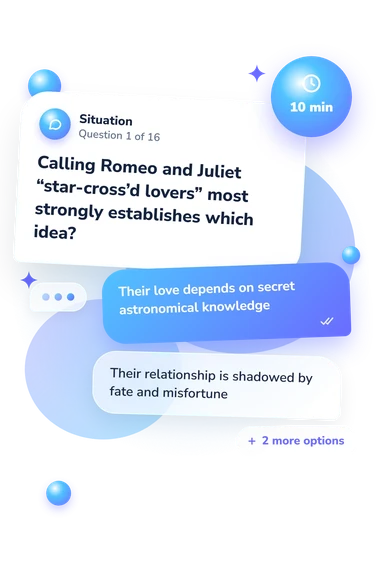
- Their love depends on secret astronomical knowledge
- Their relationship is shadowed by fate and misfortune
- Their families misunderstand the timing of their wedding
- Their social ranks make a legal marriage impossible
- He believes Lord Capulet has secretly approved the match
- He wants to prevent Juliet from entering a convent
- He has promised the Prince that Romeo will marry soon
- He hopes their marriage may help end the families’ feud
- An impoverished apothecary
- The Nurse
- A servant of the Capulets
- Friar Lawrence
Romeo and Juliet Quiz - Description and methodology of the test
Students, teachers, and independent readers can use the Romeo and Juliet Quiz to gauge how securely they understand Shakespeare’s tragedy and where their knowledge needs attention. Questions about the play connect recall with interpretation, so the result can guide a focused rereading, lesson discussion, or preparation for an assessment. As a quiz over Romeo and Juliet, it offers a practical snapshot rather than a judgment of literary ability.
What This Test Measures
Rather than measuring literary taste, the questionnaire asks readers to connect details with the play’s larger design. It suits students, teachers, and independent readers examining the play’s characters, motives, language, and consequences.
The result uses one scale, Romeo and Juliet Knowledge (0-16). Its bands are Foundation to build (0-6), Developing knowledge (7-12), and Strong knowledge (13-16). The score reflects knowledge of the play’s characters, plot, motivations, language, and dramatic design.
The four areas assessed in this quiz about Romeo and Juliet are:
- Character relationships show how loyalties, family identity, and motives are tracked.
- Plot and consequences show how decisions lead to exile, failed communication, and deaths.
- Language and imagery show whether speeches and recurring ideas are understood in context.
- Dramatic design shows whether the shift from courtship to violence and loss is recognized.
Methodology and Evidence Base
The questionnaire presents four-option multiple-choice questions about Romeo and Juliet, so the Shakespeare play quiz stays focused on content knowledge. Items address characters, causes, sequence, setting, language, and dramatic purpose. Several prompts require connections between events, not recall of isolated names.
The questionnaire produces one content-knowledge result. Item-level point allocation and normative comparisons are not specified, so the displayed result is a summary of performance on this questionnaire rather than a standardized estimate.
Shakespeare’s play supplies the events, characters, speeches, and structure assessed here, while Bowling’s 1949 thematic analysis offers context for relating love, family identity, violence, fate, and tragic consequence. These sources provide content and thematic context; neither validates nor standardizes the online quiz, which is not an adaptation of Bowling’s study.
Answer selection, guessing, prior exposure, memory, and current familiarity can affect performance. One result is therefore a snapshot of present knowledge, useful for guiding rereading or discussion, rather than a fixed measure of literary ability.
- Shakespeare, William. Romeo and Juliet. Edited by Brian Gibbons. The Arden Shakespeare. London: Methuen, 1980.
- Shakespeare, William. Romeo and Juliet. Edited by Jill L. Levenson. The Oxford Shakespeare. Oxford: Oxford University Press, 2000.
- Bowling, Lawrence Edward. "The Thematic Framework of Romeo and Juliet." PMLA, vol. 64, no. 1, 1949, pp. 208-220. 10.2307/459678.
Updated: