
Harry Potter Boyfriend Quiz
How the Scales are Structured
Who Usually Takes This Test?
See How You Compare
Below is a preview of how scores are typically distributed across each scale.
Example Questions From the Test
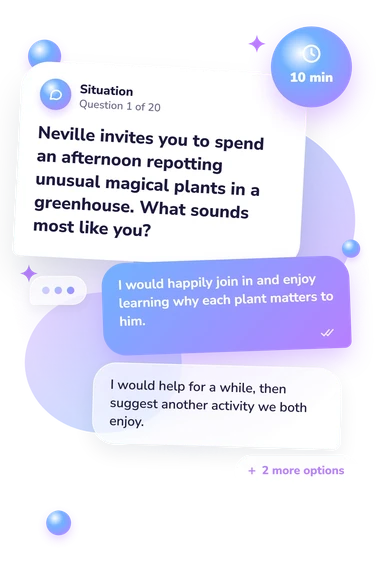
- I would happily join in and enjoy learning why each plant matters to him.
- I would help for a while, then suggest another activity we both enjoy.
- I would keep him company while focusing on a different task nearby.
- I would encourage him to enjoy the hobby alone while I make separate plans.
- Remind him of his progress and stay close while he takes the step himself.
- Help him rehearse once more, then give him space to focus.
- Distract him from the nerves and avoid making the moment feel more significant.
- Prefer a partner who approaches major challenges with visible confidence.
- Share it openly because fair competition matters more than gaining an advantage.
- Offer a useful hint without giving away everything he discovered.
- Keep it private during the competition but discuss it afterward.
- Focus entirely on winning; competitors are responsible for their own preparation.
Harry Potter Boyfriend Quiz - Description and methodology of the test
Readers who enjoy fictional romance can use the Harry Potter Boyfriend Quiz to reflect on the qualities they would welcome in a partner. Rather than treating a character as a prediction, it turns preferences about loyalty, communication, independence, and social life into a playful profile. Fans can use this Harry Potter compatibility quiz to compare relationship values with recognizable Hogwarts personalities in a structured, playful profile.
What This Assessment Explores
Across the items, fictional relationship scenarios about support, conflict, independence, ambition, family, and social life turn preferences into signals about romantic fit. The strongest score marks a character pattern, not a fixed identity.
The result uses five affinity scales:
- Cedric Diggory Affinity (0-12) reads fairness and support: Different Rhythms (0-4), Shared Ground (5-8), Strong Affinity (9-12).
- Draco Malfoy Affinity (0-12) reads ambition, intensity, banter, and growth without excusing harm: Different Rhythms (0-4), Intriguing Contrast (5-8), Strong Affinity (9-12).
- Harry Potter Affinity (0-12) reads brave independence and protection: Different Rhythms (0-4), Shared Ground (5-8), Strong Affinity (9-12).
- Neville Longbottom Affinity (0-12) reads gentleness, perseverance, courage, and growth: Different Rhythms (0-4), Growing Connection (5-8), Strong Affinity (9-12).
- Ron Weasley Affinity (0-12) reads warmth, humor, devotion, and companionship: Different Rhythms (0-4), Shared Ground (5-8), Strong Affinity (9-12).
Methodology and Evidence Base
Each item presents a relationship situation with four response options about closeness, support, disagreement, ambition, family, or daily life. The choices ask what feels most compatible, not whether a behavior is objectively right.
Within this fictional dating questionnaire, preference matching compares each answer with fictional qualities and combines the pattern into five character affinities. The highest score indicates the strongest affinity; scores within one point form a blended result. Because point values for individual responses are not published, their exact contributions cannot be reconstructed.
Its framework is conceptually consistent with Fletcher et al. (1999), which examined ideal qualities in intimate relationships. Eastwick, Finkel, and Eagly (2011), plus Eastwick, Luchies, Finkel, and Hunt (2014), explain why ideals may influence relationship processes without perfectly predicting compatibility. This questionnaire is not an adaptation of those instruments.
This online self-reflection format is rather than a standardized measure with established norms. Mood, recent experiences, self-awareness, and answer appeal can shift scores, so use the result to consider preferences and trade-offs.
- Garth J. O. Fletcher, Jeffry A. Simpson, Geoff Thomas, and Louise Giles. (1999). Ideals in Intimate Relationships. Journal of Personality and Social Psychology, 76(1), 72-89. 10.1037/0022-3514.76.1.72
- Paul W. Eastwick, Eli J. Finkel, and Alice H. Eagly. (2011). When and Why Do Ideal Partner Preferences Affect the Process of Initiating and Maintaining Romantic Relationships? Journal of Personality and Social Psychology, 101(5), 1012-1032. 10.1037/a0024062
- Paul W. Eastwick, Laura B. Luchies, Eli J. Finkel, and Lucy L. Hunt. (2014). The Predictive Validity of Ideal Partner Preferences: A Review and Meta-Analysis. Psychological Bulletin, 140(3), 623-665. 10.1037/a0032432