
Black History Quiz
How the Scales are Structured
Who Usually Takes This Test?
See How You Compare
Below is a preview of how scores are typically distributed across each scale.
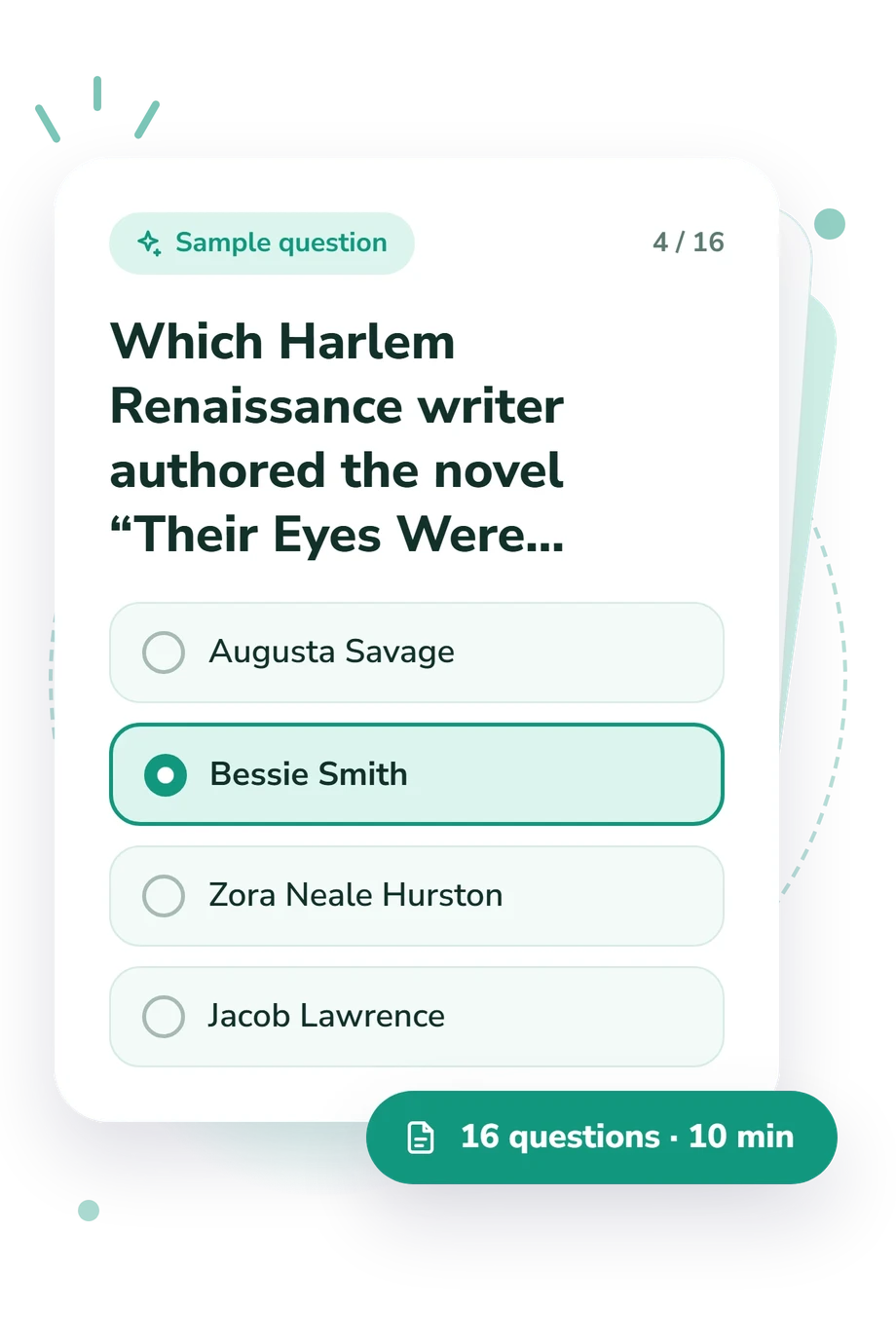
Example Questions From the Test
- The Great Migration
- The Windrush generation
- The Scramble for Africa
- The Atlantic Charter generation
- Augusta Savage
- Bessie Smith
- Zora Neale Hurston
- Jacob Lawrence
- South West Africa People’s Organization
- African National Congress
- Zimbabwe African National Union
- Pan Africanist Congress of Azania
Black History Quiz - Description and methodology of the test
For learners, educators, and curious readers, this black history quiz offers a focused way to examine knowledge of people, movements, laws, institutions, and turning points across Black history and the African diaspora. It works well as a black history month quiz for classroom review or independent study, helping readers see which areas feel secure and which deserve a closer look.
What This Assessment Explores
Questions range across North American, Caribbean, African, and diaspora history, including emancipation, Reconstruction, civil-rights legislation, migration, cultural movements, anticolonial independence, and liberation organizations. As an African American history quiz, it connects legal change with community action, leadership, and cultural expression across several periods.
The result groups the content into these broad areas:
- People and leadership show whether you connect figures with the movements or turning points they shaped.
- Laws and civic change indicate recognition of amendments, court decisions, legislation, and their purposes.
- Migration, culture, and global liberation reflect understanding of movement, artistic life, independence, and organized resistance.
Black History Knowledge (0-16) is the displayed scale. Foundations to build (0-6) signals recognition with connections to review; Developing knowledge (7-12) signals many milestones understood with gaps remaining; Strong command (13-16) signals broad, accurate knowledge across regions, figures, events, and institutions.
Methodology and Evidence Base
Each item presents a historical scenario or direct question with four answer choices. The respondent identifies a person, event, law, movement, institution, or interpretation, while distractors represent nearby historical possibilities. The black-history quiz questions therefore test recognition and context rather than opinion.
Responses form one knowledge total. No separate weighting rule, item penalty, or independent subscale is stated, so the bands describe performance across this questionnaire rather than population norms or clinical cutoffs. The result can help select subjects for review.
The closest conceptual reference is Adams's 2009 study of Black history knowledge. Later work by Adams-Bass, Stevenson, and Slaughter Kotzin (2014), and Adams-Bass and Chapman-Hilliard (2021), examines Black history knowledge alongside racial identity, socialization, achievement, and aspirations. This questionnaire is conceptually consistent with that evidence base but is not presented as a standardized administration or adaptation of those instruments.
In an African American quiz context, the result can guide review of chronology, geography, institutions, or major figures. Interpretation is shaped by education, language, cultural exposure, guessing, current recall, and unfamiliar wording, so a score is best read as a snapshot of performance on this set.
- Adams, Valerie N. (2009). Miseducation of Racism Scale-Black History Knowledge. Quantitative instrument. University of Pennsylvania, Philadelphia.
- Adams-Bass, Valerie N., Howard C. Stevenson, and Diana Slaughter Kotzin. (2014). Measuring the Meaning of Black Media Stereotypes and Their Relationship to the Racial Identity, Black History Knowledge, and Racial Socialization of African American Youth. Journal of Black Studies, 45(5), 367-395. 10.1177/0021934714530396
- Adams-Bass, Valerie N., and Collette Chapman-Hilliard. (2021). Better to Have than to Have Not: An Investigation of Black History Knowledge, Identity, Academic Achievement, and Educational Aspirations. The Journal of Negro Education, 90(4), 524-538.
Updated: