
Digital Marketing Quiz Questions
How the Scales are Structured
Who Usually Takes This Test?
See How You Compare
Below is a preview of how scores are typically distributed across each scale.
Example Questions From the Test
- utm_medium
- utm_source
- utm_campaign
- utm_content
- Use the image's original file name
- Repeat a target keyword as many times as possible
- Describe the image's relevant content or purpose concisely
- Leave the alt attribute empty for every image
- 3%
- 30%
- 3%
- 3%
Digital Marketing Quiz Questions - Description and methodology of the test
For learners and practitioners who want to check practical knowledge, digital marketing quiz questions offer a focused self-assessment of everyday campaign decisions. A quiz on digital marketing can help a reader see whether core ideas are understood well enough to guide choices about channels, measurement, content, and customer communication. The result points to review priorities rather than attempting to describe overall professional ability.
What This Assessment Measures
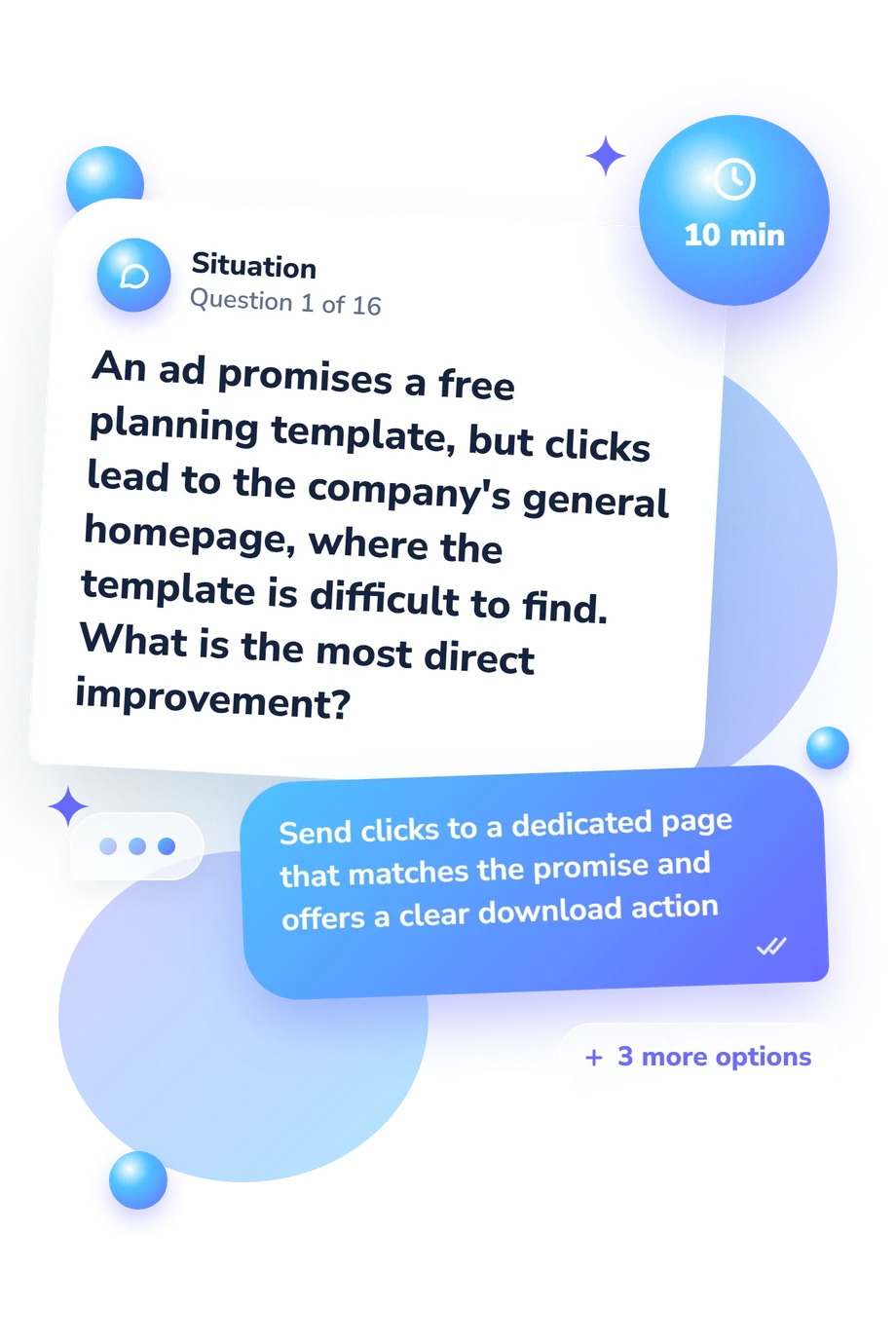
The assessment tests applied understanding rather than simple recall. Scenarios cover landing-page alignment, tracking, search visibility, paid media, email permission, and content for buyers comparing alternatives. It suits learners and practitioners who want to connect concepts with campaign decisions.
The result uses Digital Marketing Knowledge (0-16). Foundation (0-6) indicates emerging familiarity; Developing (7-12) indicates useful working knowledge; Strong (13-16) indicates a broad command of the tested concepts. These educational bands describe performance on this questionnaire, not job readiness or certification.
The main topic groups show what the online marketing quiz asks the reader to recognize:
- Campaign choices show alignment of promises, destinations, audiences, and decision-stage content.
- Measurement choices show understanding of conversion rate, CTR, ROAS, frequency, attribution, and tests.
- Search, content, and email choices show grasp of intent, organic visibility, technical signals, alt text, consent, and relevance.
Methodology and Evidence Base
Each item presents a scenario or applied question with four answer choices. Choosing the strongest response tests recognition of sound practice in tracking, testing, search, paid media, content, and customer communication. The score reflects answers within this questionnaire, not personality traits.
The content is conceptually consistent with Chaffey and Ellis-Chadwick (2022), while its measurement emphasis aligns with Järvinen and Karjaluoto (2015) and Kaushik’s work on web analytics. These sources support the relevance of metrics, attribution, conversion analysis, and optimization; they do not make the questionnaire a standardized adaptation of a published instrument.
A digital marketing online quiz can help a learner identify topics for study. The result is an educational summary, not a population norm or professional certification.
No norm group or reliability estimate is supplied for this questionnaire, so the bands are not validated cutoffs. Results may vary with recent study, work exposure, question familiarity, and scenario interpretation. Reviewing questions and answers from a digital marketing quiz can reveal gaps, but one score cannot capture marketing judgment.
- Chaffey, Dave, and Fiona Ellis-Chadwick. Digital Marketing: Strategy, Implementation and Practice. 8th ed. Pearson Education Limited, 2022. ISBN 9781292400969.
- Järvinen, Joel, and Heikki Karjaluoto. The use of Web analytics for digital marketing performance measurement. Industrial Marketing Management, 50, 117-127, 2015. 10.1016/j.indmarman.2015.04.009.
- Kaushik, Avinash. Web Analytics 2.0: The Art of Online Accountability and Science of Customer Centricity. Wiley, 2009. ISBN 9780470596449.
Updated: