
Endocrine System Quiz
How the Scales are Structured
Who Usually Takes This Test?
See How You Compare
Below is a preview of how scores are typically distributed across each scale.
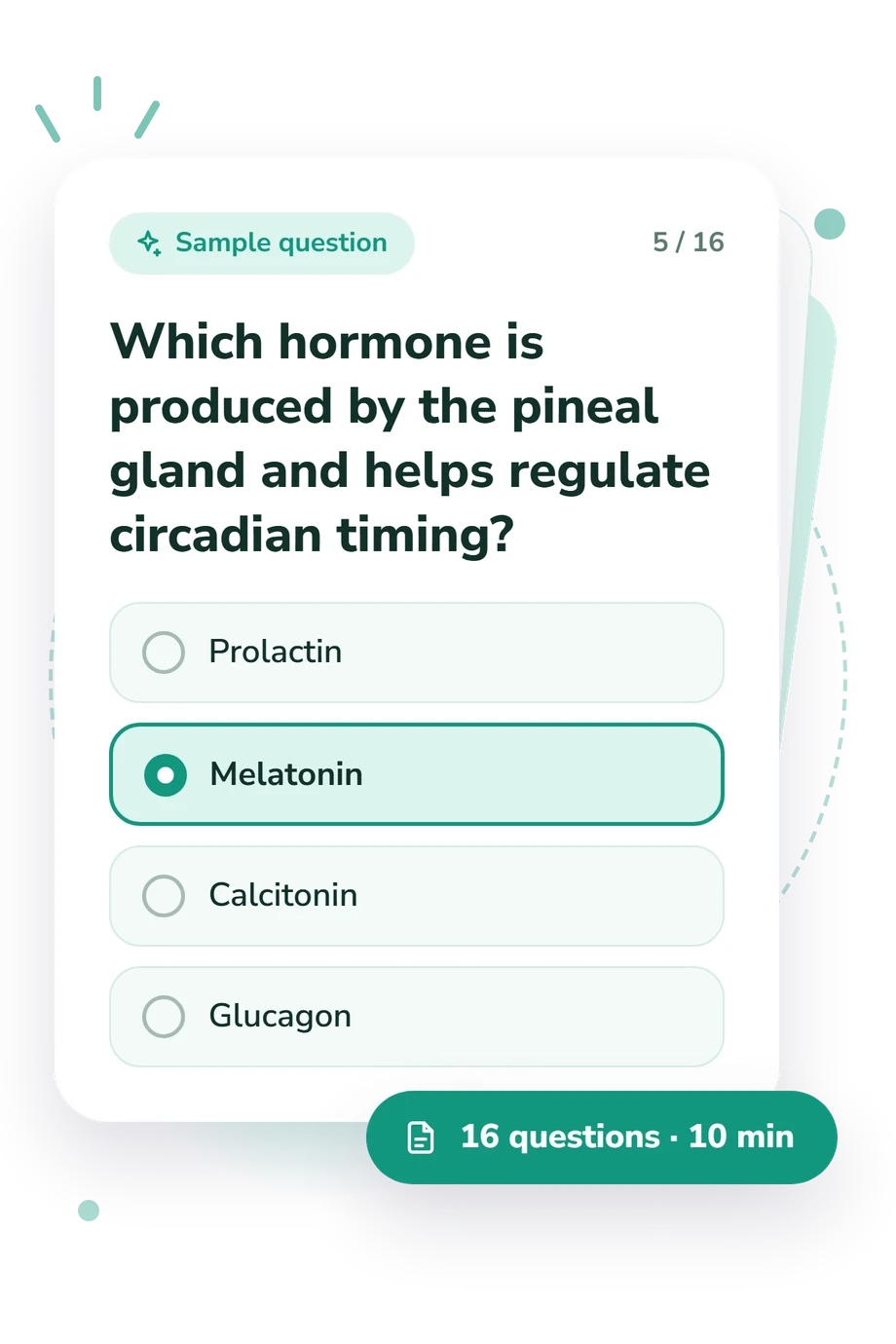
Example Questions From the Test
- Pancreatic alpha cells release glucagon
- The posterior pituitary releases oxytocin
- The adrenal cortex releases cortisol
- Pancreatic beta cells release insulin
- Thyroid gland — thyroxine (T4)
- Parathyroid glands — cortisol
- Adrenal medulla — aldosterone
- Pineal gland — insulin
- Prolactin
- Melatonin
- Calcitonin
- Glucagon
Endocrine System Quiz - Description and methodology of the test
Students, trainees, and curious readers can use the endocrine system quiz as a focused checkpoint when they want to test their readiness for a demanding subject. This endocrine quiz suits anyone who prefers active recall to passive reading, including readers without a clinical background. Its result gives a snapshot of current confidence, helping learners judge how securely they can explain what they know.
What This Assessment Explores
The assessment checks endocrine anatomy and physiology through gland identification, hormone sources, target tissues, and homeostatic control. Readers connect changes such as rising glucose or dehydration with the hormonal response that follows, making this a useful anatomy-and-physiology quiz about the endocrine system for learners.
The items also address secretion pathways, receptor location, adrenal and pituitary functions, calcium regulation, and feedback. As an endocrine hormone quiz, it shows whether a respondent can link a hormone with its source and action.
The displayed Endocrine System Knowledge scale has three bands:
- Foundations to build (0-6) signals a need to review major glands and feedback.
- Developing knowledge (7-12) shows central understanding with some areas needing practice.
- Strong knowledge (13-16) reflects a well-developed grasp of endocrine anatomy and signaling.
Methodology and Scientific Basis
Each item presents a physiological situation, factual prompt, or gland-and-hormone relationship with four answer choices. Selecting the single best answer tests recognition and application rather than written explanation. The question sequence moves from identification to feedback, receptor action, and regulation of glucose, water, calcium, and electrolytes, giving readers practical questions in this quiz about the endocrine system rather than isolated definitions.
Scoring is reported through the displayed educational scale and its descriptive bands; no standardized scoring or population norms are documented for this questionnaire. The Hall and Hall textbook (2021) provides a relevant physiology reference for hormone actions, gland physiology, feedback, and target-cell signaling, while Betts et al. (2022) provide a compatible anatomy-and-physiology reference. This questionnaire is conceptually consistent with those textbooks, not an adaptation of either one.
Downing (2003) emphasizes that interpretation must fit the evidence collected. The result is therefore a snapshot of educational knowledge: prior study, guessing, attention, and current context can affect performance. It should not be treated as a measure of endocrine health or a diagnosis, but it can guide review and show whether core relationships are recalled and applied.
- Hall, John E., and Michael E. Hall. Guyton and Hall Textbook of Medical Physiology. 14th ed. Philadelphia: Elsevier, 2021.
- Betts, J. Gordon, Kelly A. Young, James A. Wise, Eddie Johnson, Brandon Poe, Dean H. Kruse, Oksana Korol, Jody E. Johnson, Mark Womble, and Peter DeSaix. Anatomy and Physiology 2e. Houston, TX: OpenStax, 2022.
- Downing, Steven M. “Validity: on the meaningful interpretation of assessment data.” Medical Education 37, no. 9 (2003): 830-837. 10.1046/j.1365-2923.2003.01594.x
Updated: