
Disney Villain Quiz
How the Scales are Structured
Who Usually Takes This Test?
See How You Compare
Below is a preview of how scores are typically distributed across each scale.
Example Questions From the Test
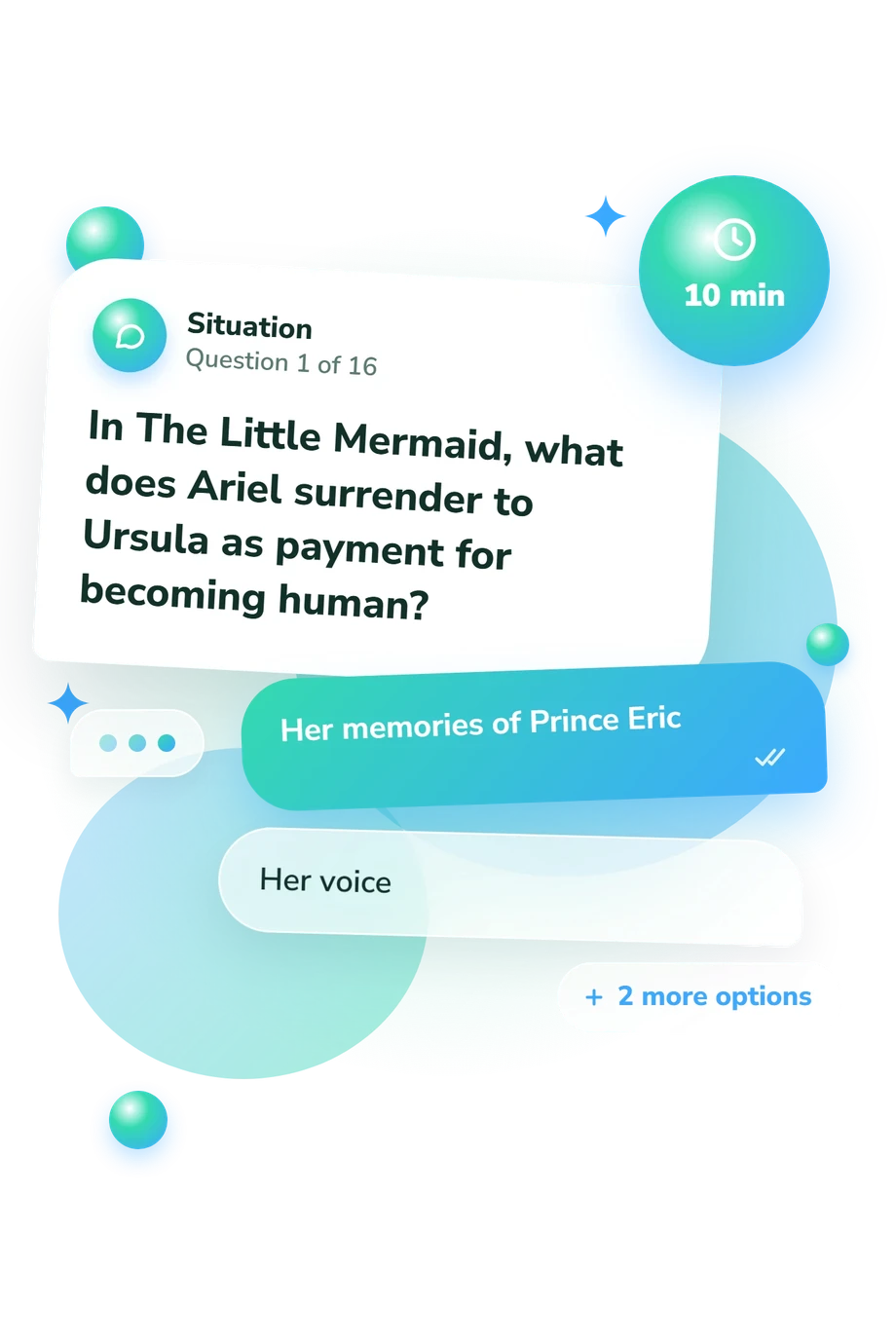
- Her memories of Prince Eric
- Her voice
- Her royal title
- Her ability to swim
- A ship’s warning bell
- Smee tapping on the deck
- The Lost Boys beating a drum
- The ticking of a swallowed clock
- It puts Kuzco into an enchanted sleep
- It makes Kuzco invisible
- It transforms Kuzco into a llama
- It erases Kuzco’s memory
Disney Villain Quiz - Description and methodology of the test
Readers who enjoy Disney animation can use the Disney Villain Quiz to decide whether a film-knowledge challenge suits them. This Disney villain knowledge quiz suits viewers who remember plot details and want to test recognition of antagonists, motives, objects, and turning points. The questions focus on what happened in the films, not on which character resembles you.
What This Assessment Explores
Rather than matching a personality to a figure, the questionnaire tests recognition of Disney animated antagonists and the details that define them. Questions cover names, motives, schemes, disguises, objects, threats, and actions across films. This makes the result useful for viewers who want to check film knowledge or identify details worth review.
The result uses the Disney Villain Knowledge scale (0-16), presented with its three bands:
- Familiar Viewer (0-6) indicates recognition of some major villains, while plans and story details may blur together.
- Developing Expert (7-12) indicates that many antagonists can be connected with their motives, methods, and defining scenes.
- Villain Authority (13-16) indicates strong, wide-ranging knowledge of Disney animated villains and their story roles.
Together, these Disney villain trivia questions assess recognition of villain stories, not personality traits or resemblance to a character.
Methodology and Scientific Basis
Each item offers four answer choices and asks for a factual response about a film, character, motive, object, or event. The items require factual answers, and the result is presented as a knowledge band. This is a knowledge assessment, not a typology.
Feng and Park's 2015 content analysis supplies thematic context for Disney and Studio Ghibli antagonists and their narrative functions. This questionnaire is not an adaptation of that study, and the analysis does not validate or standardize this online quiz. Johnston and Thomas discuss Disney villains, while Davis places Disney heroes and villains within film and gender analysis. Together, they support a film-literacy reading.
It presents catalogue-defined bands rather than published norms and is not a standardized psychological instrument, so the result is a snapshot of recall. Familiarity with particular films, memory for plot details, and guessing can affect performance. The result of this Disney villain knowledge test summarizes recall of villain-related film details and assigns the respondent to the displayed knowledge band.
- Yang Feng and Jiwoo Park. "Bad Seed or Good Seed? A Content Analysis of the Main Antagonists in Walt Disney- and Studio Ghibli-Animated Films." Journal of Children and Media, vol. 9, no. 3, 2015, pp. 368-385. 10.1080/17482798.2015.1058279.
- Ollie Johnston and Frank Thomas. The Disney Villain. Disney Editions, 1993. ISBN 1562827928.
- Amy M. Davis. Handsome Heroes and Vile Villains: Masculinity in Disney's Feature Films. John Libbey Publishing, 2014.
Updated: