
South America Flag Quiz
How the Scales are Structured
Who Usually Takes This Test?
See How You Compare
Below is a preview of how scores are typically distributed across each scale.
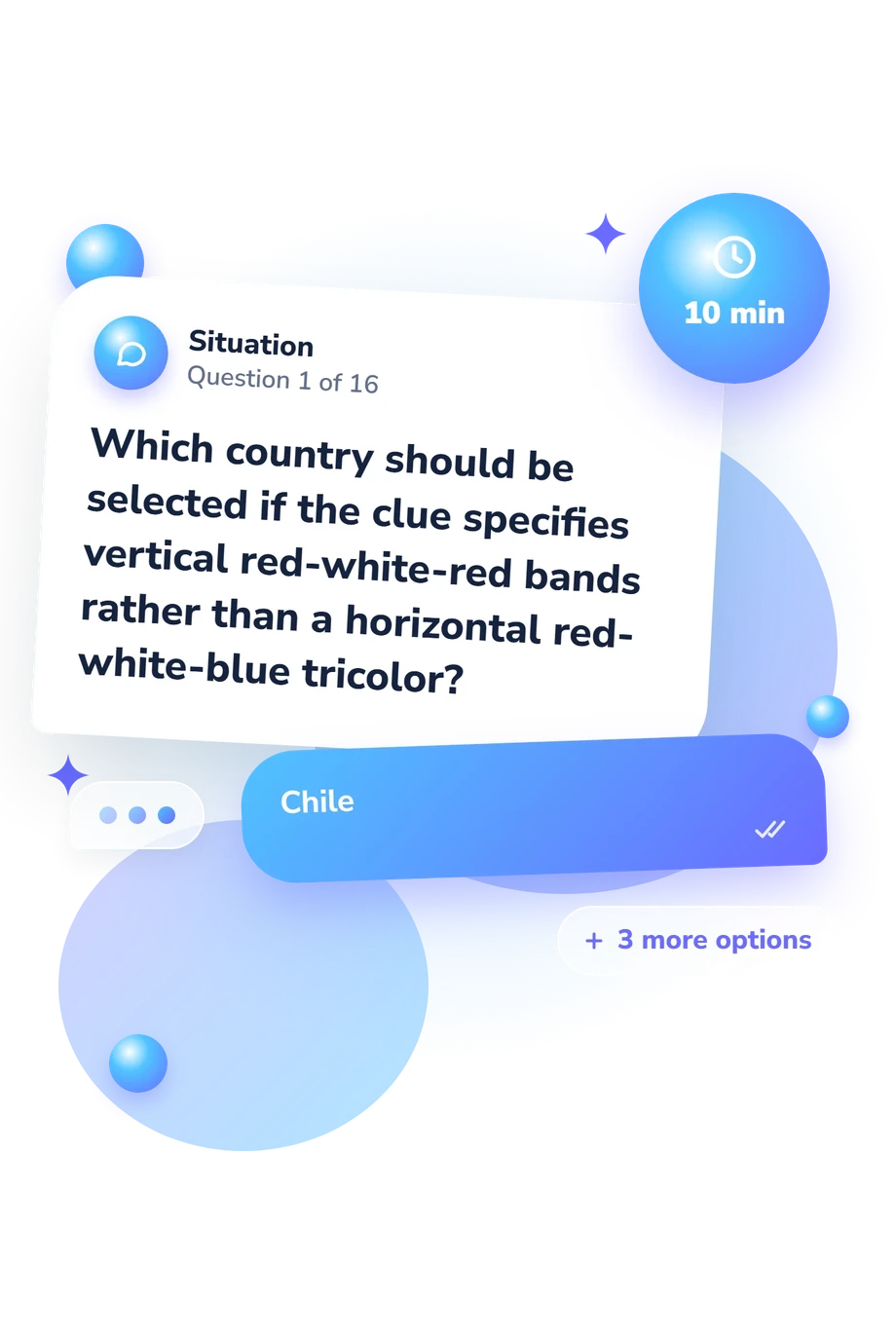
Example Questions From the Test
- Argentina and Uruguay
- Brazil and Suriname
- Ecuador and Colombia
- Chile and Peru
- Colombia
- Paraguay
- Bolivia
- Ecuador
- Bolivia
- Guyana
- Ecuador
- Colombia
South America Flag Quiz - Description and methodology of the test
Designed for readers who want to check their visual geography, the South America Flag Quiz focuses on recognizing national flags from colors, layouts, emblems, and distinctive symbols. It suits curious learners, travelers, students, and anyone building a clearer mental map of the continent. It offers a focused quiz about the flags of South America, helping learners compare colors, symbols, and distinctive designs.
What This Assessment Explores
Recognition depends on visual features rather than country names alone. The items ask you to distinguish band direction and color order, identify suns, stars, diamonds, globes, coats of arms, and notice unusual details such as different emblems on opposite sides. The answer choices create close visual-feature comparisons in a quiz about South American flags, asking learners to match a remembered pattern to the right country.
One catalogue scale, South America Flag Knowledge (0-16), organizes the result into these visitor-facing bands:
- Flag Foundations (0-6) indicates that you recognize some major designs but may benefit from reviewing color order, symbols, and similar-looking flags.
- Developing Recognition (7-12) shows that you can distinguish many national designs, while some close comparisons still need practice.
- Strong Flag Knowledge (13-16) reflects accurate, wide-ranging recognition of national flags and their defining features.
Methodology and Evidence Base
Each item offers four answer choices. As a Latin America flag quiz focused on South America, it uses prompts describing layouts, colors, symbols, or unusual details, requiring a verbal clue to be matched with a remembered visual pattern. Item weighting and penalties are unspecified, so interpret the result through the displayed scale and bands.
The 2014 study by Hayashi and Hayashi examines learning associations between unfamiliar flags and country names. Blake and Castel (2019) add evidence about flag familiarity and confidence in memory judgments; Kalampokas and colleagues (2023) represent computational links between flag images and national identities. This questionnaire is conceptually consistent with those narrower topics, not an adaptation of their instruments, and has no established psychometric validation.
Prior exposure can affect this quiz about Latin American flags because familiar patterns are easier to recognize than newly learned ones. The questions test precise feature matching, not broad South American history or geography. The result is an educational profile of Latin American flag recognition, not a standardized population ranking. Population norms are not established, so interpret the displayed levels only as recognition categories.
- Rywhay Hayashi and Tami Hayashi. The Effect of Mnemonic Strategy on the Learning of Associations between Unfamiliar National Flags and Names of Nations. Memoirs of Osaka Kyoiku University, Series IV, Education, Psychology, Special Needs Education and Physical Education, 63(1), 137-146 (2014). 10.32287/td00028017
- Adam B. Blake and Alan D. Castel. Memory and availability-biased metacognitive illusions for flags of varying familiarity. Memory & Cognition, 47(2), 365-382 (2019). 10.3758/s13421-018-0872-y
- Theofanis Kalampokas, Dimitrios Mentizis, Eleni Vrochidou, and George A. Papakostas. Connecting national flags - a deep learning approach. Multimedia Tools and Applications, 82, 39435-39457 (2023). 10.1007/s11042-023-15056-y
Updated: