
Water Cycle Quiz
How the Scales are Structured
Who Usually Takes This Test?
See How You Compare
Below is a preview of how scores are typically distributed across each scale.
Example Questions From the Test
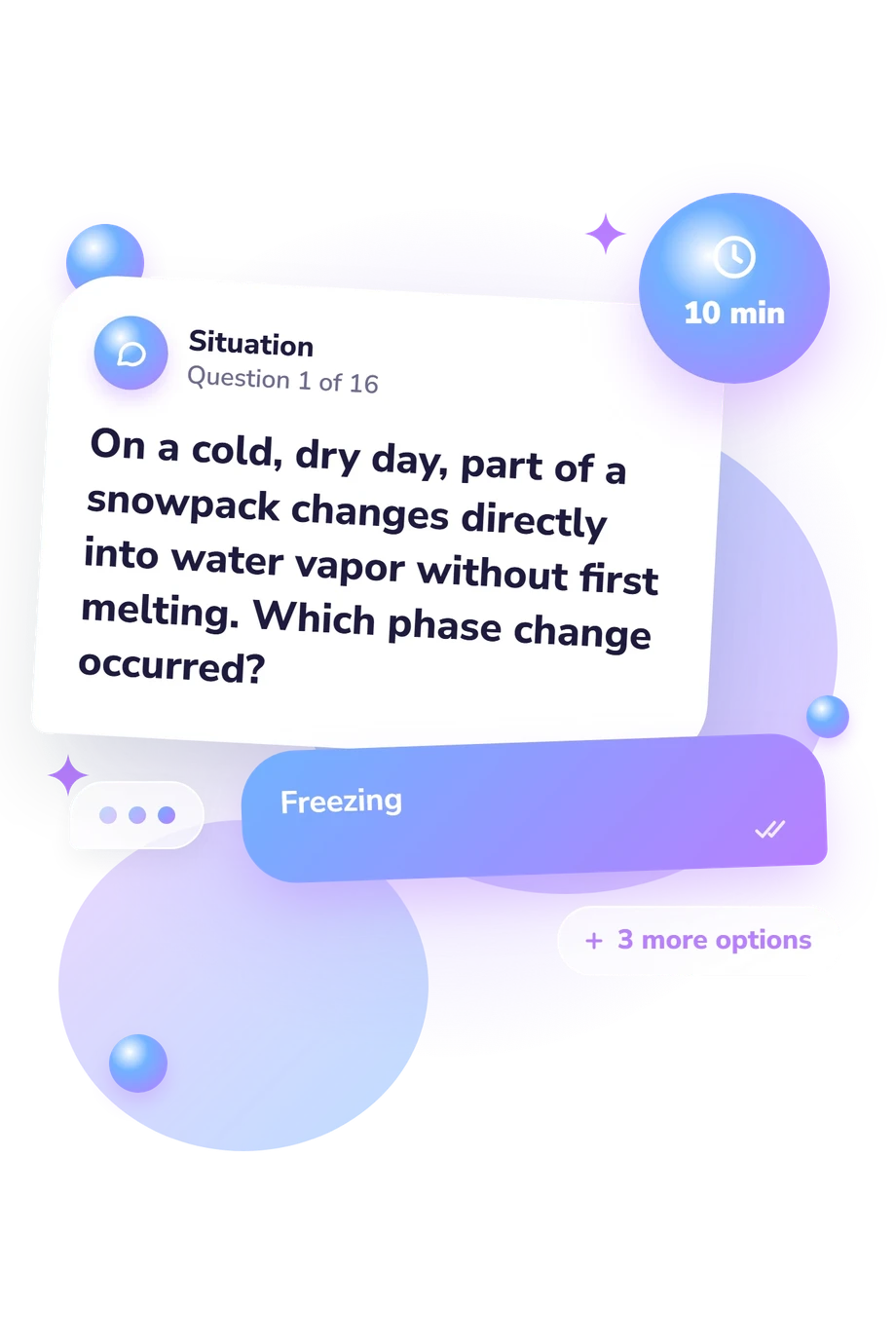
- Freezing
- Condensation
- Sublimation
- Deposition
- Precipitation
- Condensation
- Infiltration
- Collection
- They become groundwater without reaching the surface
- They fall as precipitation
- They enter plants through transpiration
- They become surface runoff while still in the cloud
Water Cycle Quiz - Description and methodology of the test
Students, teachers, and curious learners can use this water cycle quiz to check how well they connect familiar events across Earth’s hydrologic system. A water cycle knowledge check can support study or preparation by organizing these processes. It suits self-study, classroom preparation, and anyone who wants a clearer picture of how water moves through air, land, plants, and groundwater.
What This Assessment Measures
Scenario-based items connect terms with events involving air, land, groundwater, vegetation, and built environments. This quiz about water cycle processes suits learners checking terminology and understanding.
The main result is Water Cycle Knowledge, scored from 0-16. Foundations to build (0-6) signals review of phase changes and routes through Earth’s systems; Developing knowledge (7-12) reflects core understanding, with applications to strengthen; Strong knowledge (13-16) indicates accurate recognition and application of major concepts and relationships.
The question themes show what the result draws together:
- Phase changes indicate whether you distinguish evaporation, condensation, sublimation, and deposition.
- Water pathways show whether you separate infiltration, percolation, surface runoff, and groundwater flow.
- Plant and energy links show whether you recognize transpiration and solar radiation’s role in evaporation.
- Systems and land use show how watersheds, recycling, and paved surfaces change water movement.
Methodology and Evidence Base
Each item uses a short scenario and four answer choices, asking you to select the process or explanation that best fits. Questions in this water cycle assessment cover clouds, snow, puddles, soil, aquifers, plants, watersheds, solar energy, and urban surfaces. This selected-response design tests recognition and application in context, not confidence ratings or written explanations.
The closest conceptual comparison is Romine et al.’s (2015) multi-tier assessment, evaluated with Rasch-based methods. That relationship concerns the construct and content, not provenance: this online questionnaire should not be treated as an adaptation of that instrument. Schaffer’s 2013 dissertation describes a three-tier format that combines an answer, a reason, and confidence, whereas this version uses a simpler single-answer format.
Imhof and Kübler (2025) demonstrate why response format matters when diagnosing science concepts: recognition and free recall can reveal different levels of understanding. Guessing, wording, previous instruction, and current attention may influence a selected-response result. It reports one descriptive score and band summarizing recognition across phase changes, pathways, plant links, and energy relationships, not population norms. Reviewing missed processes alongside the result gives a more useful interpretation than treating the total as a complete measure of scientific understanding.
- Romine, William L., Dane L. Schaffer, and Lloyd H. Barrow. "Development and Application of a Novel Rasch-Based Methodology for Evaluating Multi-Tiered Assessment Instruments: Validation and Utilization of an Undergraduate Diagnostic Test of the Water Cycle." International Journal of Science Education, 37(16), 2740-2768, 2015. 10.1080/09500693.2015.1105398
- Schaffer, Dannah Lynn. "The Development and Validation of a Three-Tier Diagnostic Test Measuring Pre-Service Elementary Education and Secondary Science Teachers' Understanding of the Water Cycle." PhD dissertation, University of Missouri-Columbia, 2013. 10.32469/10355/37809
- Imhof, Andreas Louis, and Markus Kübler. "How to Reliably Diagnose Children's Concepts in Learning Science? Using the Water Cycle as an Example." Interdisciplinary Journal of Environmental and Science Education, 21(2), e2509, 2025. 10.29333/ijese/15960
Updated: