
HTML Quiz
How the Scales are Structured
Who Usually Takes This Test?
See How You Compare
Below is a preview of how scores are typically distributed across each scale.
Example Questions From the Test
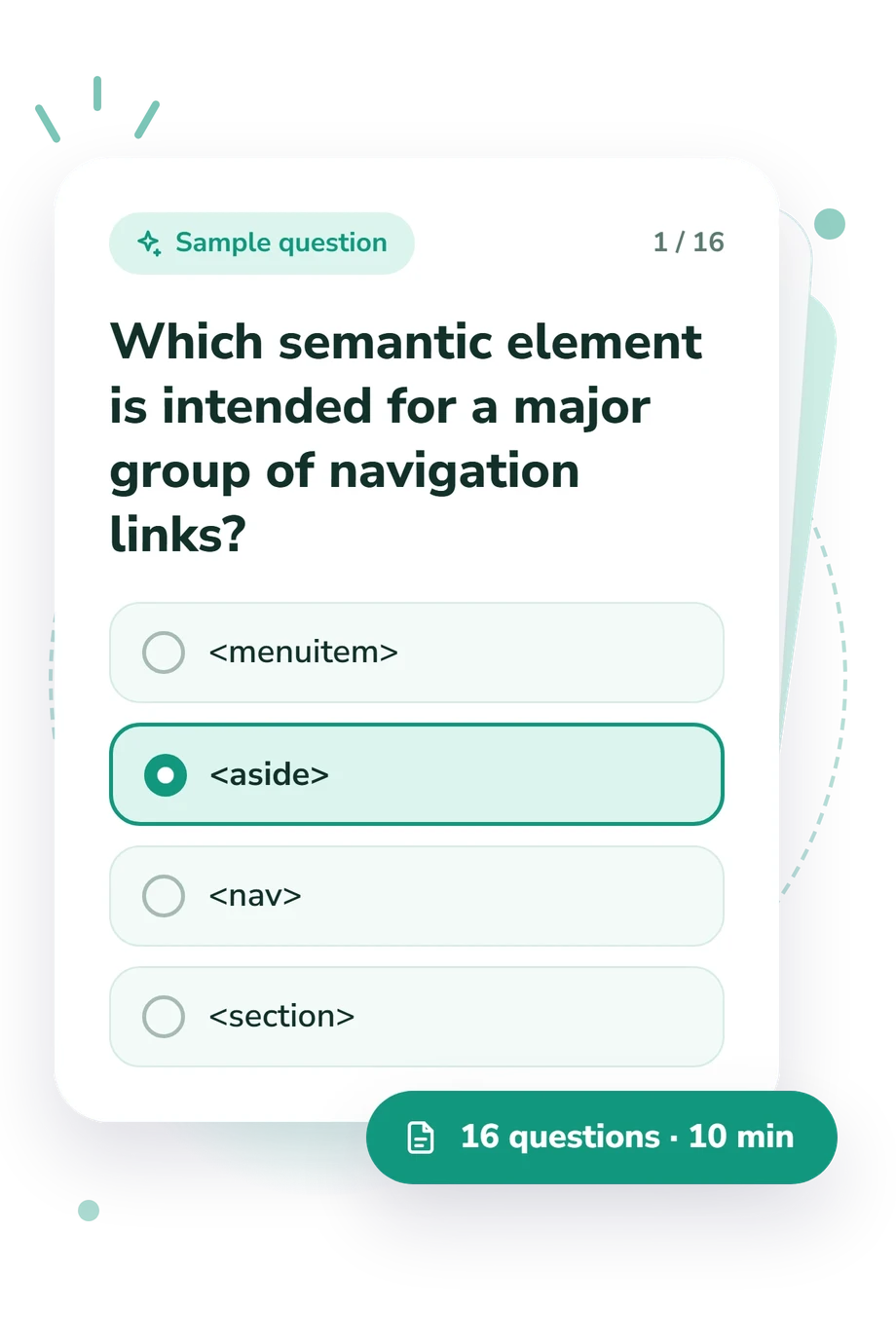
- <menuitem>
- <aside>
- <nav>
- <section>
- <html language=""English"">
- <head lang=""en"">
- <html lang=""en"">
- <language code=""en"">
- <ol>
- <dl>
- <li>
- <ul>
HTML Quiz - Description and methodology of the test
People learning web development, reviewing markup, or maintaining simple pages can use this html quiz to check whether familiar rules work in context. It emphasizes practical judgment rather than broad programming ability, so the result can show which foundations are secure and where focused study may improve everyday page-building. As an online quiz on HTML, it gives a useful starting point for deciding what to practise next.
What This Assessment Explores
Practical situations test whether you can apply core HTML conventions. It suits learners and web creators who write, review, or maintain pages.
Across the items, questions about HTML in the assessment cover meaningful elements, attributes, declarations, nesting, links, forms, and character references. Other tasks connect semantics with accessibility through headings, labels, alternative text, and figure content.
The result uses one scale, shown through these bands:
- HTML Knowledge (0-16) indicates how many tested HTML answers you handled correctly.
- Foundations to build (0-6) shows that core elements, attributes, semantics, or syntax need further review.
- Developing knowledge (7-12) reflects many essentials with some practical details to reinforce.
- Strong knowledge (13-16) indicates a reliable command of the tested foundations in typical page-building situations.
Methodology and Scientific Basis
Each item presents a short scenario with four answer options. You select the element, attribute, value, or markup that best fits it, so the format tests recognition and application of documented conventions rather than speed or personality.
Several practical examples turn HTML code tasks in the quiz into decisions about semantic tags, encoding declarations, form controls, links, relative paths, escaping, nesting, and shared class hooks. The answer key produces a correct-response count, so the result reflects performance on these items rather than a norm-referenced estimate of overall expertise.
The method is conceptually consistent with the HTML Living Standard, the 2014 W3C HTML5 recommendation, and Wallace Jackson’s discussion of semantic documents. Together, these sources frame the conventions assessed here; the questionnaire is not a standardized adaptation of them.
For interpretation, treat HTML questions and their answers as a snapshot of current knowledge. Guessing, memory, prior exposure, and testing context can affect the outcome, so use it to choose practice topics rather than treat it as a complete measure of web-development competence.
- WHATWG. HTML Living Standard. Living Standard. Editors: Anne van Kesteren, Domenic Denicola, Dominic Farolino, Philip Jägenstedt, and Simon Pieters.
- Hickson, Ian; Berjon, Robin; Faulkner, Steve; Leithead, Travis; Navara, Erika Doyle; O'Connor, Edward; Pfeiffer, Silvia. HTML5: A vocabulary and associated APIs for HTML and XHTML. W3C Recommendation, 28 October 2014.
- Jackson, Wallace. HTML5 Semantics: Defining Semantic Documents. In: HTML5 Quick Markup Reference, pp. 73-86. Apress, 2016. 10.1007/978-1-4302-6536-8_10
Updated: