
Neuron Labeling Quiz
How the Scales are Structured
Who Usually Takes This Test?
See How You Compare
Below is a preview of how scores are typically distributed across each scale.
Example Questions From the Test
- Axon terminal
- Dendritic shaft
- Node of Ranvier
- Axon hillock
- Nissl body
- Synaptic vesicle
- Nucleus
- Myelin sheath
- Dendritic spine
- Axon hillock
- Axon collateral
- Synaptic cleft
Neuron Labeling Quiz - Description and methodology of the test
For students, trainees, or curious learners, this neuron anatomy quiz offers a focused way to check whether key structures are genuinely distinguishable rather than merely familiar. The questions connect labels with textual descriptions of locations, morphology, and functions. The result from this neuron labeling quiz shows where terminology is secure and where targeted review would be useful. That makes it suitable for study planning and practical self-review.
What This Assessment Explores
The assessment checks neuronal anatomy through text-based descriptions of locations, morphology, and functions. It asks readers to distinguish the soma, nucleus, dendrites, axon, terminals, synaptic cleft, myelin, and glial cells. As a quiz about parts of a neuron, it tests whether learners identify structures and connect each term with a location or role.
The following groups show the content behind the result:
- Cell-body structures connect the soma, nucleus, and Nissl bodies with cellular organization.
- Processes and synaptic regions distinguish input, output, signal initiation, and neurotransmitter release.
- Myelin and glial structures identify insulation, nodes of Ranvier, and the cells that support axons.
The result summarizes overall accuracy on text-based neuron structure and terminology items through the Neuron Labeling Knowledge scale, 0-16: Foundation 0-6, Developing 7-12, and Strong 13-16. These bands move from review needed to accurate distinctions across examples.
Methodology and Scientific Basis
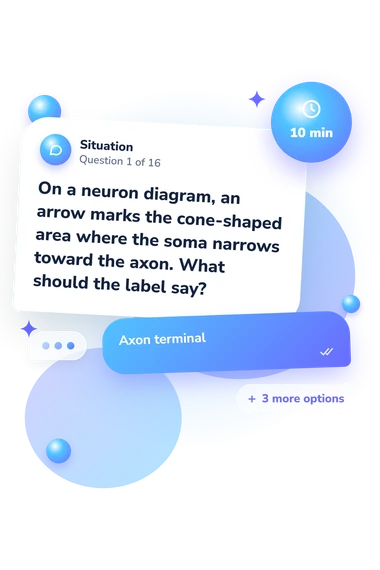
The response format uses short prompts with four answer choices. Some describe an arrow’s location or a microscopic feature in words; others ask about information flow, cellular roles, or glial support. This makes the neuron quiz a test of label recognition alongside location and function, rather than a vocabulary list.
Zeedzen-Scheffers et al. (2024) provide relevant educational context for visual preparation in neuroanatomy, while Vorstenbosch et al. (2014) show that images can influence cognitive processes in anatomy assessment. These studies provide general context for anatomy assessment but do not validate this questionnaire or establish its scoring. Purves et al. (2018) supply terminology consistent with the structures named here.
Responses are aggregated into the reported accuracy summary; no additional weighting rule or population norm is specified. Interpreting a neuron diagram quiz item may depend on recognizing boundaries, neighboring regions, and the requested level of specificity. The score can guide revision, but it may also reflect prior study, guessing, and how clearly a learner interprets each cue. It is an online knowledge check rather than a complete measure of neuroanatomical competence.
- Ine Zeedzen-Scheffers, Jort Karstens, Dylan J. H. A. Henssen, Lucas L. Boer, and Marianne van den Hurk (2024). Comparing the effectiveness of augmented reality and anatomical atlases in student preparation for neuroanatomy dissection. Scientific Reports, 14, 24939. 10.1038/s41598-024-76379-w
- Marc A. T. M. Vorstenbosch, Shifra T. Bouter, Marianne M. van den Hurk, Jan G. M. Kooloos, Sanneke M. Bolhuis, and Roland F. J. M. Laan (2014). Exploring the validity of assessment in anatomy: do images influence cognitive processes used in answering extended matching questions? Anatomical Sciences Education, 7(2), 107-116. 10.1002/ase.1382
- Dale Purves, George J. Augustine, David Fitzpatrick, William C. Hall, Anthony-Samuel LaMantia, Richard D. Mooney, Michael L. Platt, and Leonard E. White, editors (2018). Neuroscience, 6th edition. Sinauer Associates, an imprint of Oxford University Press.
Updated: