
Organ Quiz
How the Scales are Structured
Who Usually Takes This Test?
See How You Compare
Below is a preview of how scores are typically distributed across each scale.
Example Questions From the Test
- Large intestine
- Esophagus
- Gallbladder
- Small intestine
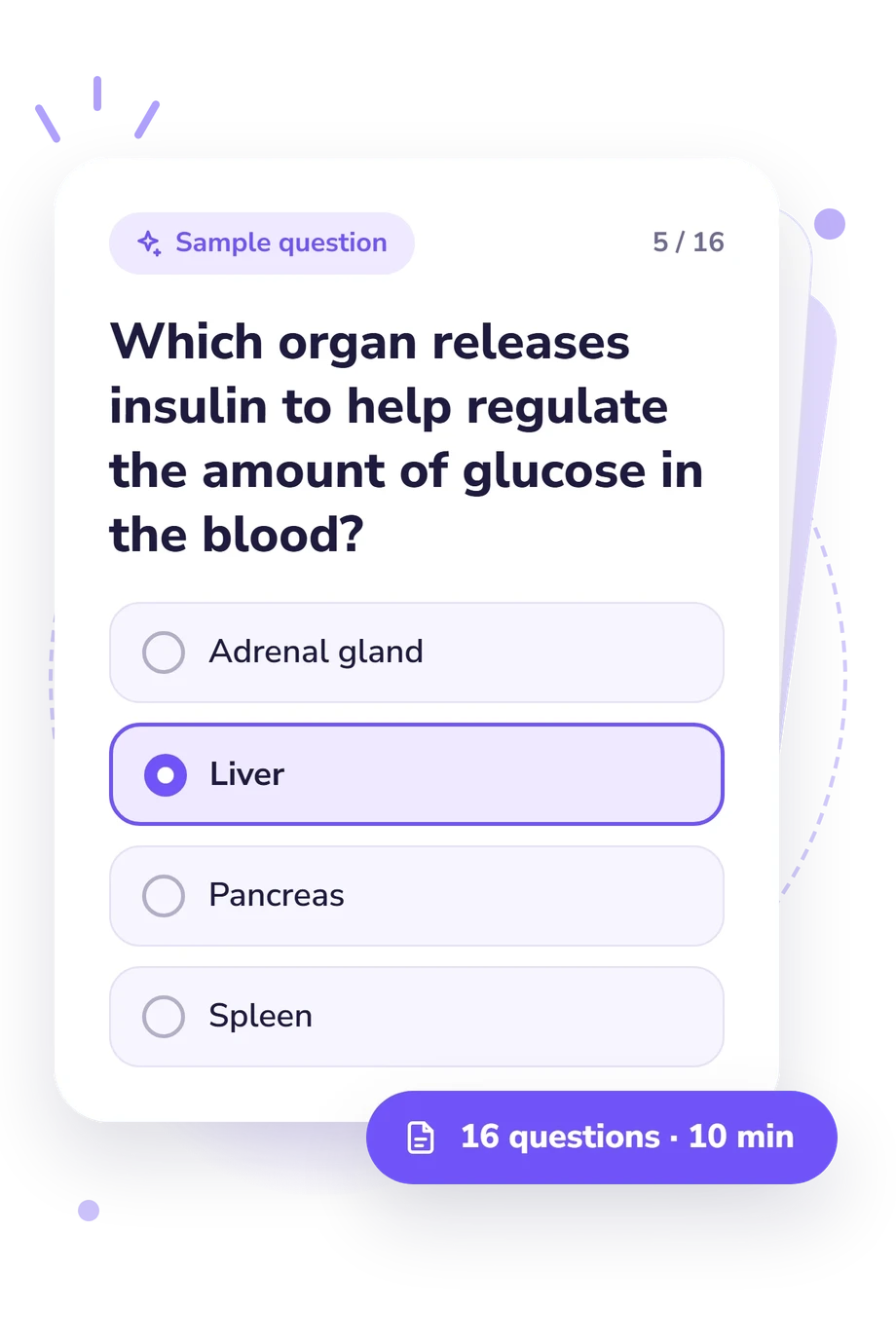
- Adrenal gland
- Liver
- Pancreas
- Spleen
- Kidneys
- Lungs
- Small intestine
- Adrenal glands
Organ Quiz - Description and methodology of the test
People who want to connect body structures with everyday physiology can use this organ quiz to check whether familiar names translate into functional understanding. It suits curious learners, students beginning anatomy, and anyone revising core life-science concepts. As an organ identification quiz, it turns common biological situations into a focused snapshot of functional knowledge.
What This Assessment Explores
Functional anatomy is the focus: the questions ask you to recognize organs from their roles and connect them with digestion, circulation, respiration, excretion, endocrine regulation, memory, speech, and temperature control.
Some items describe brief situations, while others ask directly about a structure or process. As a test of knowledge about human organs, the questionnaire supports review of body systems rather than investigation of a personal health concern.
The Human Organ Knowledge scale ranges from 0 to 16:
- Foundation-building (0-6) means you recognize some organ functions and may benefit from reviewing the major body systems.
- Developing knowledge (7-12) means you understand many core functions, with room to strengthen less familiar connections.
- Strong knowledge (13-16) means you show a well-rounded grasp of major organs and how they support body processes.
Methodology and Scientific Basis
Each item presents four answer choices, and you select the option that best fits the described organ, function, or physiological situation. Scoring is direct: every correct answer contributes one point to the single displayed scale, so the result summarizes overall performance rather than separate anatomy subtests.
The closest named evidence is the foundational knowledge assessment tool reported by Pienaar, Prince, and Abrahams and examined in subsequent work by Abrahams and colleagues. This questionnaire is conceptually consistent with that educational approach, but it is not presented as an adaptation of the published instrument.
The OpenStax textbook supplies a complementary reference framework for organ functions and relationships among body systems.
For revision, the organ knowledge test can indicate whether broader review of organ functions and body-system relationships may be useful, although online multiple-choice performance is affected by guessing, attention, prior instruction, and familiarity with wording.
No population norms or clinical interpretation are supplied, so the bands should be read as learning categories rather than population cutoffs. Interpret results alongside study goals and broader evidence of understanding.
- Pienaar L, Prince R, Abrahams A. Development of a baseline assessment tool to establish students’ foundational knowledge of life sciences at entry to university. African Journal of Health Professions Education. 2021;13(1):77-82. 10.7196/AJHPE.2021.v13i1.1226
- Abrahams A, Pienaar L, Bugarith K, Gunston G, Badenhorst E. A foundational knowledge assessment tool to predict academic performance of medical students in first-year anatomy and physiology. Advances in Physiology Education. 2022;46(4):598-605. 10.1152/advan.00017.2022
- Betts JG, Young KA, Wise JA, Johnson E, Poe B, Kruse DH, Korol O, Johnson JE, Womble M, DeSaix P. Anatomy and Physiology 2e. Houston, TX: OpenStax; 2022.
Updated: