
Lewis Structure Quiz
How the Scales are Structured
Who Usually Takes This Test?
See How You Compare
Below is a preview of how scores are typically distributed across each scale.
Example Questions From the Test
- CO₂
- SF₆
- NH₃
- BF₃
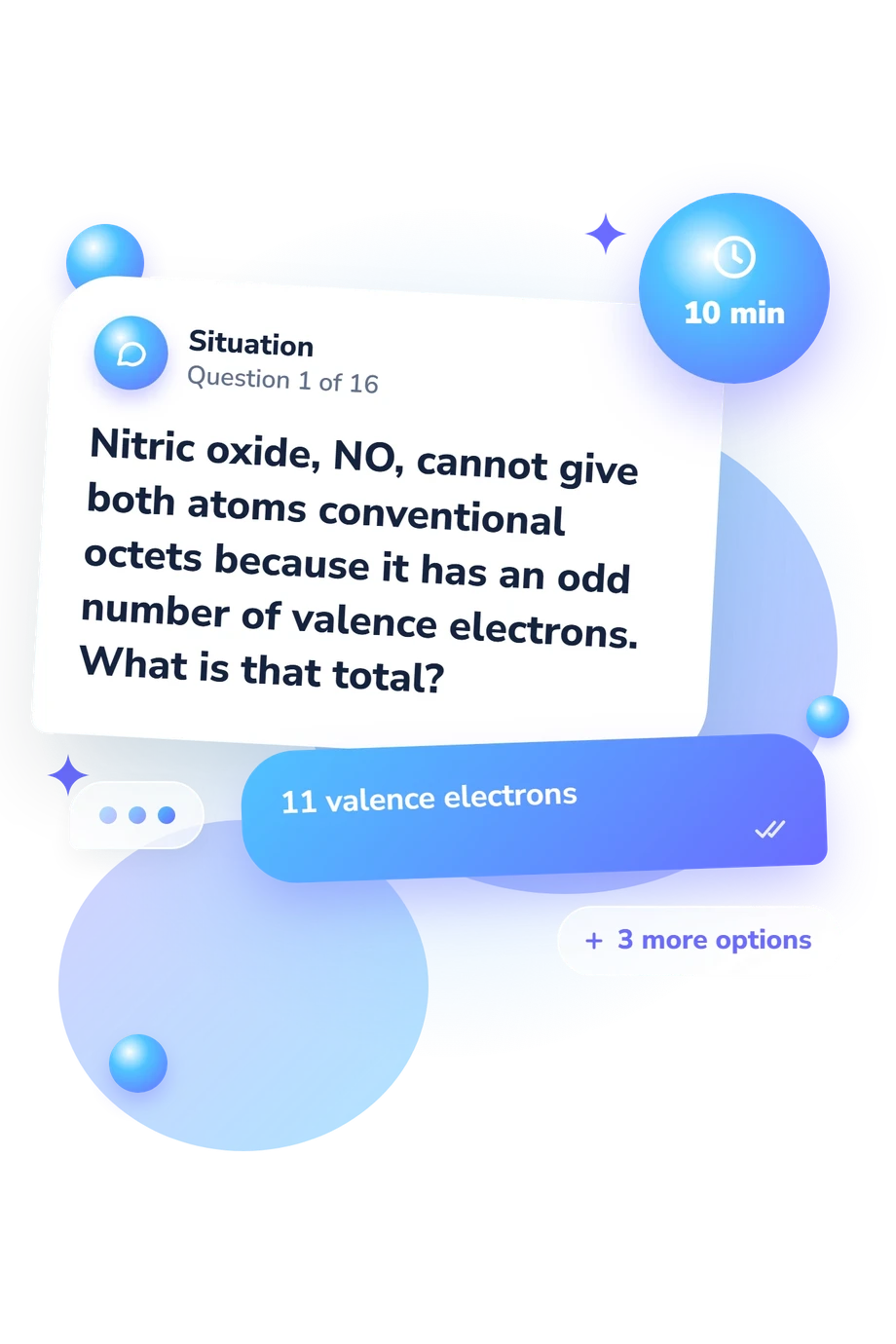
- 23 valence electrons
- 24 valence electrons
- 18 valence electrons
- 32 valence electrons
- No lone pairs
- One lone pair
- Three lone pairs
- Two lone pairs
Lewis Structure Quiz - Description and methodology of the test
Students revising general chemistry can use this Lewis Structure Quiz to check whether they can move from electron counting to a defensible molecular drawing. It suits learners who want a focused lewis dot structure quiz before classwork, homework, or an exam. The aggregate result summarizes overall performance across the quiz tasks; reviewing individual answers can guide topic review when that feedback is provided.
What This Assessment Measures
Items cover Lewis structure decisions rather than overall chemistry. They ask learners to count valence electrons, choose an atomic skeleton, place electrons, recognize octet exceptions, and evaluate formal charge. Resonance, bond order, and electron-group geometry also appear.
The tasks provide lewis dot structure practice by applying rules to familiar molecules and ions rather than memorizing isolated definitions.
The main skill areas are:
- Valence-electron accounting checks whether totals fit the species and its charge.
- Bond and lone-pair placement shows whether structures are built completely and plausibly.
- Formal-charge analysis shows whether drawings can be compared systematically.
- Resonance and geometry interpretation links Lewis formulas with equivalent bonds and electron arrangement.
The result uses one scale, Lewis Structure Knowledge: 0-16. Its bands are Foundation Building (0-6), Developing Command (7-12), and Strong Command (13-16), describing this quiz’s performance rather than overall chemistry ability.
Methodology and Scientific Basis
Each item presents a chemistry scenario with four answer choices. Learners calculate valence-electron totals, select bonding patterns, identify formal charges, or interpret resonance and geometry. Each correct answer contributes one point to the total, which summarizes performance across electron-counting, bonding, formal-charge, resonance, and geometry tasks.
Sandi-Urena et al. (2020) offer the closest conceptual comparison, treating learning Lewis structures as coordination among electron counts, symbolic representations, and chemical rules. This questionnaire is conceptually consistent with that work, not an adaptation of it. Packer and Woodgate (1991) are relevant to its formal-charge reasoning, while Lewis (1916) provides the shared-electron and octet framework behind the chemistry assessed here.
Because no population norms or independently validated cutoffs are stated, focused Lewis structure practice uses internal performance bands. Results can reflect current preparation, rushed reading, or a single calculation error, so they are best used to target review rather than infer overall chemistry mastery.
- Santiago Sandi-Urena, Giovanni Loría Cambronero, and Dayanna Jinesta Chaves. "Conceptualisation of Lewis structures by chemistry majors." Chemistry Teacher International, 2(1), 2020, article 20180019. 10.1515/cti-2018-0019
- John E. Packer and Sheila D. Woodgate. "Lewis structures, formal charge, and oxidation numbers: A more user-friendly approach." Journal of Chemical Education, 68(6), 1991, 456-458. 10.1021/ed068p456
- Gilbert N. Lewis. "The atom and the molecule." Journal of the American Chemical Society, 38(4), 1916, 762-785. 10.1021/ja02261a002
Updated: