
Antigone Quiz
How the Scales are Structured
Who Usually Takes This Test?
See How You Compare
Below is a preview of how scores are typically distributed across each scale.
Example Questions From the Test
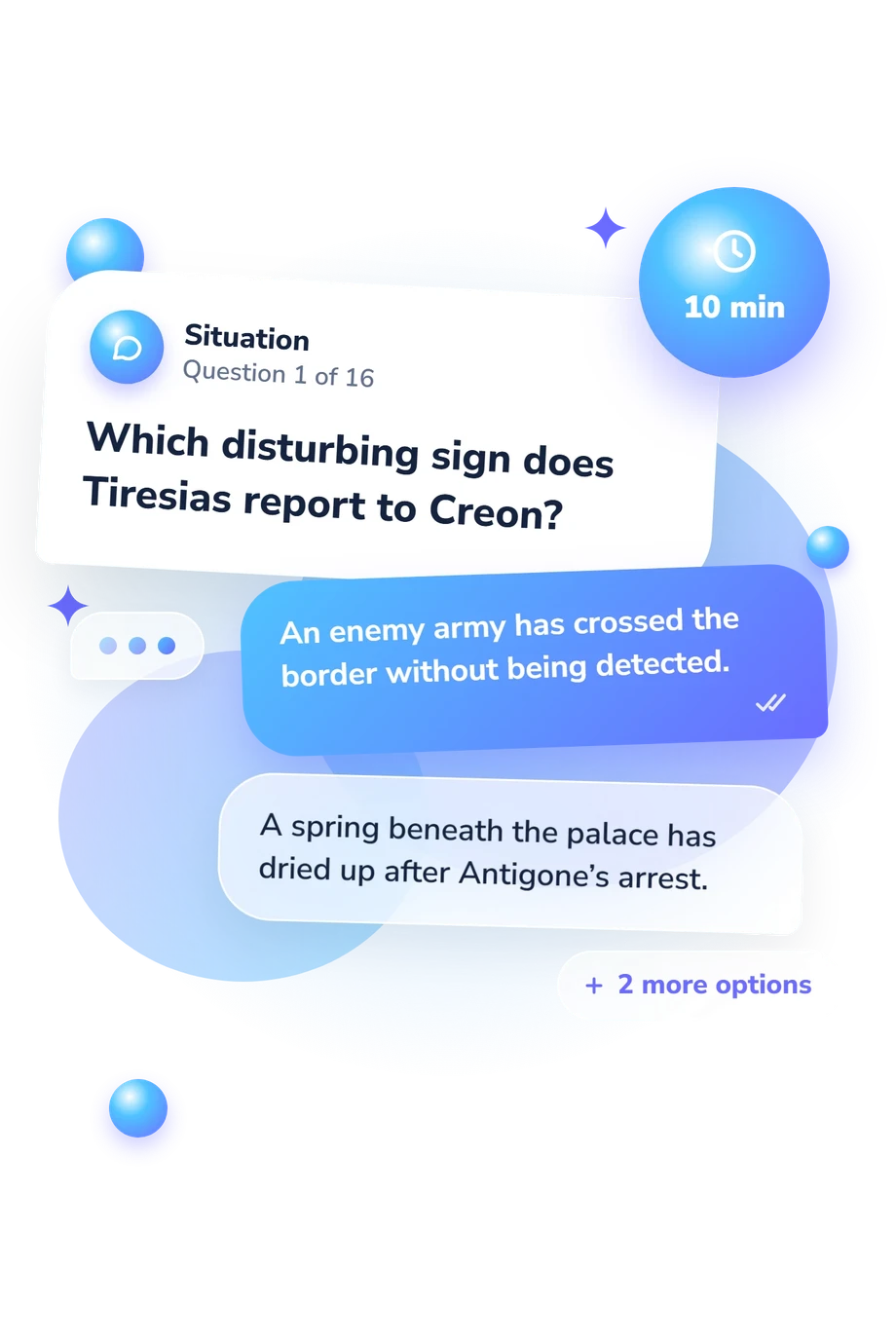
- An enemy army has crossed the border without being detected.
- A spring beneath the palace has dried up after Antigone’s arrest.
- The ghost of Oedipus has appeared beside Eteocles’ grave.
- Birds are fighting and shrieking after feeding on Polynices’ unburied body, while sacrifices fail.
- She asks the Chorus to exile Creon and crown Ismene.
- She takes her own life after condemning Creon for the deaths of their sons.
- She travels to Antigone’s tomb to complete the burial rites.
- She forgives Creon and withdraws permanently from public life.
- Haemon has led a rebellion against his father’s government.
- Oedipus has returned from exile to reclaim the throne from Creon.
- Argos has conquered Thebes and installed Polynices as its ruler.
- Eteocles and Polynices have killed each other in a civil conflict over Thebes.
Antigone Quiz - Description and methodology of the test
Students, teachers, and independent readers may use an Antigone literature quiz to assess how well their understanding integrates scenes, motives, and the play’s tragic conflict. The assessment connects plot knowledge with religious duty, political authority, and tragic consequence. For anyone preparing to read, teach, or discuss Sophocles’ tragedy, the Antigone Quiz offers a structured check of that integrated understanding.
What This Assessment Explores
The focus is close understanding of Sophocles’ tragedy rather than broad literary opinion. As an Antigone knowledge test, it examines the civil conflict before the action, the burial dispute, and the choices of Antigone, Creon, Ismene, Haemon, Eurydice, and Tiresias. It also asks readers to connect motives with reversals, religious obligation, civic power, rigidity, delayed recognition, and irreversible consequence.
The displayed scale brings these elements together:
- Antigone Knowledge (0-16) indicates how fully the reader understands the play’s events, characters, imagery, and tragic argument. Foundation to build (0-6) signals that these elements need review; Developing command (7-12) reflects substantial understanding with some details worth revisiting; Strong command (13-16) indicates a well-integrated understanding of the tragedy.
The result gives a broad indication of integrated understanding across the play’s stated elements.
Methodology and Evidence Base
The questionnaire uses sixteen multiple-choice items, each with four answer choices. Respondents select the option that best fits the play, moving between factual recognition and interpretation. The content includes the political situation, Tiresias’s warning, burial customs, resistance, and the consequences of Creon’s reversal. The format tests understanding rather than isolated vocabulary.
Results are reported through the displayed scale and its three bands; the questionnaire does not specify how individual answers are weighted or use a norm-referenced comparison. This online assessment is a structured literature knowledge check, not a standardized psychological instrument; its result does not measure intelligence, literary worth, or clinical functioning.
Using Sophocles’ Antigone as its content source, the questions represent tensions among family obligation, civic authority, divine law, and tragic structure. Performance can vary with prior familiarity with the play, the translation used, memory, guessing, and attention. The quiz questions about Antigone in this assessment select particular plot events and interpretive points, so they cannot represent every possible reading of the play. The result can guide rereading and discussion.
- Sophocles. Sophocles Antigone. Translated by Reginald Gibbons and Charles Segal. Oxford University Press, 2003. 10.1093/oso/9780195143737.001.0001
- Lardinois, André. Antigone. In A Companion to Sophocles, edited by Kirk Ormand, pp. 53-68. Wiley-Blackwell, 2012. 10.1002/9781118350508.ch5
Updated: