
Your Mental Health Today Test / Quiz
How the Scales are Structured
Who Usually Takes This Test?
See How You Compare
Below is a preview of how scores are typically distributed across each scale.
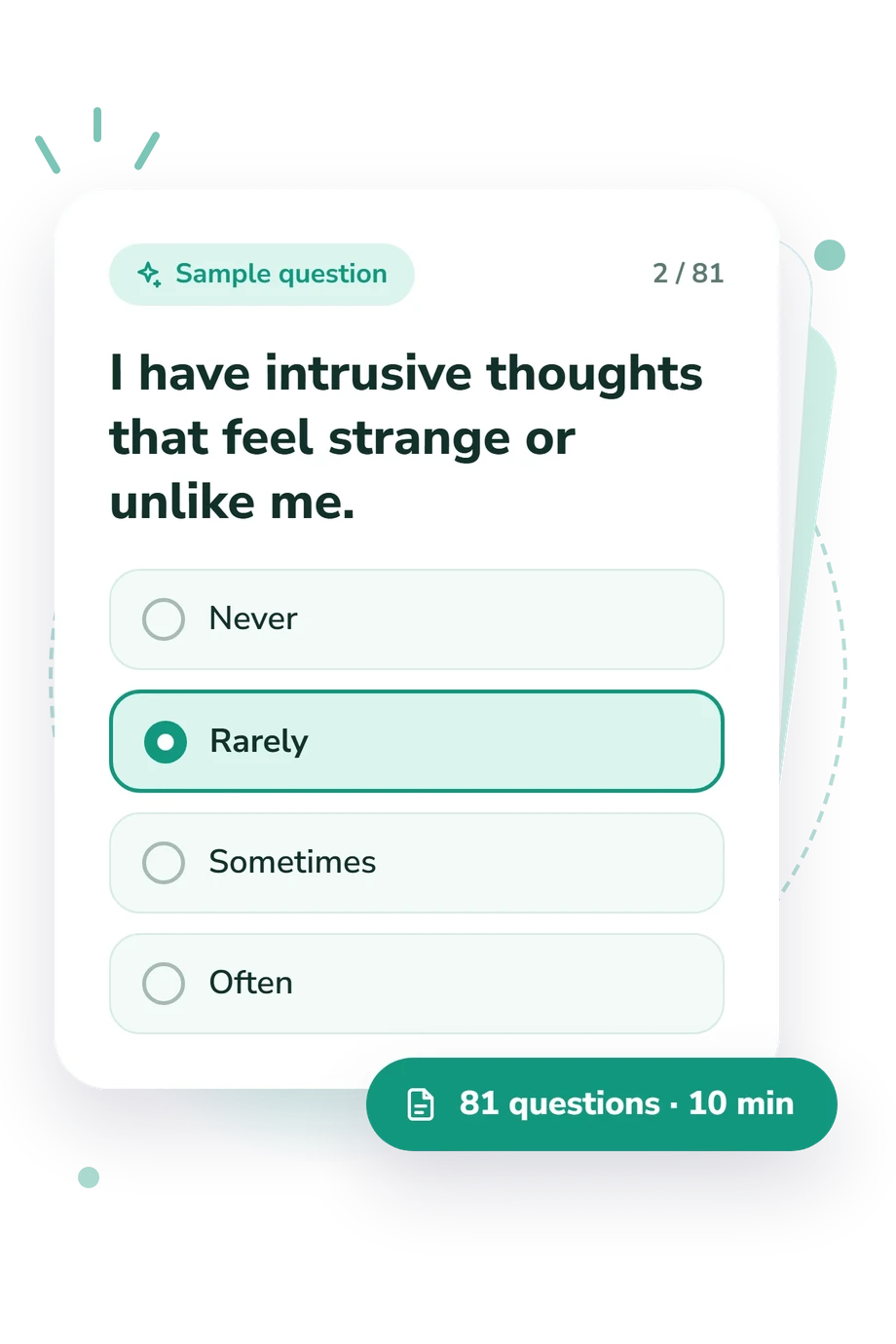
Example Questions From the Test
- No
- Maybe/Unsure
- Yes, once
- Yes, more than once
- Never
- Rarely
- Sometimes
- Often
- No
- Yes, once (manageable)
- Yes, more than once
- Yes, frequent or overwhelming
Your Mental Health Today Test / Quiz - Description and methodology of the test
People who have noticed recent shifts in perception, thinking, sleep, or emotional control can use this questionnaire to organize what has been happening and how disruptive it feels. The insanity test focuses on current experiences rather than assigning a fixed identity or label. Its reality check quiz format separates unusual experiences from urgent warning signs and the distress or disruption associated with them across perception, thinking, daily functioning, and safety.
What This Assessment Explores
Items cover feeling unreal or detached, confusion, difficulty trusting perceptions, racing or interrupted thoughts, sleep disruption, impaired responsibilities, risky behavior, and safety concerns. Frequency, intensity, distress, and practical impact all matter. Perception questions are paired with distress, functioning, and safety, giving this unusual perception quiz a broader focus than perception alone.
The result is organized into three dimensions:
- Crisis Flag Index (0-10) screens urgent warning signs; its bands are Low 0-3, Moderate 4-6, and High 7-10.
- Perceptual & Thought Unusualness (0-30) measures the frequency and intensity of unusual perceptions or thoughts; its bands are Typical range 0-10, Occasional unusual experiences 11-20, and Frequent/intense unusual experiences 21-30.
- Reality-Check Distress (0-40) measures how distressing and disruptive recent experiences feel; its bands are Low distress 0-13, Moderate distress 14-26, and High distress 27-40.
Methodology and Evidence Base
Responses use recent periods, usually the past seven days or two weeks. Depending on the item, choices describe presence, frequency, intensity, distress, impairment, or safety; they are not identical across questions. The online result displays three separate scale scores with result bands; it does not state how each response is converted into points or provide a standardized normative scoring system.
Its method is conceptually consistent with the Prodromal Questionnaire-Brief Version (Loewy et al., 2011), earlier PQ work, and later clinic-screening research by Loewy and colleagues. This is a conceptual relationship: the online questionnaire is not an adaptation, standardized administration, or validated equivalent of those instruments. Its displayed bands are descriptive categories for this online result and should not be treated as established diagnostic thresholds. The unusual-experience content resembles a psychosis screening questionnaire, while the result remains a structured self-report snapshot.
Interpretation depends on honest recall, self-awareness, sleep, stress, substances, physical health, and context. A high crisis score signals stronger urgent warning signs and warrants prompt attention to immediate safety, while the other scores describe how unusual or disruptive recent experiences have felt.
- Loewy, R. L., Pearson, R., Vinogradov, S., Bearden, C. E., & Cannon, T. D. (2011). Psychosis risk screening with the Prodromal Questionnaire-brief version (PQ-B). Schizophrenia Research, 129(1), 42-46. 10.1016/j.schres.2011.03.029
- Loewy, R. L., Bearden, C. E., Johnson, J. K., Raine, A., & Cannon, T. D. (2005). The prodromal questionnaire (PQ): Preliminary validation of a self-report screening measure for prodromal and psychotic syndromes. Schizophrenia Research, 79(1), 117-125. 10.1016/j.schres.2005.03.007
- Loewy, R. L., Therman, S., Manninen, M., Huttunen, M. O., & Cannon, T. D. (2012). Prodromal psychosis screening in adolescent psychiatry clinics. Early Intervention in Psychiatry, 6(1), 69-75. 10.1111/j.1751-7893.2011.00286.x
Updated: