
Period Quiz
How the Scales are Structured
Who Usually Takes This Test?
See How You Compare
Below is a preview of how scores are typically distributed across each scale.
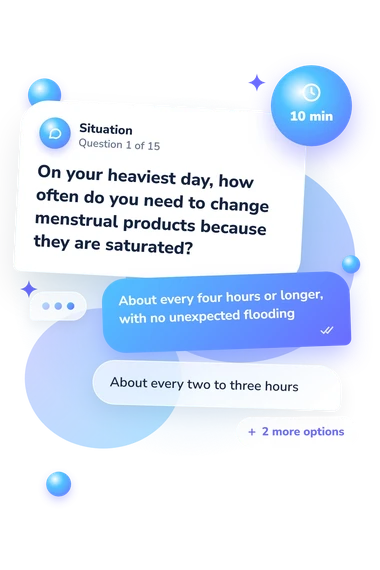
Example Questions From the Test
- About every four hours or longer, with no unexpected flooding
- About every two to three hours
- Every one to two hours, or I regularly need two forms of protection
- Every hour or faster for at least two hours, or blood soaks through clothing or bedding
- None, or only occasional small clots
- A few clots around the size of a small coin during heavier flow
- Repeated clots larger than about 2.5 cm across
- Very large clots occur repeatedly alongside flooding, marked weakness, or dizziness
- They are not painful or meaningfully different
- I notice mild pressure or discomfort that passes
- Pain repeatedly makes me delay or avoid urinating or having a bowel movement
- I cannot pass urine or stool, or severe pain occurs with visible blood in urine or stool
Period Quiz - Description and methodology of the test
People deciding whether their symptoms deserve closer attention may benefit from this period quiz, especially when bleeding, timing, or pelvic discomfort feels different from usual. A menstrual symptom assessment can help frame a practical next step: keep observing a stable pattern, arrange routine advice, or respond urgently to a concerning experience.
What This Assessment Explores
This assessment suits anyone seeking a structured review of menstrual bleeding, cycle timing, reproductive warning signs, pelvic pain, and daily impact. As a menstrual health questionnaire, it focuses on symptom patterns and their effect on everyday life.
The displayed scales cover:
- Bleeding Patterns (0-15) covers heavy, prolonged, between-period, or post-sex bleeding and blood-loss effects; bands: Review context (0), Worth monitoring (1-2), Prompt follow-up (3-15).
- Cycle Timing and Reproductive Signs (0-15) covers missed or shifting periods, pregnancy concerns, menopause-related bleeding, and illness signs; bands: Review context (0), Worth monitoring (1-2), Prompt follow-up (3-15).
- Pelvic Pain and Daily Impact (0-15) covers cramps, pain outside bleeding, pain with penetration or examination, and activity disruption; bands: Review context (0), Worth discussing (1-2), Prompt follow-up (3-15).
Methodology and Scientific Basis
Each item offers four response choices, moving from absent or expected experiences toward increasing frequency, duration, disruption, or urgency. The groups cover bleeding, timing, pain, pregnancy possibility, menopause, and illness, making this a menstrual symptom review of current self-reported experiences.
The interface converts responses into thematic scores, but no per-answer formula is stated, so point values should not be inferred from the ranges. The displayed bands are unvalidated summaries rather than clinical cutoffs; read each thematic score alongside the specific symptom endorsed and the current context.
Conceptually, the bleeding-related content is consistent with the Menstrual Bleeding Questionnaire, which focuses on heavy menstrual bleeding. The menstrual-history approach associated with Matteson, Munro, and Fraser, FIGO classification of abnormal uterine bleeding, and ACOG guidance on ectopic pregnancy provide clinical context for the other topics; they do not validate the full questionnaire.
Recall, current symptoms, self-awareness, and willingness to report sensitive experiences can affect results. Fainting, chest pain, breathing difficulty, or one-sided pain when pregnancy is possible warrant urgent medical help or assessment, rather than waiting on the score.
- Matteson KA, Scott DM, Raker CA, Clark MA. The menstrual bleeding questionnaire: development and validation of a comprehensive patient-reported outcome instrument for heavy menstrual bleeding. BJOG: An International Journal of Obstetrics & Gynaecology. 2015;122(5):681-689. 10.1111/1471-0528.13273
- Matteson KA, Munro MG, Fraser IS. The structured menstrual history: developing a tool to facilitate diagnosis and aid in symptom management. Seminars in Reproductive Medicine. 2011;29(5):423-435. 10.1055/s-0031-1287666
- Munro MG, Critchley HOD, Fraser IS, FIGO Menstrual Disorders Committee. The two FIGO systems for normal and abnormal uterine bleeding symptoms and classification of causes of abnormal uterine bleeding in the reproductive years: 2018 revisions. International Journal of Gynecology & Obstetrics. 2018;143(3):393-408. 10.1002/ijgo.12666
- American College of Obstetricians and Gynecologists' Committee on Practice Bulletins-Gynecology. ACOG Practice Bulletin No. 193: Tubal Ectopic Pregnancy. Obstetrics & Gynecology. 2018;131(3):e91-e103. 10.1097/AOG.0000000000002560