
When Will I Get My Second Period Quiz
How the Scales are Structured
Who Usually Takes This Test?
See How You Compare
Below is a preview of how scores are typically distributed across each scale.
Example Questions From the Test
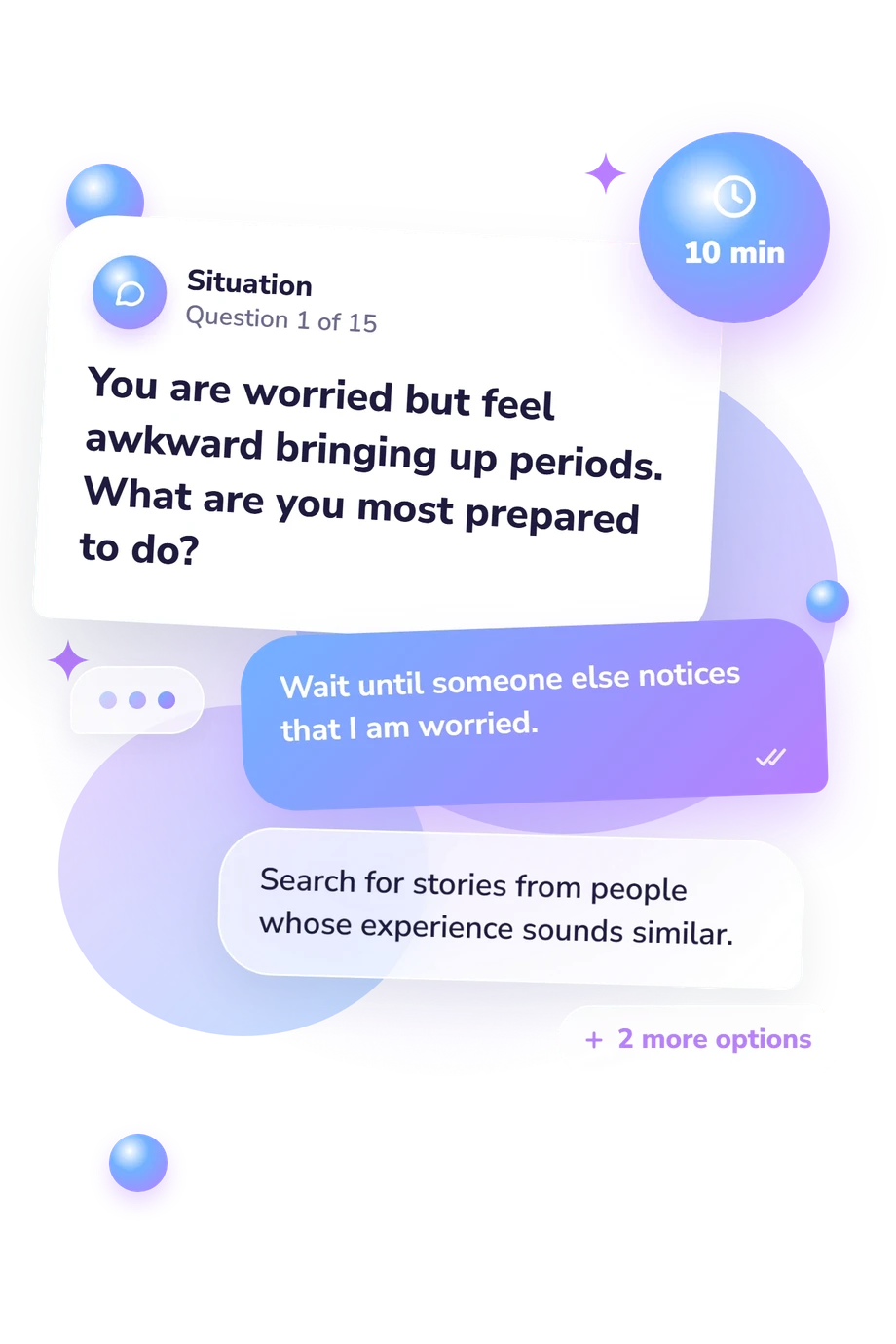
- Wait until someone else notices that I am worried.
- Search for stories from people whose experience sounds similar.
- Choose one trusted person and explain that I have a cycle question.
- Write down what I want to say, contact a trusted person or clinician, and ask directly for the support I need.
- I would assume the prediction shows exactly when my body was supposed to start.
- I would move the predicted date forward and treat the new date as the answer.
- I would keep the estimate in mind but allow for a wider window.
- I would treat it as a rough estimate, continue tracking, and use elapsed time—not the app alone—to decide whether to seek advice.
- I could only place it within a season or a broad part of the year.
- I could estimate the month, but not the week.
- I could estimate the week using messages, events, or a calendar.
- I could calculate it from a date I recorded.
When Will I Get My Second Period Quiz - Description and methodology of the test
Someone wondering when their next period may be can use this assessment, a when will my next period be quiz, to replace a hoped-for date with a clearer reflection on uncertainty. When Will I Get My Second Period Quiz gives people in this situation a profile of how they approach the question and what kind of next step may feel manageable. It offers a reflective result rather than a promised prediction.
What This Assessment Explores
Questions explore how a person interprets possible pre-period changes and responds to uncertainty. Scenarios cover spotting, discharge, cramps, mood, bleeding, app predictions, dates, preparation, pregnancy possibility, trusted support, and professional advice. When considering second-period timing, this questionnaire shows whether observations are treated as clues, exact countdowns, or information needing context.
These are the dimensions represented in the result:
- Body Signal Interpretation (0-15) shows how you read possible changes: Searching for Certainty (0-5), Pattern Explorer (6-10), or Balanced Observer (11-15).
- Cycle Tracking Skills (0-15) shows how usable your timing information is: Starting Record (0-5), Useful Foundation (6-10), or Detailed Tracker (11-15).
- Support and Next-Step Readiness (0-15) shows readiness to handle uncertainty, prepare for an unexpected period start, and involve appropriate support: Building a Plan (0-5), Some Support Ready (6-10), or Prepared to Act (11-15).
Methodology and Scientific Basis
Each item offers four choices, progressing from memory, fixed dates, or waiting toward observation, flexibility, preparation, support, and advice. The questionnaire is an online self-reflection tool with no stated standardized scoring method; its bands are unvalidated reflective categories rather than medical cutoffs or a forecast, and self-report may reflect current worry, memory, context, and self-awareness.
The 1986 World Health Organization study documents variation in early post-menarcheal cycles, so this assessment treats signs as context rather than an exact countdown. Harley and colleagues (2024) report U.S. variation in cycle characteristics by reproductive timing and age at first menstruation. ACOG Committee Opinion No. 651 (2015) supports menstrual history as health information and attention to unusually long gaps or concerning symptoms. The questionnaire is conceptually consistent with these sources, not an adaptation or validated reproduction of them.
The questionnaire can support period tracking by organizing observations, preparing questions, and clarifying when support may help. If three months pass without another period or pregnancy is possible, contact a healthcare professional; seek prompt help for severe pain, fainting, or very heavy bleeding.
- World Health Organization Task Force on Adolescent Reproductive Health. World Health Organization multicenter study on menstrual and ovulatory patterns in adolescent girls. II. Longitudinal study of menstrual patterns in the early postmenarcheal period, duration of bleeding episodes and menstrual cycles. Journal of Adolescent Health Care. 1986;7(4):236-244. 10.1016/S0197-0070(86)80015-8
- Kim G. Harley, Annalisa Watson, Samantha Robertson, Virginia J. Vitzthum, Amanda Shea. Menstrual Cycle Characteristics of U. S. Adolescents According to Gynecologic Age and Age at Menarche. Journal of Pediatric and Adolescent Gynecology. 2024;37(4):419-425. 10.1016/j.jpag.2024.03.005
- Committee on Adolescent Health Care, American College of Obstetricians and Gynecologists. Menstruation in Girls and Adolescents: Using the Menstrual Cycle as a Vital Sign. Committee Opinion No. 651. Obstetrics & Gynecology. 2015;126(6):e143-e146. 10.1097/AOG.0000000000001215
Updated: