
Water Safety Quiz
How the Scales are Structured
Who Usually Takes This Test?
See How You Compare
Below is a preview of how scores are typically distributed across each scale.
Example Questions From the Test
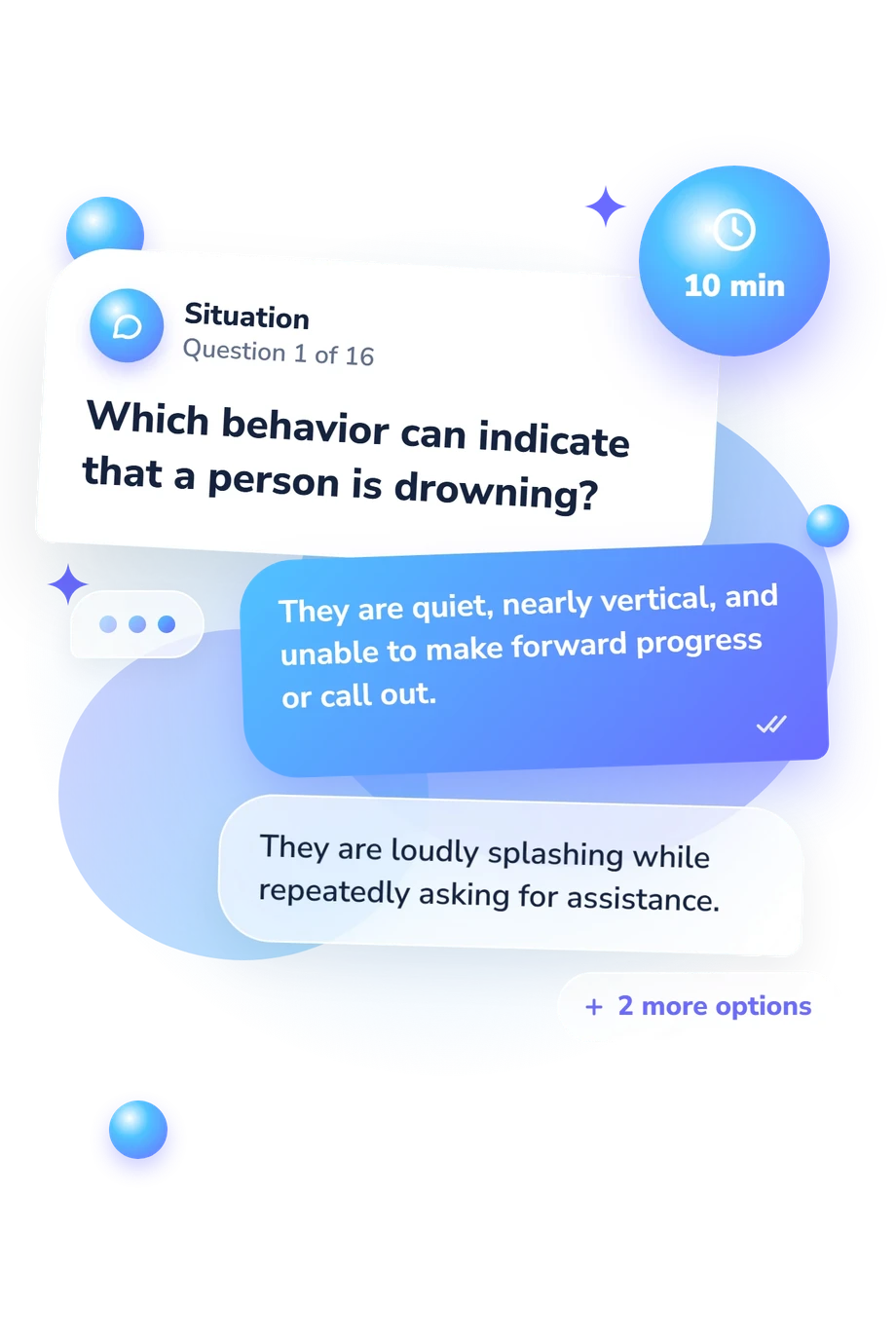
- They are quiet, nearly vertical, and unable to make forward progress or call out.
- They are loudly splashing while repeatedly asking for assistance.
- They are floating horizontally while speaking normally.
- They are swimming slowly but steadily toward a clear destination.
- Watch from a nearby chair while checking a phone occasionally.
- Stay within arm’s reach and give the child continuous, focused attention.
- Ask an older child who swims well to supervise.
- Rely on flotation toys while remaining within sight.
- Check the pool and other nearby water immediately while someone alerts others and calls for help.
- Search bedrooms and closets before alarming other guests.
- Wait at the pool gate in case the child returns there.
- Begin by reviewing security-camera footage to determine the child’s direction.
Water Safety Quiz - Description and methodology of the test
For people who want to make safer decisions around pools, beaches, boats, or floodwater, this water safety quiz offers a focused way to check practical knowledge. It is useful for swimmers, parents, caregivers, boaters, and anyone responsible for another person near water. The result from this water safety assessment indicates an overall knowledge band and general areas for review rather than identifying familiar areas or personal strengths.
What This Assessment Explores
The questionnaire covers drowning recognition, supervision, safe entry, cold water, floodwater, beach hazards, weather, barriers, life jackets, CPR, medical follow-up, reaching assists, and alcohol-related risk.
Across the questions, the safer choice depends on spotting a hazard and selecting an appropriate response rather than acting on confidence or speed. Together, its quiz questions about water safety address three practical knowledge areas:
- Supervision and recognition show awareness of distress signals and the focused attention children need.
- Environmental and prevention choices cover entry, weather, barriers, flotation, and alcohol-related judgment.
- Rescue response reflects safer help-seeking, CPR priorities, medical follow-up, and avoiding untrained entry.
The displayed Water Safety Knowledge scale runs from 0-16: Foundations to build (0-6), Developing knowledge (7-12), and Strong awareness (13-16). It indicates breadth of safety knowledge, not bravery, physical ability, or swimming skill.
Methodology and Evidence Base
Each item presents a brief water-safety scenario with four answer choices. The respondent selects the safest priority in situations involving supervision, weather, flotation, first aid, or rescue, including missing-child response, rip currents, and post-submersion breathing problems. This applied format tests knowledge, not swimming skill.
The questionnaire produces the displayed knowledge score, shown in the stated bands. This unvalidated educational score reflects the respondent’s current answers and does not provide certification.
Content is conceptually consistent with national guidance on water safety, but this questionnaire is not a validated adaptation of that published work. Its coverage overlaps with water competence principles and World Health Organization guidance on supervision, basic skills, flotation, and emergency action.
As a swimming safety quiz, it helps identify topics that may merit refresher study, while real-world safety also depends on physical skills, local conditions, and trained emergency action. If someone is in trouble, alert a lifeguard or emergency services; do not enter the water for a rescue unless trained and equipped.
- Peden, Amy E., Richard Charles Franklin, and Justin Scarr. "Measuring Australian Children's Water Safety Knowledge: The National Water Safety Quiz." International Journal of Aquatic Research and Education 10, no. 2 (2017), Article 4. 10.25035/ijare.10.02.04
- Shen, Jiabin, Shulan Pang, and David C. Schwebel. "Evaluation of a Drowning Prevention Program Based on Testimonial Videos: A Randomized Controlled Trial." Journal of Pediatric Psychology 41, no. 5 (2016): 555-565. 10.1093/jpepsy/jsv104
- Stallman, Robert K., Kevin Moran, Linda Quan, and John Langendorfer. "From Swimming Skill to Water Competence: Towards a More Inclusive Drowning Prevention Future." International Journal of Aquatic Research and Education 10, no. 2 (2017), Article 3. 10.25035/ijare.10.02.03
- World Health Organization. WHO Guideline on the Prevention of Drowning Through Provision of Day-Care and Basic Swimming and Water Safety Skills. Geneva: World Health Organization, 2021. ISBN 9789240030008
Updated: