
AP Psych Unit 2 Quiz
How the Scales are Structured
Who Usually Takes This Test?
See How You Compare
Below is a preview of how scores are typically distributed across each scale.
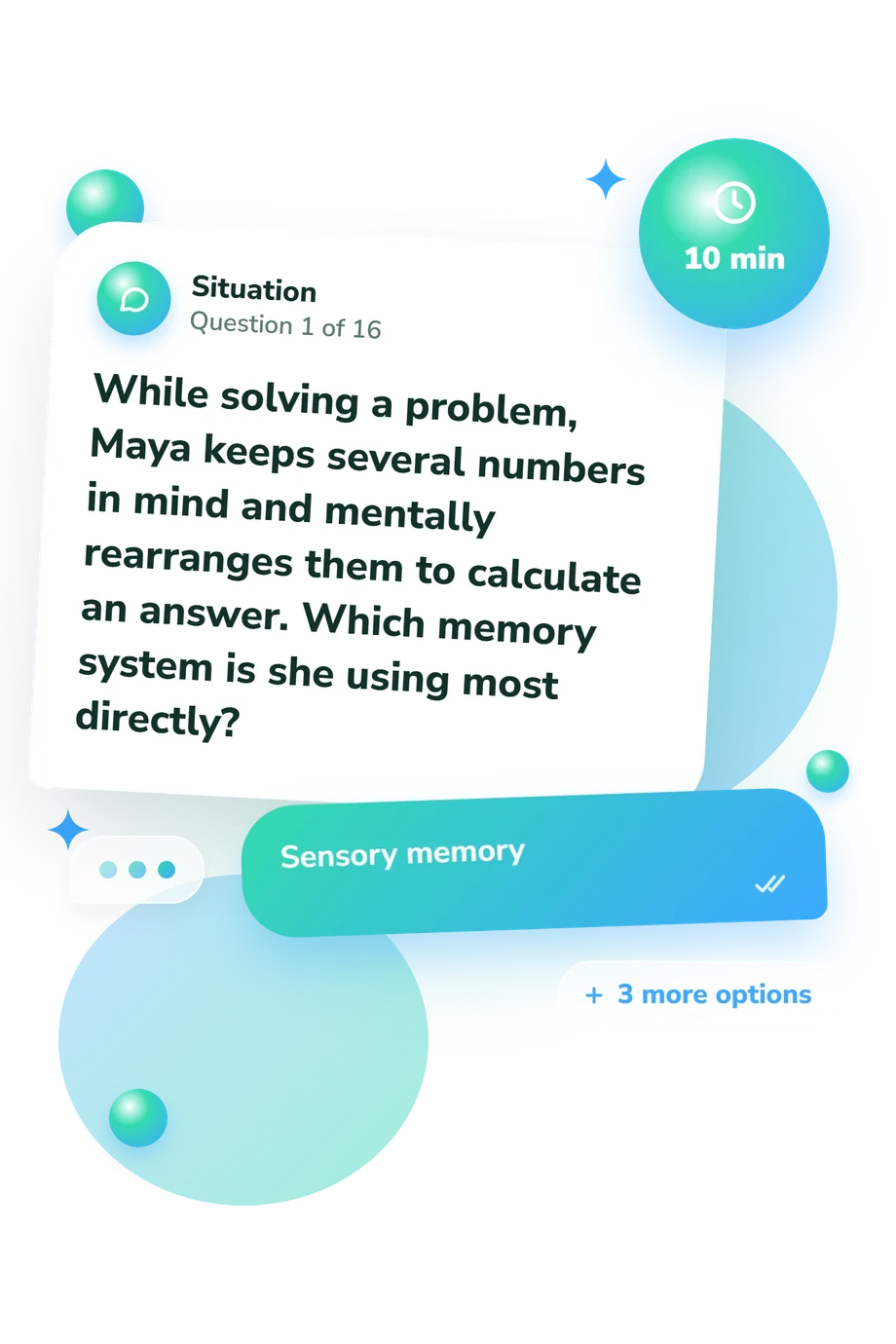
Example Questions From the Test
- Sensory memory
- Episodic memory
- Working memory
- Procedural memory
- Proactive interference
- The misinformation effect
- Anterograde amnesia
- Retroactive interference
- Studying for three uninterrupted hours the night before the test
- Studying for 30 minutes on each of six evenings
- Rereading the same chapter twice in one sitting
- Highlighting all key terms immediately after first reading them
AP Psych Unit 2 Quiz - Description and methodology of the test
Students consolidating cognition material can use this assessment as a focused knowledge check rather than a broad measure of intelligence. The AP Psych Unit 2 Quiz turns classroom-style situations into decisions about psychological concepts. An AP Psychology Unit 2 Quiz result can show which ideas feel secure and which deserve review.
What This Assessment Explores
Memory, language, problem solving, bias, and learning scenarios ask for the concept that best explains each situation. Responses show how well learners identify and apply cognition terms, helping them locate topics needing further study. These AP Psych Unit 2 practice questions make review active through application, not simple recognition.
The scenarios cover these areas:
- Memory items test working memory, interference, encoding specificity, and retrieval effects.
- Language and learning items test telegraphic speech, phonemes, spacing, and testing effects.
- Categorization and problem-solving items examine prototypes, algorithms, and functional fixedness, showing how concepts guide decisions.
- Bias and assessment items distinguish confirmation bias, reliability, and predictive validity.
The AP Psychology Unit 2 Knowledge scale runs from 0 to 16: Foundation to build (0-6), Developing knowledge (7-12), and Strong knowledge (13-16). These bands describe demonstrated Unit 2 cognition knowledge, not an official AP score prediction.
Methodology and Scientific Basis
The questionnaire uses four answer choices for each scenario, with one option intended to fit the psychological concept. Items connect classroom examples with terms such as proactive interference, confirmation bias, the spacing effect, and functional fixedness across memory, language, problem solving, bias, and learning principles. The scoring display uses one overall knowledge total, so it summarizes the tested areas rather than producing separate subscores.
Its content is conceptually consistent with the AP Psychology Unit 2 framework, which organizes cognition topics including memory, language, problem solving, and related research methods. Working-memory content is consistent with the model described by Baddeley and Hitch, while the collision-wording example echoes the language-and-memory finding associated with Loftus and Palmer.
As an AP Psychology Unit 2 review, the score helps choose what to revisit in notes or class materials. This version provides one educational score covering memory, language, problem solving, and related cognition concepts rather than separate subscores or an official AP prediction. Results may reflect prior exposure, attention, guessing, and familiarity with textbook wording, so one attempt is a current learning snapshot.
- College Board. AP Psychology Course and Exam Description, Effective Fall 2025. New York, NY: College Board, 2024.
- Loftus, Elizabeth F., and John C. Palmer. "Reconstruction of Automobile Destruction: An Example of the Interaction Between Language and Memory." Journal of Verbal Learning and Verbal Behavior, vol. 13, no. 5, 1974, pp. 585-589. 10.1016/S0022-5371(74)80011-3.
- Baddeley, Alan D., and Graham Hitch. "Working Memory." In Psychology of Learning and Motivation, vol. 8, edited by Gordon H. Bower, pp. 47-89. Academic Press, 1974. 10.1016/S0079-7421(08)60452-1.
Updated: