
Hanukkah Quiz
How the Scales are Structured
Who Usually Takes This Test?
See How You Compare
Below is a preview of how scores are typically distributed across each scale.
Example Questions From the Test
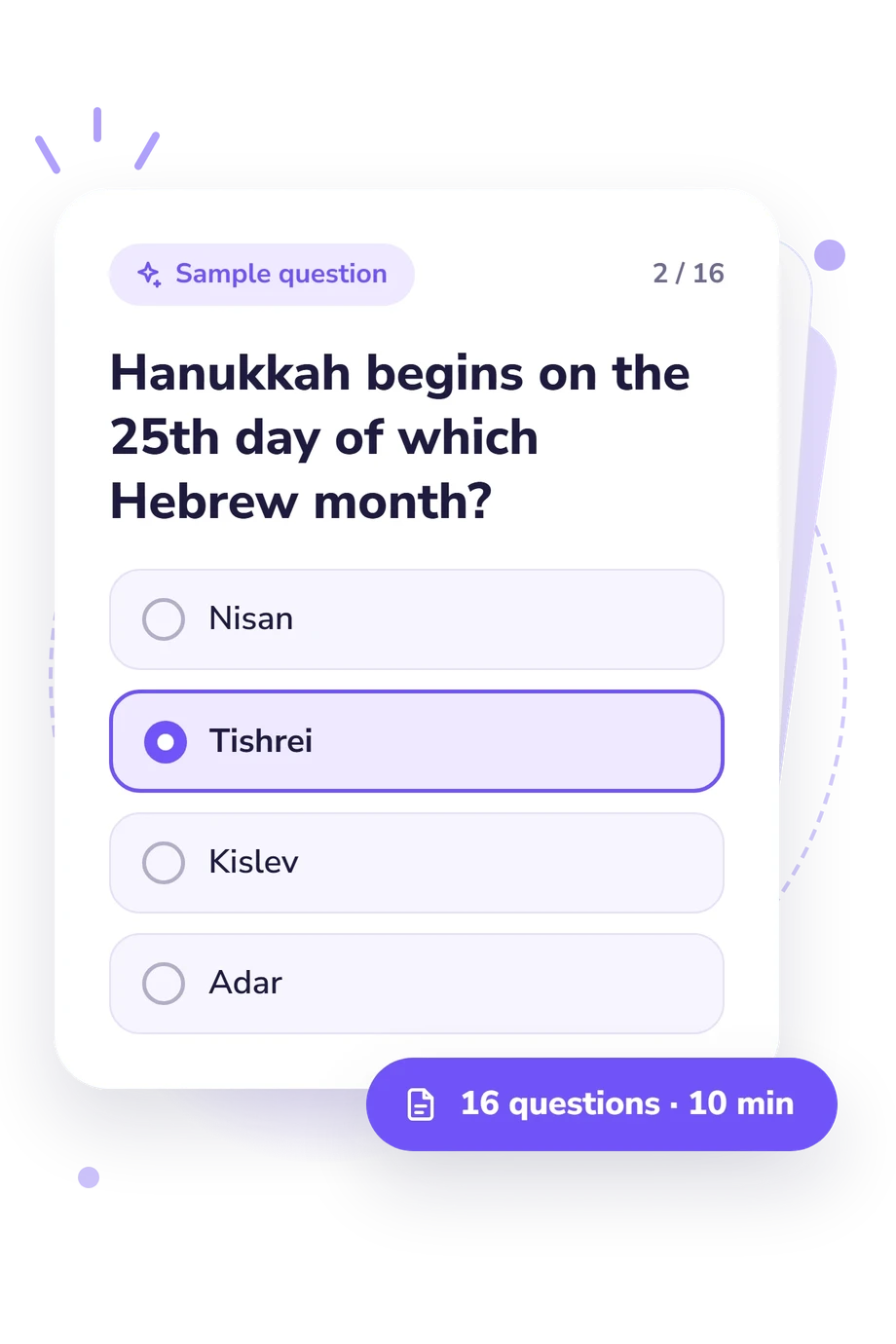
- Nisan
- Tishrei
- Kislev
- Adar
- It has eight branches and no place for a helper light
- It has seven lights arranged in a circle
- It has ten lights representing the Ten Commandments
- It has places for eight nightly lights plus a shamash
- It burned for eight days despite being enough for one
- It was replaced before the menorah could be lit
- It was divided among eight separate lamps
- It was used to prepare food for the Maccabees
Hanukkah Quiz - Description and methodology of the test
People who want to check their understanding of Hanukkah’s history and living traditions can use this Hanukkah Quiz as a focused knowledge exercise. Designed for general readers, it also works as a hanukkah trivia quiz for learners, families, teachers, or anyone preparing for a celebration. The result shows which areas of historical and practical knowledge are secure and where further reading may help, without treating familiarity as religious commitment.
What This Assessment Explores
The questionnaire measures recognition of Hanukkah’s history, ritual objects, calendar details, prayers, household customs, and widely shared meanings. It suits anyone building factual familiarity with the holiday, whether learning independently or preparing for discussion or observance. As a chanukah quiz, it emphasizes public traditions rather than personal belief.
Its main thematic groups are:
- Historical foundations link the Maccabean Revolt, Seleucid rule, Temple rededication, and the oil account.
- Symbols and ritual practice cover the hanukkiah, shamash, dreidel letters, candle order, and publicizing the miracle.
- Calendar and household observance address eight nights, Friday timing, Hallel, Al Hanissim, and oil-cooked foods.
The result is Hanukkah Knowledge, scored 0-16 by correct answers. Foundations to Build (0-6) signals knowledge to develop; Developing Knowledge (7-12) shows a solid grasp with details to strengthen; Strong Knowledge (13-16) reflects broad, accurate familiarity.
Methodology and Evidence Base
Each item presents a question followed by four answer choices, asking the respondent to select the best answer. The questions and answers about Hanukkah cover factual recall and discrimination between similar customs, historical settings, symbols, and observances.
Scoring is direct: the total is the number of correct responses, and the displayed result band follows the stated score ranges. No weighting, penalty for guessing, or clinical interpretation is claimed by this format.
Goodman (2018) supplies cultural and historical context for the holiday. Klawans and Wills (2020), including Daniel R. Schwartz’s translation and annotations for 1 Maccabees, supports the Seleucid and Temple-rededication framing. VanderKam (1987) examines Hanukkah’s timing and significance through 1 and 2 Maccabees. The questionnaire is conceptually consistent with these works, not a standardized adaptation of them.
Because this is an online self-report knowledge check rather than a normed psychological scale, performance can reflect prior education, wording familiarity, attention, and guessing. The result is best read as a snapshot of tested knowledge: missed answers identify topics for review, while a higher band indicates stronger familiarity with the material covered.
- Goodman, Philip, editor. The Hanukkah Anthology. Jewish Publication Society, 2018.
- Klawans, Jonathan, and Lawrence M. Wills, editors. The Jewish Annotated Apocrypha: New Revised Standard Version Bible Translation. Includes Daniel R. Schwartz’s translation and annotations for 1 Maccabees, pages 203-249. Oxford University Press, 2020.
- VanderKam, James C. “Hanukkah: Its Timing and Significance According to 1 and 2 Maccabees.” Journal for the Study of the Pseudepigrapha, volume 1, issue 1, 1987, pages 23-40. 10.1177/095182078700000103
Updated: