
Adjective Clause Quiz
How the Scales are Structured
Who Usually Takes This Test?
See How You Compare
Below is a preview of how scores are typically distributed across each scale.
Example Questions From the Test
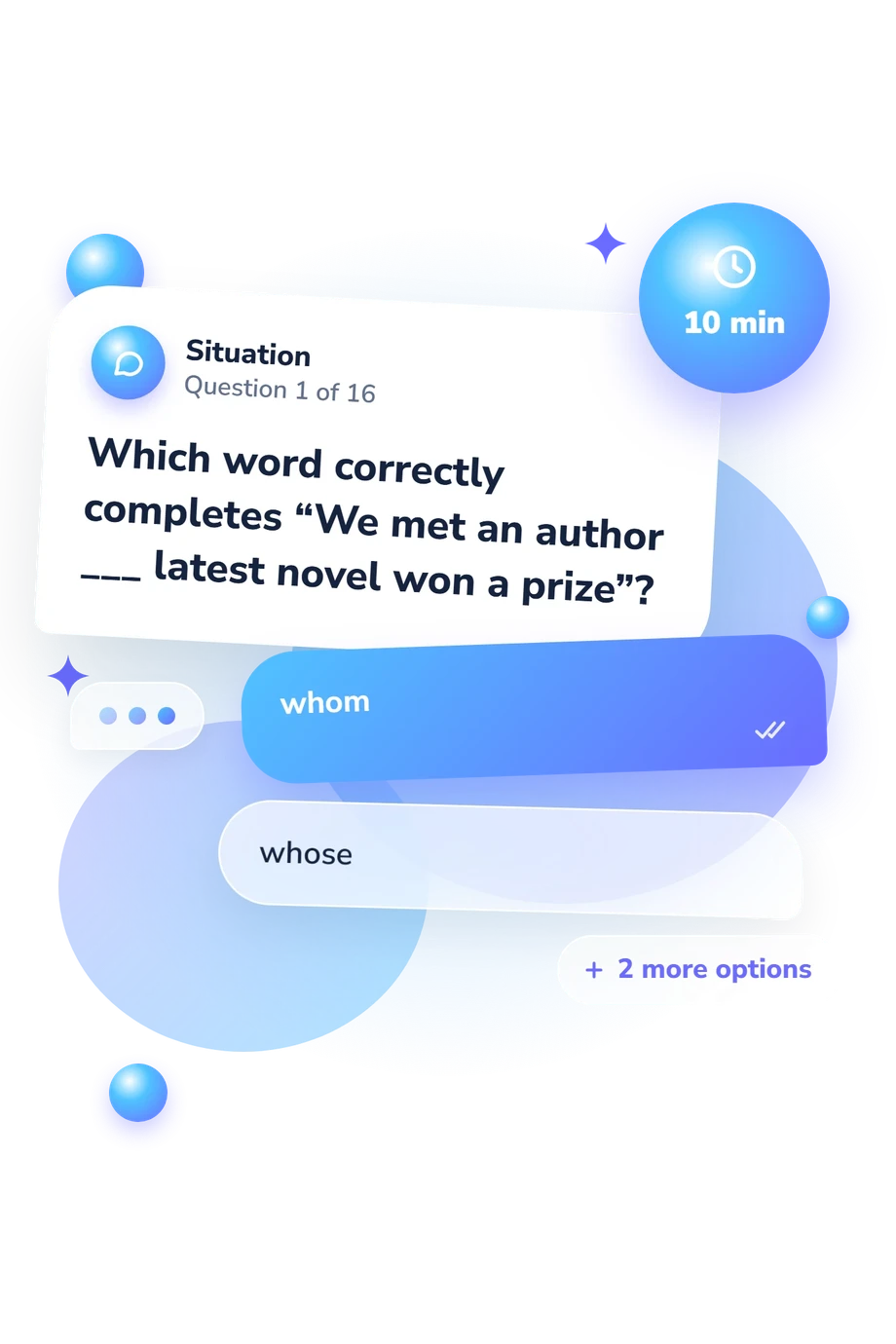
- whom
- whose
- who
- which
- Leo, who had been rescued from a warehouse, adopted a cat.
- Leo adopted a cat after he rescued the warehouse.
- Leo adopted a cat that had been rescued from a warehouse.
- The warehouse that adopted Leo had rescued a cat.
- The woman whom carrying the blue folder is our guide.
- The woman whose carrying the blue folder is our guide.
- The woman which is carrying the blue folder is our guide.
- The woman who is carrying the blue folder is our guide.
Adjective Clause Quiz - Description and methodology of the test
Students, teachers, and independent learners can use this assessment to examine how confidently they handle adjective clauses in real sentence contexts. For learners who want a focused grammar check, this adjective clause quiz shows whether relative words, clause roles, punctuation, and reduced forms are being applied accurately. As an adjective clause practice quiz, this assessment can guide review by separating secure skills from rules that need another look.
What This Assessment Measures
The questions examine choices that make an adjective clause grammatical and clear: selecting relative words, identifying clause function, separating essential from nonessential information, reducing clauses, and correcting unclear attachment. Together, these tasks show whether you can connect a clause to its antecedent while preserving meaning.
The result is Adjective Clause Knowledge, 0-16, with Foundations (0-6), Developing (7-12), and Strong (13-16). The bands describe increasing control of recognition, punctuation, and revision.
Four practical skill areas are represented:
- Relative-word choice shows whether you can match who, whom, whose, which, that, where, or when to the sentence.
- Clause identification shows whether you can distinguish an adjective clause from other subordinate clauses.
- Punctuation shows whether essential and extra information is marked accurately.
- Reduction and clarity show whether you can shorten clauses and avoid ambiguous attachment.
Use this adjective clause test result to target rules needing review.
Methodology and Evidence Base
The items present a sentence, a pair to combine, a clause to classify, or an editing decision with four choices. They test recognition and application across subject and object relatives, pronoun omission, punctuation, reduced clauses, and ambiguity. Some tasks ask you to preserve meaning while changing form or identify whether information is essential, so the format checks rule recognition and sentence-level judgment.
The questionnaire displays a knowledge result with an associated band, but the result description does not define how individual choices are converted into points.
The framework is conceptually consistent with the grammatical account of relative constructions and clause functions by Huddleston and Pullum. It also aligns with processing findings discussed by Traxler, Morris, and Seely concerning differences between subject and object relatives. These publications provide conceptual context; they do not validate or establish norms for this questionnaire, and the questionnaire is not claimed to be adapted from either work.
Self-administered results may reflect guessing, attention, familiarity with formal edited English, and current study context. Use the outcome to choose adjective clause exercises, not to represent overall writing ability.
- Huddleston, Rodney, and Geoffrey K. Pullum. “Relative Constructions and Unbounded Dependencies.” The Cambridge Grammar of the English Language, Cambridge University Press, 2002, pp. 1031-1096. DOI 10.1017/9781316423530.013.
- Traxler, Matthew J., Robin K. Morris, and Rachel E. Seely. “Processing Subject and Object Relative Clauses: Evidence from Eye Movements.” Journal of Memory and Language, vol. 47, no. 1, 2002, pp. 69-90. DOI 10.1006/jmla.2001.2836.
Updated: