
Am I Royalty Quiz
How the Scales are Structured
Who Usually Takes This Test?
See How You Compare
Below is a preview of how scores are typically distributed across each scale.
Example Questions From the Test
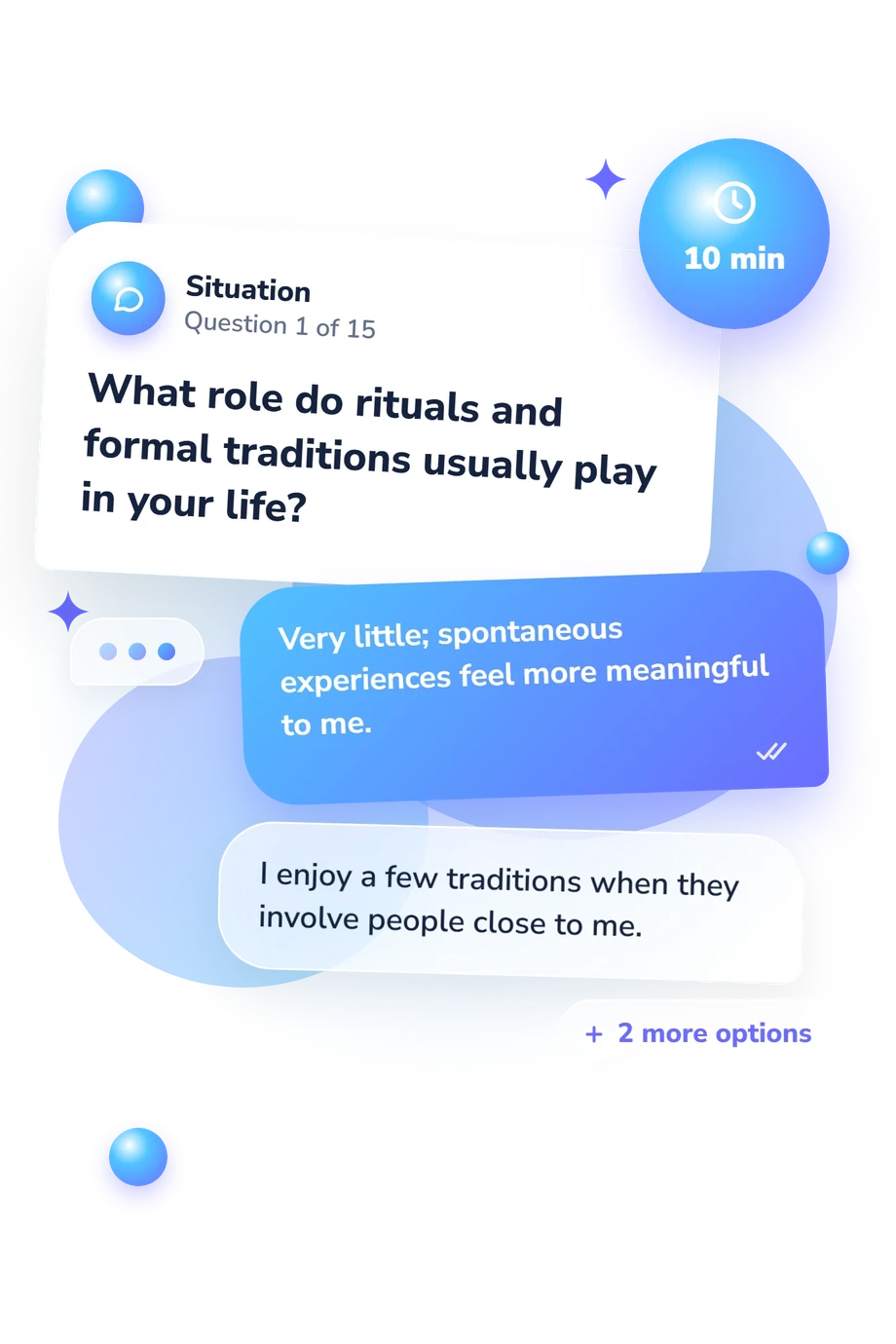
- Very little; spontaneous experiences feel more meaningful to me.
- I enjoy a few traditions when they involve people close to me.
- I value ceremonies that give important moments structure.
- I am deeply drawn to ritual, continuity, and the meaning carried by symbols.
- I would need meaningful benefits or experiences during my own involvement.
- The relationships I form while working on it would matter most.
- Visible milestones would help me stay committed to the eventual goal.
- Knowing that future people may benefit would be a strong reason to continue.
- Wear something comfortable that meets only the basic requirement.
- Add one themed detail while keeping the rest familiar.
- Create a polished outfit that clearly respects the occasion.
- Treat the clothing as part of the ceremony and plan every element intentionally.
Am I Royalty Quiz - Description and methodology of the test
People curious about whether their style feels royal can use the Am I Royalty Quiz as a playful reflection on social choices. It suits anyone exploring royal-style preferences and how they might respond when visibility, tradition, or responsibility enters the picture, without turning that curiosity into a claim about ancestry or rank.
What This Assessment Explores
The questions examine preferences for tactful influence, social awareness, ceremonial presentation, composure, stewardship, and continuity. Scenarios include traditions, formal occasions, negotiation, criticism, inherited resources, and duties that may outlast convenience. The result describes response patterns, not royal identity, rank, or leadership ability.
These are the three dimensions shown in the result:
- Diplomatic Influence (0-15) measures tact, social awareness, coalition-building, and influence through words: Direct Voice (0-5), Adaptive Envoy (6-10), or Courtly Diplomat (11-15).
- Royal Bearing (0-15) measures ceremony, visible composure, and intentional presentation: Informal Presence (0-5), Situational Presence (6-10), or Regal Presence (11-15).
- Stewardship and Duty (0-15) measures attraction to continuity, responsibility, service, and wider obligations: Personal Autonomy (0-5), Selective Steward (6-10), or Duty-Led Steward (11-15).
Across situations, the profile describes personality preferences associated with royalty, from independence and adaptation to a formal, duty-led style; mixed results are expected.
Methodology and Scientific Basis
Each item presents a social situation with four responses arranged from independent or informal choices to deliberate, relational, ceremonial, or duty-focused choices. This self-report format combines selections into the displayed dimensions. The exact weighting of individual responses is not specified, so the score ranges should not be used to infer a point schedule.
Conceptually, the questionnaire is consistent with Political Skill Inventory (Ferris et al., 2005), particularly social astuteness, interpersonal influence, networking, and apparent sincerity. Leary and Kowalski’s impression-management model helps frame the emphasis on composure and intentional presentation. Stewardship and Duty is conceptually consistent with stewardship theory described by Davis, Schoorman, and Donaldson (1997), where responsibility may extend beyond immediate self-interest. These connections identify related ideas; they do not make this questionnaire an adaptation of those published instruments.
The result is descriptive: read it as a pattern across situations rather than a single verdict. It has no stated population norms, reliability estimates, or clinical cutoffs. Current circumstances, self-awareness, and the wish to appear favorable can influence self-report, so this royal-themed self-reflection works best as a focused prompt.
- Ferris, Gerald R., Darren C. Treadway, Robert W. Kolodinsky, Wayne A. Hochwarter, Charles J. Kacmar, Ceasar Douglas, and Dwight D. Frink. "Development and Validation of the Political Skill Inventory." Journal of Management 31, no. 1 (2005): 126-152. 10.1177/0149206304271386
- Leary, Mark R., and Robin M. Kowalski. "Impression Management: A Literature Review and Two-Component Model." Psychological Bulletin 107, no. 1 (1990): 34-47. 10.1037/0033-2909.107.1.34
- Davis, James H., F. David Schoorman, and Lex Donaldson. "Toward a Stewardship Theory of Management." Academy of Management Review 22, no. 1 (1997): 20-47. 10.5465/amr.1997.9707180258
Updated: