
20 Question Quiz
How the Scales are Structured
Who Usually Takes This Test?
See How You Compare
Below is a preview of how scores are typically distributed across each scale.
Example Questions From the Test
- Aldous Huxley
- George Orwell
- Ray Bradbury
- H. G. Wells
- Egyptian hieroglyphs
- The Phoenician alphabet
- Mesopotamian cuneiform
- Norse runes
- 2 times
- 10 times
- 100 times
- 1,000 times
20 Question Quiz - Description and methodology of the test
People who want a focused check of broad knowledge can use the 20 question quiz to see how they handle familiar facts and short reasoning problems. It suits curious learners, students revising general topics, and anyone who wants a quiz that tests broad knowledge. The result can help identify subjects that deserve more attention.
What This Assessment Explores
The questionnaire samples broad knowledge rather than one school subject. Its general knowledge quiz questions cover evidence-based inference, cultural and historical recall, simple quantitative relationships, and principles from science, civics, technology, geography, economics, language, and art. The result gives learners and curious adults a compact indication of performance and possible topics for review.
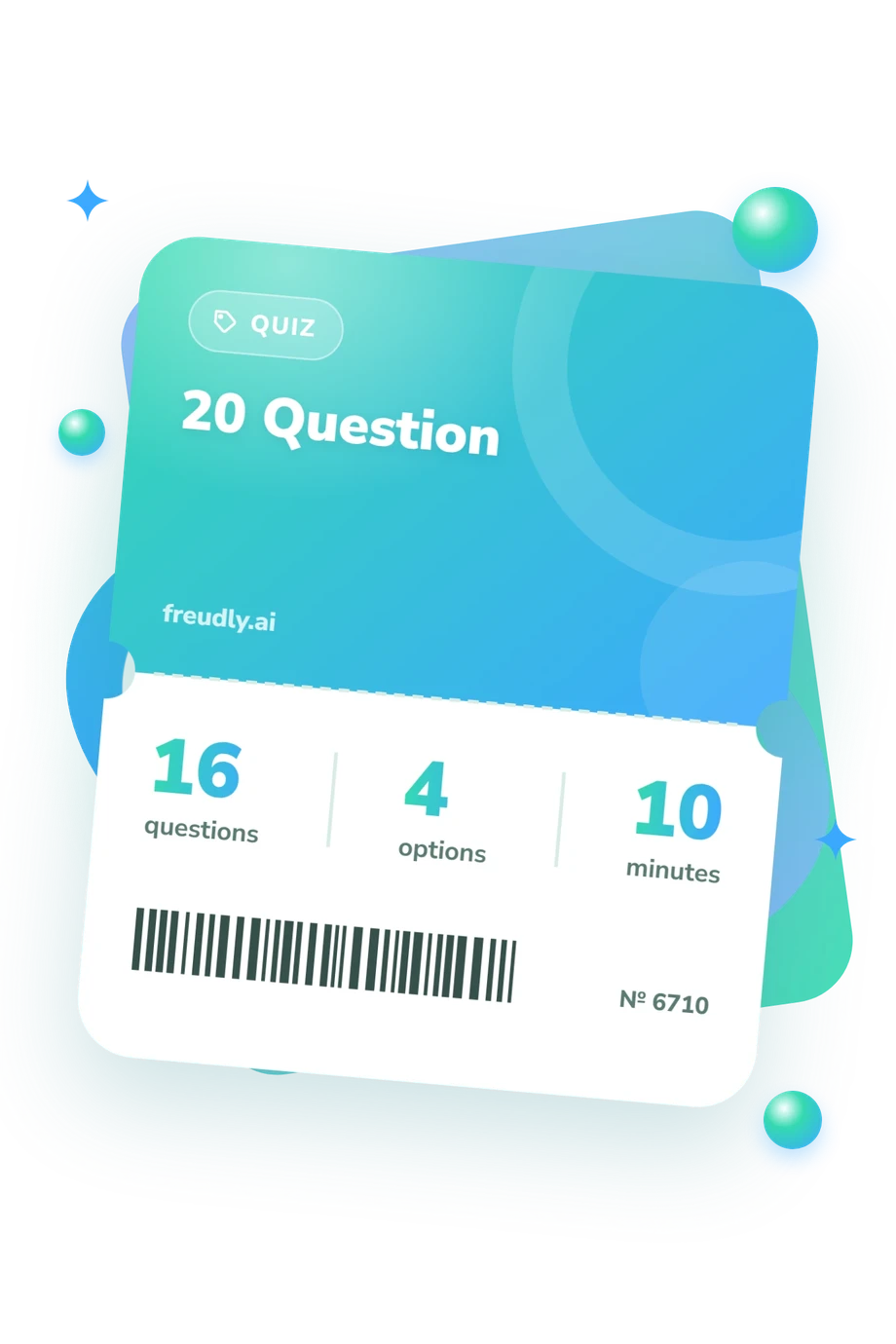
The assessment reports one scale, General Knowledge Knowledge (0-16), with three result bands:
- Building Foundations (0-6) indicates that you recognized some ideas while leaving many topics available to explore.
- Developing Range (7-12) shows a solid base across several subjects, although some gaps remain.
- Broad Knowledge (13-16) reflects strong recall and reasoning across this varied set.
Together, these bands describe performance on this trivia set, not a comprehensive measure of intelligence or education.
Methodology and Scientific Basis
Each item uses four-option multiple choice, and the respondent selects the best answer rather than rating a feeling or frequency. The score counts correct responses and can be read against the displayed bands without inferring an additional scoring rule.
A relevant comparison is the General Knowledge Test examined in the 2001 study by Irwing, Cammock and Lynn. The questionnaire is conceptually consistent with that work, but the cited study does not validate this online assessment. Furnham and Chamorro-Premuzic’s 2006 study connects general knowledge with individual differences in personality and intelligence, while the 2020 study by Martín-Luengo and colleagues shows how such questions can be assembled and normed in a specific language and population. Those studies provide context but do not establish population norms for this online assessment.
For self-reflection and topic selection, this online knowledge assessment is useful, but performance can shift with language, education, cultural familiarity, prior exposure, attention, and guessing. Read the displayed result as a brief snapshot of this question set.
- Paul Irwing, Tommy Cammock, and Richard Lynn. (2001). Some evidence for the existence of a general factor of semantic memory and its components. Personality and Individual Differences, 30(5), 857-871. 10.1016/S0191-8869(00)00078-7
- Adrian Furnham and Tomas Chamorro-Premuzic. (2006). Personality, intelligence and general knowledge. Learning and Individual Differences, 16(1), 79-90. 10.1016/j.lindif.2005.07.002
- Beatriz Martín-Luengo, Oksana Zinchenko, Maria Alekseeva, and Yury Shtyrov. (2020). Russian Norms for 500 General-Knowledge Questions. Frontiers in Psychology, 11, Article 545304. 10.3389/fpsyg.2020.545304
Updated: