
England Quiz
How the Scales are Structured
Who Usually Takes This Test?
See How You Compare
Below is a preview of how scores are typically distributed across each scale.
Example Questions From the Test
- Runnymede
- Canterbury
- Bosworth Field
- Hastings
- Wembley Stadium
- Lord’s Cricket Ground
- The All England Lawn Tennis and Croquet Club
- Twickenham Stadium
- Whitby
- Blackpool
- Dover
- Torquay
England Quiz - Description and methodology of the test
Curious learners who want a structured way to check their familiarity with England can use the England Quiz as a focused cultural knowledge check. It suits anyone interested in an England trivia quiz that links facts with places, public institutions, literature, and everyday traditions. The result gives an overall knowledge level, showing how the respondent performed across the questionnaire rather than reporting separate topic scores.
What This Assessment Explores
These questions make the test a quiz about England that examines recognition of places, institutions, historical events, and cultural references. The broad audience includes curious visitors, students, travelers, and readers checking general familiarity rather than one specialized subject.
The main thematic groups are:
- History links Magna Carta, Hastings, industrial change, and national traditions with key events and figures.
- Geography identifies cities, counties, borders, coastlines, and landmarks such as Bath, Dover, and Stonehenge.
- Institutions cover England’s place in the United Kingdom, the monarchy, and the Church of England.
- Culture includes literature, theatre, tennis, food, regional speech, and national symbols.
The England Knowledge scale runs from 0-16. Foundations (0-6) reflects partial recognition; Developing Knowledge (7-12) reflects a solid grasp with gaps; Strong Knowledge (13-16) reflects broad, accurate knowledge across the quiz’s cultural, historical, and geographical clues.
Methodology and Scientific Basis
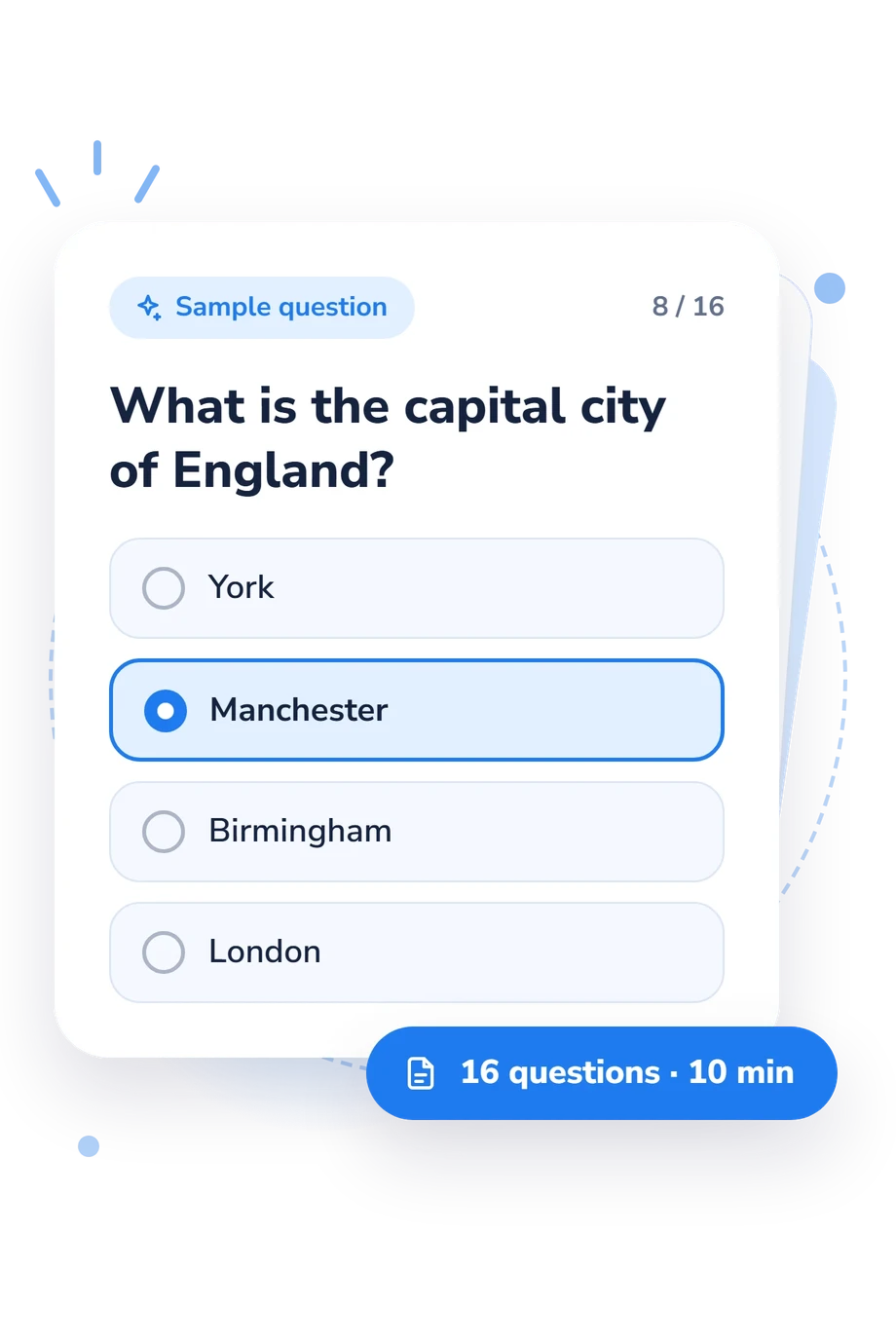
Sixteen multiple-choice items present four answer choices tied to a fact or situation. This England knowledge quiz reports one overall result rather than separate history, geography, and culture subscores. That structure suits broad self-checking, not one isolated ability.
The method is general-information assessment focused on declarative knowledge-facts that can be recognized or recalled. Nelson and Narens norms (1980) offer a reference for accuracy in general-information questions. Watrin, Schroeders, and Wilhelm (2023) place declarative knowledge within crystallized knowledge across countries, while the BEFKI GC-K study by Schipolowski and colleagues (2013) demonstrates a concise approach to measuring crystallized intelligence. This questionnaire is conceptually consistent with those approaches, not an adaptation of their instruments.
Read the bands descriptively: a higher result means stronger performance on sampled facts, not complete knowledge or fixed intelligence. The cited studies contextualize related knowledge constructs but do not norm or validate this questionnaire; its displayed bands are descriptive. Schooling, travel, media exposure, language familiarity, guessing, and topic selection can affect the result, so use it to guide further learning and self-reflection.
- Nelson, Thomas O., and Louis Narens. (1980). Norms of 300 general-information questions: Accuracy of recall, latency of recall, and feeling-of-knowing ratings. Journal of Verbal Learning and Verbal Behavior, 19(3), 338-368. 10.1016/S0022-5371(80)90266-2
- Watrin, Luc, Ulrich Schroeders, and Oliver Wilhelm. (2023). Gc at its boundaries: A cross-national investigation of declarative knowledge. Learning and Individual Differences, 102, 102267. 10.1016/j.lindif.2023.102267
- Schipolowski, Stefan, Oliver Wilhelm, Ulrich Schroeders, Anastassiya Kovaleva, Christoph J. Kemper, and Beatrice Rammstedt. (2013). BEFKI GC-K: A Short Scale for the Measurement of Crystallized Intelligence. Methods, Data, Analyses, 7(2), 153-181. 10.12758/mda.2013.010
Updated: