
1 Corinthians Quiz
How the Scales are Structured
Who Usually Takes This Test?
See How You Compare
Below is a preview of how scores are typically distributed across each scale.
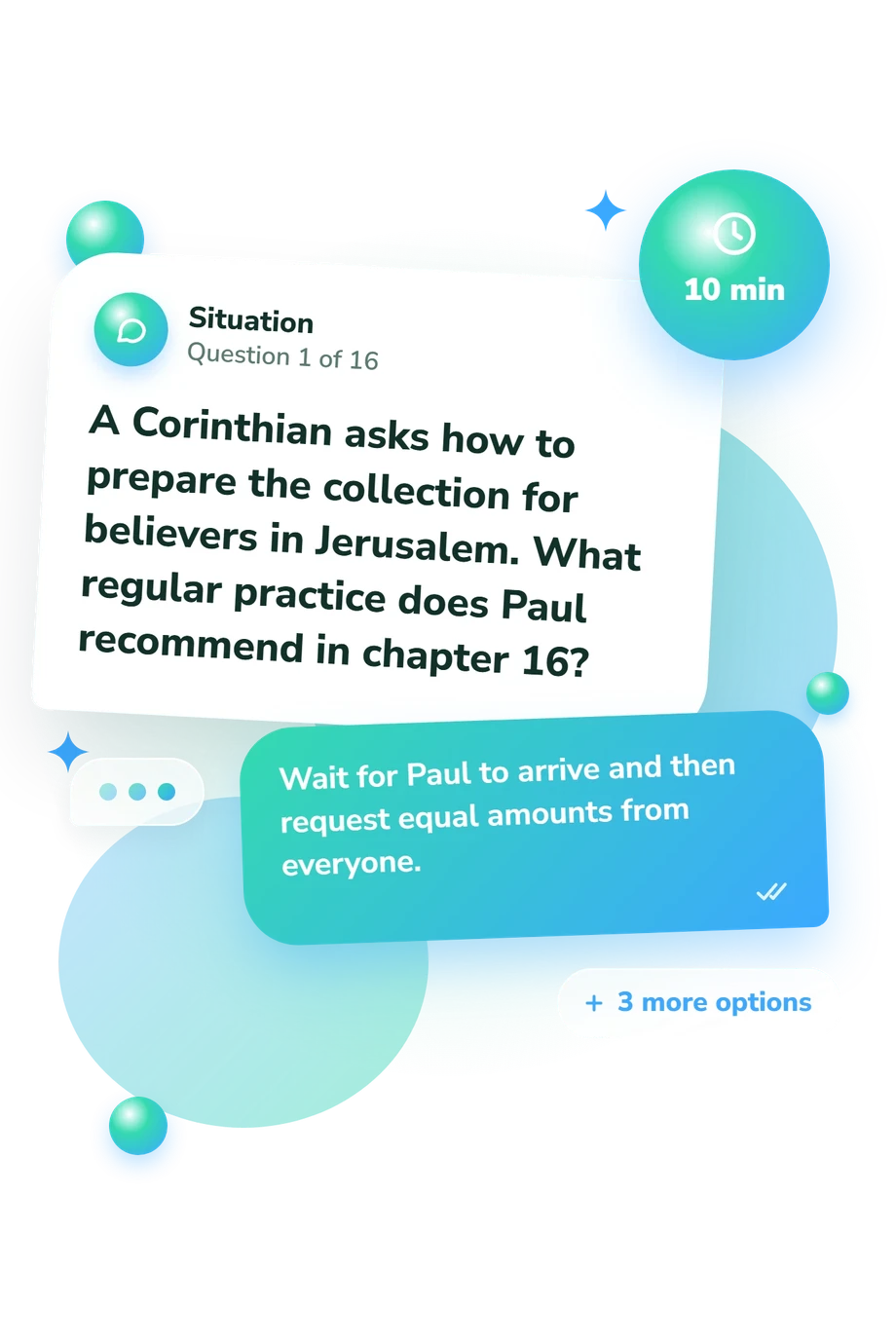
Example Questions From the Test
- He argues that education has no value for anyone who follows Christ.
- He says what appears foolish in God’s work is wiser than human wisdom, focusing especially on the message of the cross.
- He teaches that persuasive speaking is the clearest evidence of divine wisdom.
- He presents secret philosophical knowledge as the foundation of the gospel.
- It is sown invisible and raised visible.
- It is sown perishable and raised imperishable.
- It is sown complete and raised unfinished.
- It is sown heavenly and raised earthly.
- Adam
- Christ
- Cephas
- Paul
1 Corinthians Quiz - Description and methodology of the test
For readers who want to examine how well they understand Paul’s letter, this 1 Corinthians Quiz offers a focused review of its arguments, images, ethical guidance, and teaching about the church. It suits study, rereading, or checking recall after reading the letter with a quiz on 1 Corinthians. The result places overall quiz performance in a band that can guide further reading without measuring spiritual maturity or theological authority.
What This Assessment Explores
The questions move across the letter’s major concerns rather than testing isolated vocabulary. They ask readers to recognize Paul’s challenge to human wisdom, his teaching on unity and spiritual gifts, the responsibilities of communal worship, ethical decisions involving sexuality, lawsuits, conscience, generosity, and the resurrection. The 1 Corinthians Bible Quiz asks readers to connect doctrine, conduct, and the life of a divided congregation.
The result is reported on the 1 Corinthians Knowledge scale (0-16), with three result bands:
- Foundations to revisit (0-6) indicates that some themes are recognized, while chapter-by-chapter rereading may clarify the letter’s setting and arguments.
- Developing understanding (7-12) shows a solid grasp of many central teachings, with room to connect details across the letter.
- Strong understanding (13-16) reflects accurate recognition of major themes and their application in context.
Methodology and Evidence Base
Each item uses a multiple-choice format with four answer options. The alternatives test recognition of passages, contrasts, images, instructions, and conclusions, so the task depends on reading comprehension and contextual recall rather than agreement with Paul. The displayed result reports performance on this quiz against the 0-16 bands shown to the reader, reflecting recognition of the passages and ideas represented by the questions.
Its content is conceptually consistent with Ciampa and Rosner (2010), whose commentary helps situate the letter’s arguments, and with Thiselton’s 2000 commentary on its Greek text. Sider’s 1975 study addresses the resurrection-body questions, while the 2021 updated English translation supplies the biblical wording. The questionnaire is not an adaptation of any one of these works; the sources provide contextual reference points, and the quiz is conceptually consistent with them as a direct knowledge assessment.
For readers choosing a bible quiz about Corinthians, the result can indicate which chapters or themes deserve closer study, including the relationship between belief and conduct. Performance may vary with wording familiarity, attention, and current knowledge, so a score is best read as a snapshot of recall rather than a full account of the reader’s understanding.
- Ciampa, Roy E., and Brian S. Rosner. The First Letter to the Corinthians. The Pillar New Testament Commentary. Grand Rapids, MI: Wm. B. Eerdmans Publishing Co., 2010.
- Sider, Ronald J. “The Pauline Conception of the Resurrection Body in I Corinthians XV. 35-54.” New Testament Studies 21, no. 3 (1975): 428-439. 10.1017/S002868850000967X.
- National Council of the Churches of Christ in the United States of America. New Revised Standard Version Updated Edition. 2021.
- Thiselton, Anthony C. The First Epistle to the Corinthians: A Commentary on the Greek Text. New International Greek Testament Commentary. Grand Rapids, MI: Wm. B. Eerdmans Publishing Co., 2000.
Updated: