
Abnormal Psychology Quiz
How the Scales are Structured
Who Usually Takes This Test?
See How You Compare
Below is a preview of how scores are typically distributed across each scale.
Example Questions From the Test
- A case formulation
- A laboratory reliability coefficient
- A list of symptoms without an explanatory framework
- A prevalence estimate
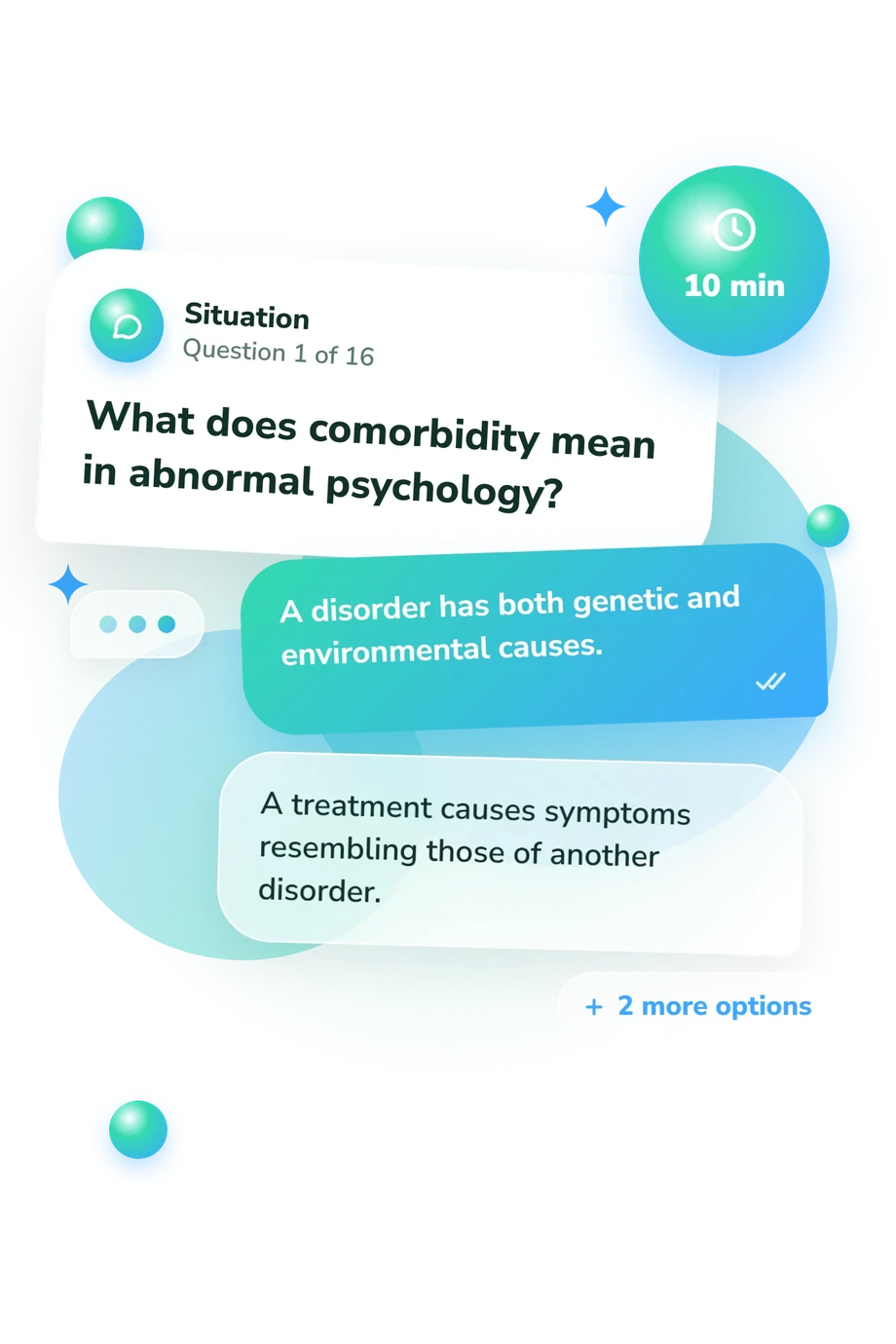
- A disorder has both genetic and environmental causes.
- A treatment causes symptoms resembling those of another disorder.
- One symptom appears in several different diagnostic criteria sets.
- Two or more disorders or clinically relevant conditions occur in the same person.
- Self-reported symptoms can never be used in treatment research.
- A treatment can only be effective if every participant becomes symptom-free.
- Eight weeks is too short to study any change in depressive symptoms.
- Without an appropriate comparison, improvement could reflect time, expectations, or other influences.
Abnormal Psychology Quiz - Description and methodology of the test
Students, trainees, and curious readers can use the abnormal psychology quiz for an overall estimate of their understanding of concepts used to describe, assess, and research psychological disorders. This abnormal psych quiz presents concept-based questions rather than asking for personal symptom disclosure. The items cover diagnostic distinctions, research quality, cultural context, treatment principles, and risk-sensitive assessment.
What This Assessment Explores
The questionnaire examines whether a reader can apply foundational abnormal-psychology concepts to brief clinical, cultural, and research situations. This questionnaire is an abnormal psychology test for learners who want to judge how context, impairment, evidence, and timing change interpretation.
These themes show what the knowledge result reflects:
- Case formulation and assessment connect symptoms with history, stressors, supports, medical factors, and functional impact.
- Diagnosis and classification distinguish obsessions, compulsions, negative symptoms, comorbidity, mania, and hypomania.
- Research and measurement clarify prevalence, sensitivity, interrater reliability, comparison groups, and causal limits.
- Treatment and safety address exposure-based learning, culturally responsive judgment, and responses to possible suicide risk.
A stronger result suggests broader command of the concepts represented here; a lower band can prompt review of the concepts covered by the questions.
Methodology and Evidence Base
Each item presents a short prompt with four answer choices, and the respondent selects the option that best fits the concept or scenario. The format samples recognition and application: it asks the reader to distinguish related terms, judge evidence, and identify a defensible assessment response.
Results are reported on the Abnormal Psychology Knowledge scale (0-16): Foundations to build (0-6), Developing knowledge (7-12), or Strong knowledge (13-16). These are unvalidated educational bands, not clinical cutoffs. Reviewing the abnormal psychology questions can help learners turn a broad score into a practical revision plan.
The content is conceptually consistent with Hooley, Butcher, Nock, and Mineka (2017), while terminology and diagnostic distinctions align with the DSM-5-TR. Its biopsychosocial framing is also consistent with Engel’s (1977) model. These sources support the concepts presented; they do not make this questionnaire a standardized adaptation of their work.
Interpretation is limited by the selected topics, multiple-choice wording, prior study, attention, and test-taking strategy. The score cannot assess an individual’s mental health; actual symptoms or safety concerns require qualified assessment and, when danger is immediate, urgent local help.
- Hooley, Jill M., Butcher, James N., Nock, Matthew K., and Mineka, Susan. (2017). Abnormal Psychology (17th ed.). Pearson.
- American Psychiatric Association. (2022). Diagnostic and Statistical Manual of Mental Disorders, Fifth Edition, Text Revision (DSM-5-TR). American Psychiatric Association Publishing. DOI 10.1176/appi.books.9780890425787.
- Engel, George L. (1977). The need for a new medical model: A challenge for biomedicine. Science, 196(4286), 129-136. DOI 10.1126/science.847460.
Updated: