
2000s Movie Quiz
How the Scales are Structured
Who Usually Takes This Test?
See How You Compare
Below is a preview of how scores are typically distributed across each scale.
Example Questions From the Test
- Linguini
- Gusteau
- Emile
- Remy
- Matt Damon
- Daniel Craig
- Clive Owen
- Christian Bale
- Spain under the early Franco regime
- France during World War I
- Italy during the Renaissance
- Mexico during its revolution
2000s Movie Quiz - Description and methodology of the test
For viewers deciding whether a decade-focused knowledge assessment suits their interests, the 2000s movie quiz assesses knowledge of films, actors, characters, and story worlds from the 2000s. It suits casual film fans considering a decade film quiz that covers popular and critically discussed releases. A broad spread of titles and details helps you judge whether this assessment matches the knowledge you want to test.
What This Assessment Explores
The questionnaire measures knowledge of 2000s films, accessed through factual recall, not personal taste. It suits casual film fans checking recognition of actors, characters, directors, plots, settings, genres, and story details across varied releases. The result reflects breadth and accuracy of film knowledge.
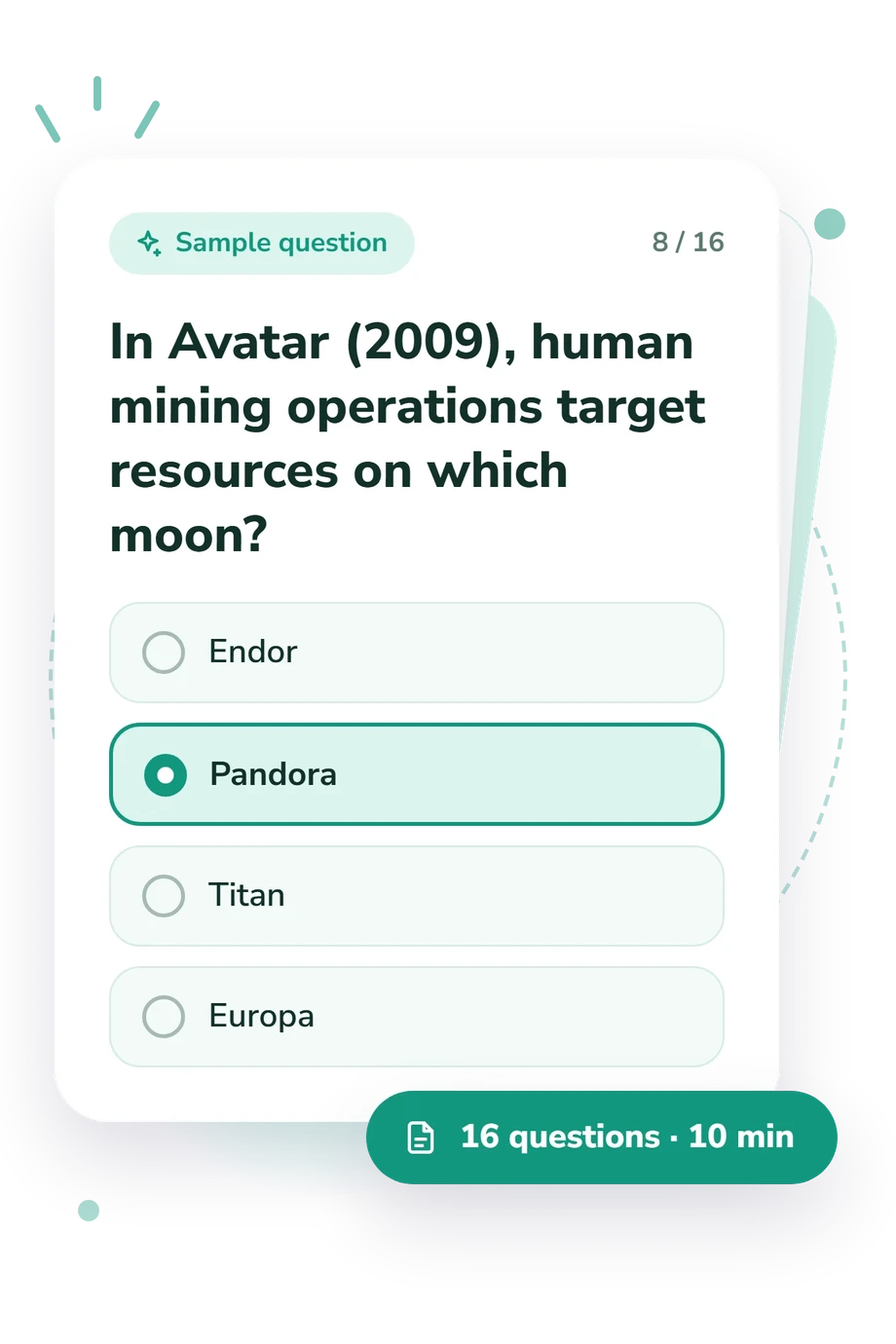
Each item presents four answer choices, making the questionnaire a focused check of 2000s film knowledge. Prompts describe scenes or ask directly about titles, performers, filmmakers, contexts, and narrative facts.
The questions sample these areas:
- Character and film recognition shows whether memorable figures are linked to the right movie.
- Plot and premise recognition shows whether central events and relationships are connected to the right titles.
- Filmmaking, genre, and setting knowledge reflects recognition of creators, categories, places, and historical worlds.
The result appears as 2000s Movie Knowledge (0-16): Foundation (0-6), Developing (7-12), or Standout (13-16).
Methodology and Evidence Base
This online questionnaire uses four-option, selected-response items testing recognition and recall rather than personal preference. The questionnaire reports the displayed knowledge scale, with its catalogue-defined bands organizing interpretation rather than functioning as clinical thresholds.
Corrigan (2012) provides limited context on 2000s American cinema, linking genres, themes, industrial contexts, and filmmaking practices. Because this questionnaire also includes international films, that work is background for its range, not evidence that it measures or validates the displayed knowledge scale. Bordwell, Thompson, and Smith provide complementary distinctions among genre, narrative, style, and production.
Furman and colleagues (2007) examined memory for one extended audiovisual narrative, so it offers limited context for why a respondent may recognize some film details and miss others; it does not validate decade-wide film knowledge or this questionnaire's scoring. The result is therefore a snapshot of remembered knowledge at completion.
Results may shift with recent viewing, cultural exposure, guessing, and uneven familiarity with genres or regions. This 2000s cinema quiz offers self-reflection about a specific knowledge sample, but one score cannot capture every aspect of film expertise.
- Corrigan, Timothy, editor, with contributions by Anna Everett, Sharon Willis, Thomas Schatz, Linda Ruth Williams, Dina Smith, Bob Rehak, Nora Alter, Nigel Morris, Karen Beckman, and Dana Polan. American Cinema of the 2000s: Themes and Variations. Rutgers University Press, 2012. 10.36019/9780813553238
- Furman, Orit, Nimrod Dorfman, Uri Hasson, Lila Davachi, and Yadin Dudai. "They Saw a Movie: Long-Term Memory for an Extended Audiovisual Narrative." Learning & Memory, vol. 14, no. 6, 2007, pp. 457-467. 10.1101/lm.550407
- Bordwell, David, Kristin Thompson, and Jeff Smith. Film Art: An Introduction. 12th ed., McGraw-Hill Education, 2019.
Updated: