
Video Game SFX Quiz
How the Scales are Structured
Who Usually Takes This Test?
See How You Compare
Below is a preview of how scores are typically distributed across each scale.
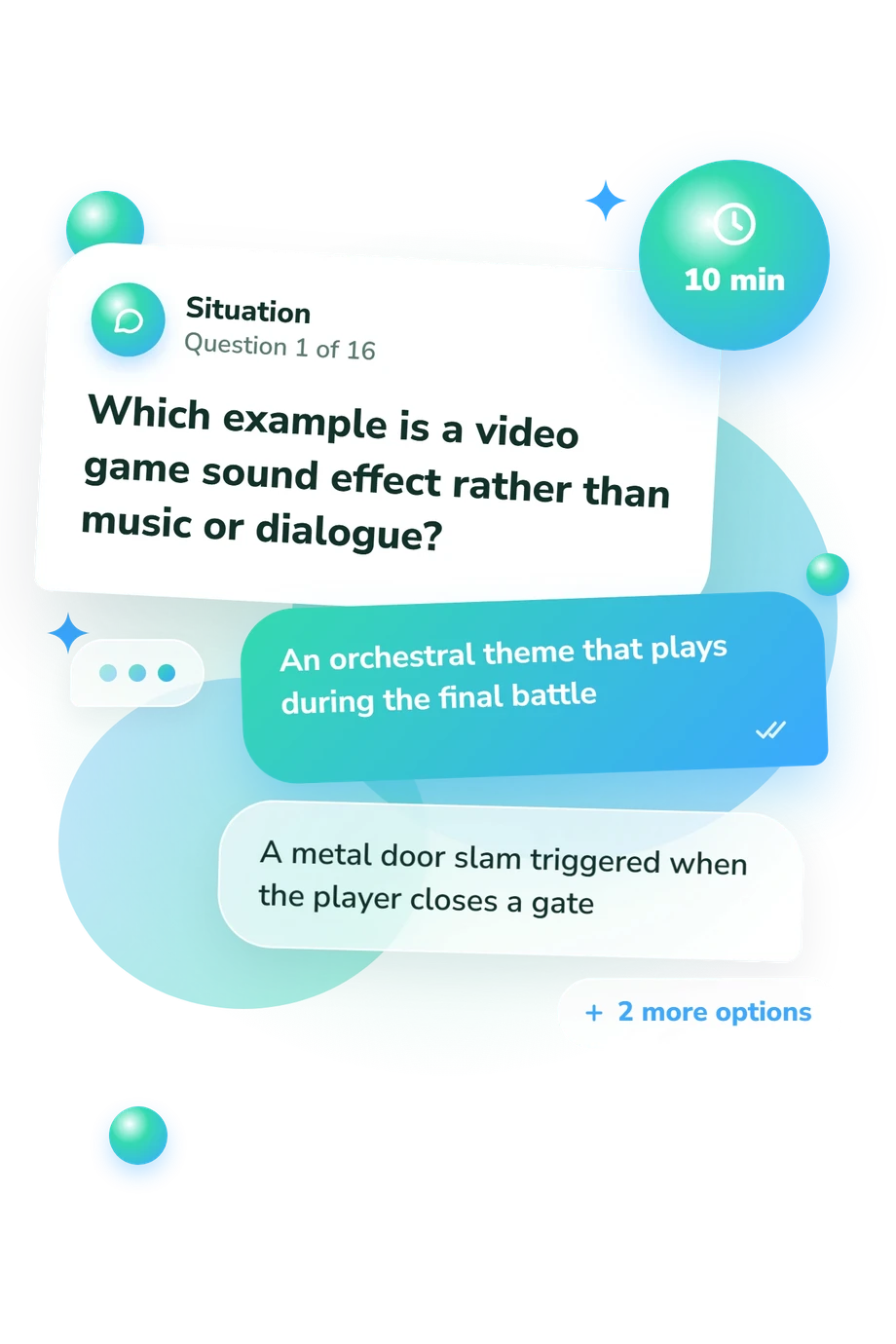
Example Questions From the Test
- An orchestral theme that plays during the final battle
- A metal door slam triggered when the player closes a gate
- A narrator explaining the mission objective
- A character speaking during a conversation scene
- Foley recording
- Audio mastering
- Automated dialogue replacement
- Sidechain compression
- Phase cancellation
- Frequency masking
- Reverberation buildup
- Clipping
Video Game SFX Quiz - Description and methodology of the test
Designed for players, hobbyists, students, and aspiring sound designers, this video game sfx quiz checks whether you can connect interactive audio problems with practical solutions. It offers a focused way to gauge overall SFX knowledge and use the broad subjects represented by the questions to guide further study. People curious about how effects support action, feedback, atmosphere, and player understanding can use this videogame SFX quiz to assess their game-audio knowledge.
What This Assessment Explores
The questions connect audible outcomes with production and implementation choices, so this video game sound effects quiz tests practical game-audio knowledge. It is suited to people building familiarity with interactive audio, regardless of whether they are learning independently or considering game-audio work. The result describes current knowledge of common SFX decisions rather than taste or broad musical ability.
The result uses one scale, Video Game SFX Knowledge (0-16), with Foundations to Build (0-6), Developing Knowledge (7-12), and Strong SFX Knowledge (13-16). Together, the questions cover these practical areas:
- Sound-effect fundamentals show how Foley, clipping, looping, and layered impacts shape a convincing result.
- Mixing and dynamics show how loudness, masking, ducking, and reduced-dynamic-range playback affect clarity.
- Spatialization, implementation, and accessibility show how timing, surfaces, distance, interface presentation, and alternative cues support play.
Methodology and Evidence Base
Each item presents a game-audio problem with four answer choices. The alternatives distinguish concepts such as clipping, occlusion, latency, attenuation, diegetic sound, and accessibility cues, so the respondent must choose the most appropriate production or implementation decision. The themes move from recording and editing through mixing, event timing, spatial behavior, and player feedback.
Responses are condensed into one result rather than separate trait scores. The approach is conceptually consistent with Stevens and Raybould (2011), whose practical guide addresses game-sound creation and interactive implementation; this questionnaire is not adapted from that work. Collins (2008) supports the technical and expressive treatment of game sound, while Guillen, Jylhä, and Hassan (2021) provide context for inclusion and accessibility.
This game sound effects test produces one descriptive result for performance on these questions. It does not present a reference-population comparison, so the score shows how the respondent handled this set rather than a population standing. Familiarity with production terms, guessing, attention, and listening conditions can affect the outcome, so missed concepts are best used to choose practice in listening, implementation, and feedback.
- Stevens, Richard, and Dave Raybould. The Game Audio Tutorial: A Practical Guide to Sound and Music for Interactive Games. Focal Press, 2011.
- Guillen, Georgina, Henrietta Jylhä, and Lobna Hassan. The Role Sound Plays in Games: A Thematic Literature Study on Immersion, Inclusivity and Accessibility in Game Sound Research. In Academic Mindtrek 2021-Proceedings of the 24th International Academic Mindtrek Conference, 12-20. ACM, 2021. 10.1145/3464327.3464365.
- Collins, KC. Game Sound: An Introduction to the History, Theory, and Practice of Video Game Music and Sound Design. MIT Press, 2008.
Updated: