
Animal Classification Quiz
How the Scales are Structured
Who Usually Takes This Test?
See How You Compare
Below is a preview of how scores are typically distributed across each scale.
Example Questions From the Test
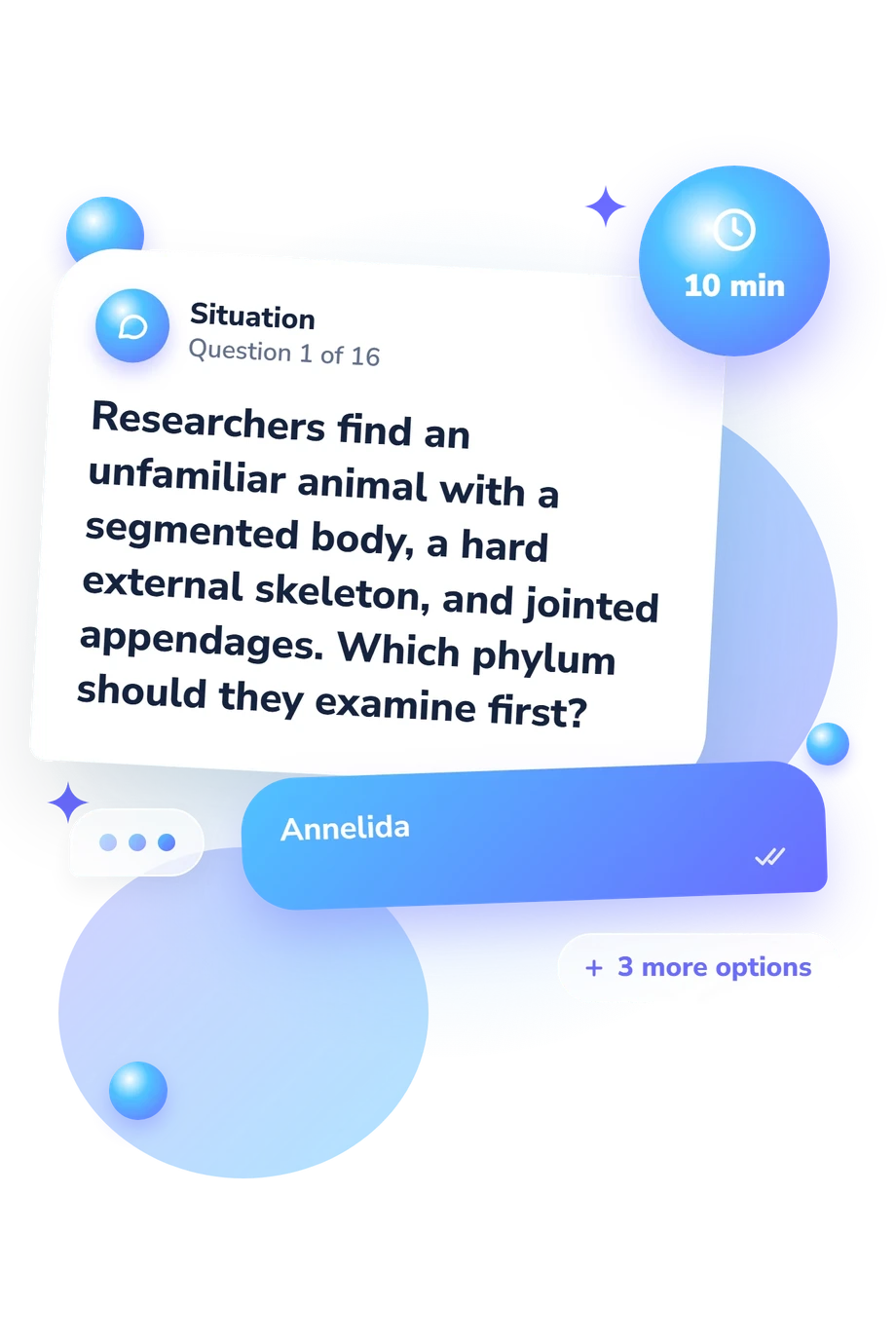
- Arthropoda
- Cnidaria
- Mollusca
- Echinodermata
- Having forelimbs adapted as wings
- Laying shelled eggs
- Maintaining a relatively stable internal body temperature
- Feathers
- Amphibia
- Reptilia
- Chondrichthyes, the cartilaginous fishes
- Mammalia
Animal Classification Quiz - Description and methodology of the test
For students, teachers, and curious readers, this animal classification quiz provides a focused way to check how confidently they connect animal features with taxonomic groups. It is designed for a quick learning snapshot, not an exhaustive examination of zoology. An animal taxonomy quiz of this kind can turn familiar examples into a structured profile and suggest topics that deserve further study.
What This Assessment Explores
This questionnaire tests whether you can use observable and biological evidence to place animals into appropriate taxonomic groups. It covers major invertebrate phyla and vertebrate classes, including mammals, birds, reptiles, amphibians, and fishes.
Questions also examine taxonomic hierarchy, binomial names, and the difference between superficial similarity and inherited relationships. Framed as a classification of animals quiz, it asks you to reason from body coverings, appendages, symmetry, reproduction, and DNA evidence.
It suits learners reviewing introductory biology and readers who want a concise profile of their current knowledge. Results appear on the Animal Classification Knowledge scale, which runs from 0-16. The displayed bands are:
- Building Foundations (0-6) indicates that basic traits need reinforcement.
- Developing Classifier (7-12) shows that familiar examples are often classified correctly.
- Strong Knowledge (13-16) reflects accurate links among traits, taxonomy, and evolution.
Together, the bands suggest where further biology review may be most useful.
Methodology and Scientific Basis
Each item presents a short biological scenario or concept with four answer choices. You select the classification that best fits evidence such as an exoskeleton, a water vascular system, feathers, hair, gills, or amniotic eggs. Other items test taxonomic order, scientific names, and the difference between superficial similarity and shared ancestry.
The result is a total across the multiple-choice questions; higher totals indicate more accurate classification of the tested examples. As an animal classification test, it is an online educational self-assessment rather than a published norm-referenced instrument, so its bands describe performance on this question set, not standing in a representative population.
Hickman et al. (2021) provides the core zoological framework for the groups and traits addressed here. The emphasis on evolutionary relationships is conceptually consistent with Field et al. (1988), which used molecular evidence to examine animal phylogeny, and Aguinaldo et al. (1997), which examined a major moulting-animal clade. This questionnaire is not presented as an adaptation of those works.
Interpretation is strongest when the result is treated as a snapshot of recall and application. Guessing, attention, and recent study can influence performance, so it cannot establish the full breadth of biological knowledge.
- Hickman, Cleveland P., Jr., Susan L. Keen, Allan Larson, and David J. Eisenhour. Animal Diversity. 9th ed. New York: McGraw Hill, 2021.
- Field, K. G., G. J. Olsen, D. J. Lane, S. J. Giovannoni, M. T. Ghiselin, E. C. Raff, N. R. Pace, and R. A. Raff. “Molecular phylogeny of the animal kingdom.” Science 239, no. 4841 Pt 1 (1988): 748-753. 10.1126/science.3277277.
- Aguinaldo, A. M., J. M. Turbeville, L. S. Linford, M. C. Rivera, J. R. Garey, R. A. Raff, and J. A. Lake. “Evidence for a clade of nematodes, arthropods and other moulting animals.” Nature 387, no. 6632 (1997): 489-493. 10.1038/387489a0.
Updated: