
Visual Weight Quiz
How the Scales are Structured
Who Usually Takes This Test?
See How You Compare
Below is a preview of how scores are typically distributed across each scale.
Example Questions From the Test
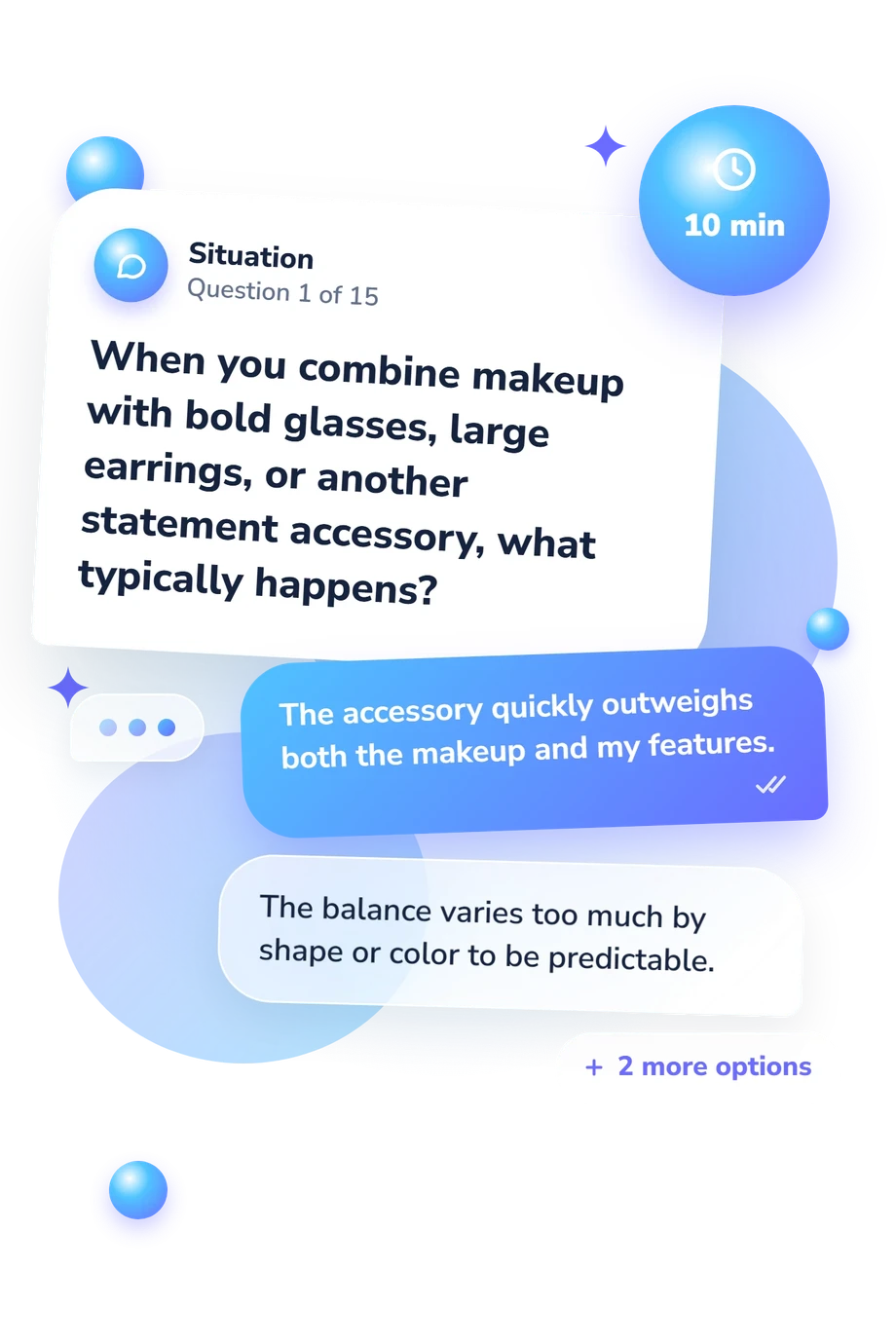
- The accessory quickly outweighs both the makeup and my features.
- The balance varies too much by shape or color to be predictable.
- The accessory becomes the focus, but my features remain present.
- The statement piece coexists with my features and does not automatically take over.
- Complete and naturally polished without further definition.
- Sometimes complete and sometimes unfinished, depending on the setting.
- Pleasantly understated, though one defined element would improve the balance.
- Visually unfinished until I add deeper color or clearer definition.
- A very sheer application with almost no visible definition.
- A moderate application with softly defined eyes, cheeks, or lips.
- A bold application with clear contrast across several features.
- Anything from light to bold can work, but the exact colors matter more than intensity.
Visual Weight Quiz - Description and methodology of the test
People choosing makeup, eyewear, or jewelry can use this styling reflection to examine how much definition feels integrated with their features. The visual weight quiz is intended for anyone curious about whether softer, balanced, or bolder choices create the most cohesive impression. This visual weight test turns everyday reactions into a comparative profile that can guide experimentation without treating appearance as fixed.
What This Assessment Explores
Across the items, this visual weight assessment examines how definition, contrast, and styling intensity interact. Questions cover black liner, saturated lipstick, statement accessories, sheer makeup, feature prominence, visible lines, lighting, distance, and needed adjustments.
The three result dimensions are:
- High Visual Weight Affinity (0-15) measures affinity with pronounced definition and stronger contrast, with Limited affinity (0-5), Mixed affinity (6-10), and Strong affinity (11-15).
- Medium Visual Weight Affinity (0-15) reflects affinity with moderate definition, balanced prominence, and adjustable intensity, with Limited affinity (0-5), Mixed affinity (6-10), and Strong affinity (11-15).
- Low Visual Weight Affinity (0-15) measures affinity with soft contrast, delicate definition, and lighter styling, with Limited affinity (0-5), Mixed affinity (6-10), and Strong affinity (11-15).
The highest score is the strongest affinity; scores within one point suggest a blend.
Methodology and Scientific Basis
Each item presents four response options describing different reactions to intensity, balance, or definition. Choosing the closest description lets the questionnaire compare patterns across the three affinities; the result is comparative rather than a rule assigning a universal amount of makeup. The visual weight profile compares the three scores; scores within one point indicate a blended result.
Etcoff et al. (2011) is the closest conceptual anchor: its research shows that cosmetics can modulate the perception of facial signals. Russell (2009) connects cosmetics with facial contrast, Jones et al. (2018) examine apparent changes in feature size, and Porcheron et al. (2017) place facial contrast in a broader perceptual context. The questionnaire is conceptually consistent with these findings; it is not an adaptation of them and has not been validated by those studies.
This is an unvalidated styling reflection, so its bands function as interpretive categories rather than standardized population norms. Self-report can also be influenced by current preferences, makeup familiarity, lighting, and self-awareness. Use the profile to compare styling experiments and notice which levels of definition feel most cohesive.
- Etcoff, N. L., Stock, S., Haley, L. E., Vickery, S. A., & House, D. M. (2011). Cosmetics as a Feature of the Extended Human Phenotype: Modulation of the Perception of Biologically Important Facial Signals. PLOS ONE, 6(10), e25656. 10.1371/journal.pone.0025656
- Russell, R. (2009). A Sex Difference in Facial Contrast and its Exaggeration by Cosmetics. Perception, 38(8), 1211-1219. 10.1068/p6331
- Jones, A. L., Porcheron, A., & Russell, R. (2018). Makeup Changes the Apparent Size of Facial Features. Psychology of Aesthetics, Creativity, and the Arts, 12(3), 359-368. 10.1037/aca0000152
- Porcheron, A., Mauger, E., Soppelsa, F., Liu, Y., Ge, L., Pascalis, O., Russell, R., & Morizot, F. (2017). Facial Contrast Is a Cross-Cultural Cue for Perceiving Age. Frontiers in Psychology, 8, 1208. 10.3389/fpsyg.2017.01208
Updated: