
Helen Fisher Quiz
How the Scales are Structured
Who Usually Takes This Test?
See How You Compare
Below is a preview of how scores are typically distributed across each scale.
Example Questions From the Test
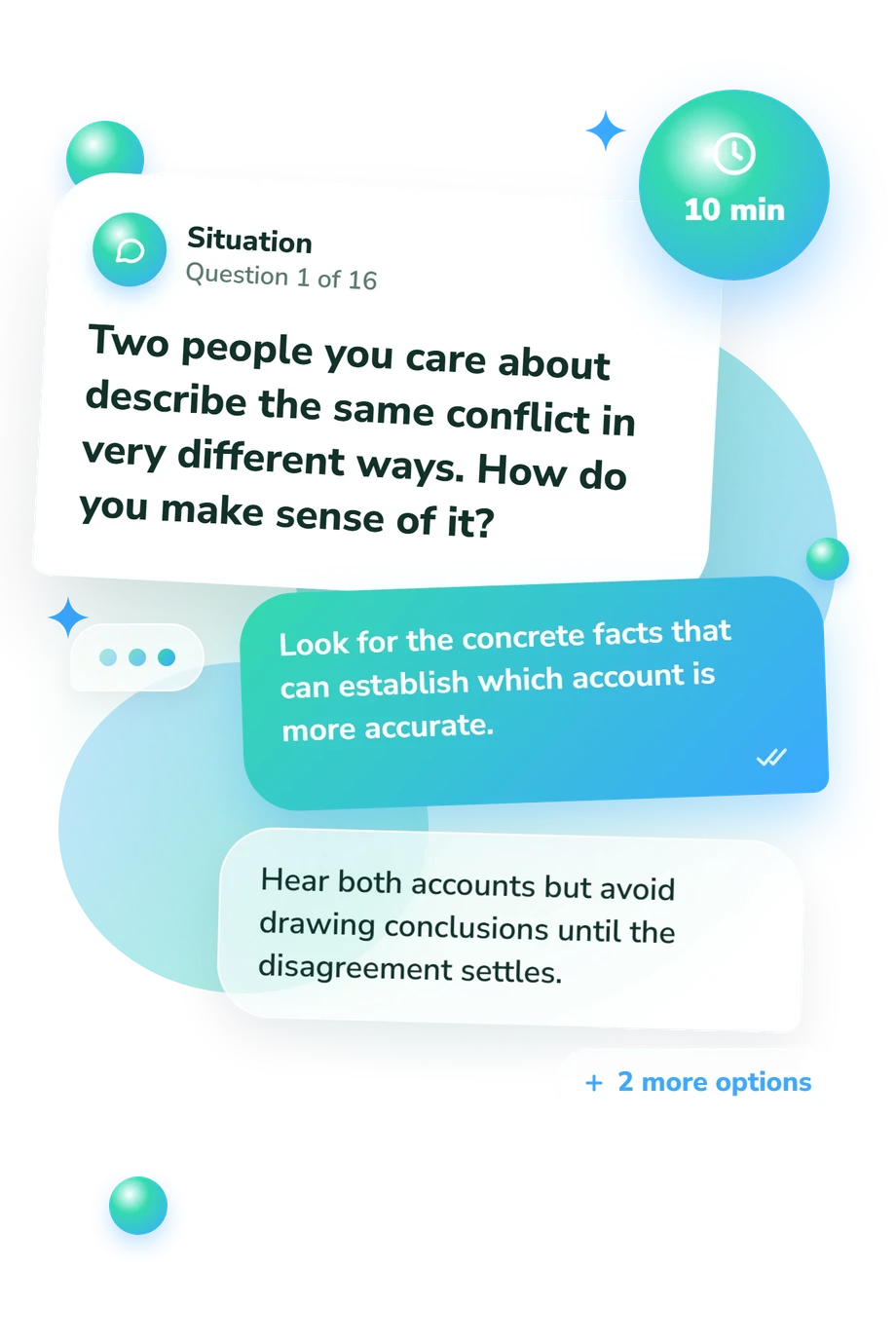
- Look for the concrete facts that can establish which account is more accurate.
- Hear both accounts but avoid drawing conclusions until the disagreement settles.
- Consider how each person’s expectations may have shaped their version.
- Hold both perspectives in mind and trace the emotions, history, and meanings behind them.
- Let the group talk longer so concerns and ideas can continue to surface.
- Take on one manageable task while others determine the overall direction.
- Clarify the main problem and suggest a practical sequence of steps.
- Separate the essential from the irrelevant, set priorities, and drive a decision.
- Whether the efficiency gain clearly serves the larger objective.
- Whether a small adjustment could address the concern without changing the decision.
- How the person’s experience may affect trust and cooperation afterward.
- How to reshape the decision so practical needs and the person’s perspective are meaningfully integrated.
Helen Fisher Quiz - Description and methodology of the test
For readers reflecting on decisions, relationships, and group situations, the Helen Fisher Quiz offers a structured way to examine recurring preferences rather than right or wrong answers. Its profile can show one leading affinity or a close blend across four broad patterns. As a Helen Fisher personality quiz, it is most useful when you want language for how you approach structure, analysis, novelty, and emotional context.
What This Assessment Explores
These prompts sample responses to evidence, planning, tradition, experimentation, problems, disagreement, and emotional undercurrents. In a Helen Fisher love quiz context, relationship scenarios connect those preferences with trust and perspective-taking.
The profile organizes the result into four displayed scales:
- Builder (0-12) reflects structure, reliability, and continuity: Selective affinity (0-4), Steady affinity (5-8), or Strong affinity (9-12).
- Director (0-12) reflects detached analysis, directness, and efficient problem-solving: Selective affinity (0-4), Situational affinity (5-8), or Strong affinity (9-12).
- Explorer (0-12) reflects novelty, experimentation, and spontaneous discovery: Selective affinity (0-4), Flexible affinity (5-8), or Strong affinity (9-12).
- Negotiator (0-12) reflects empathy, imagination, and contextual understanding: Selective affinity (0-4), Responsive affinity (5-8), or Strong affinity (9-12).
Your highest score is the strongest affinity; any scale within one point joins a blended result. The profile can therefore show one preference or a combination.
Methodology and Evidence Base
Each item presents an everyday situation with four self-report responses. The chosen option represents the inclination that feels closest; there are no correct answers, and the format captures preferences rather than performance.
The questionnaire is a quiz associated with Dr Helen Fisher’s framework, but it is separate from the Fisher Temperament Inventory (FTI), not a direct reproduction or validated administration of it. The FTI is the named source most closely aligned with these four dimensions.
Results appear as four totals: the highest is the strongest affinity, while any total within one point joins the blended profile. No published norms, clinical cutoffs, or item-weighting rule are stated for this online version, so its ranges are displayed bands, not standardized population scores.
The 2013 neural-correlates and 2010 biological-correlate studies add context but do not validate this questionnaire. It is not an are you a testosterone or a dopamine quiz that assigns hormone levels; it reports preference patterns. Self-report results can shift with current mood, recent experiences, self-awareness, and presentation style, so read the profile as structured reflection rather than a diagnosis.
- Fisher, H. E., Island, H. D., Rich, J., Marchalik, D., & Brown, L. L. (2015). Four broad temperament dimensions: description, convergent validation correlations, and comparison with the Big Five. Frontiers in Psychology, 6, 1098. 10.3389/fpsyg.2015.01098
- Brown, L. L., Acevedo, B., & Fisher, H. E. (2013). Neural correlates of four broad temperament dimensions: testing predictions for a novel construct of personality. PLOS ONE, 8(11), e78734. 10.1371/journal.pone.0078734
- Fisher, H. E., Rich, J., Island, H. D., & Marchalik, D. (2010). The second to fourth digit ratio: A measure of two hormonally-based temperament dimensions. Personality and Individual Differences, 49(7), 773-777. 10.1016/j.paid.2010.06.027
Updated: