
Education Level Quiz
How the Scales are Structured
Who Usually Takes This Test?
See How You Compare
Below is a preview of how scores are typically distributed across each scale.
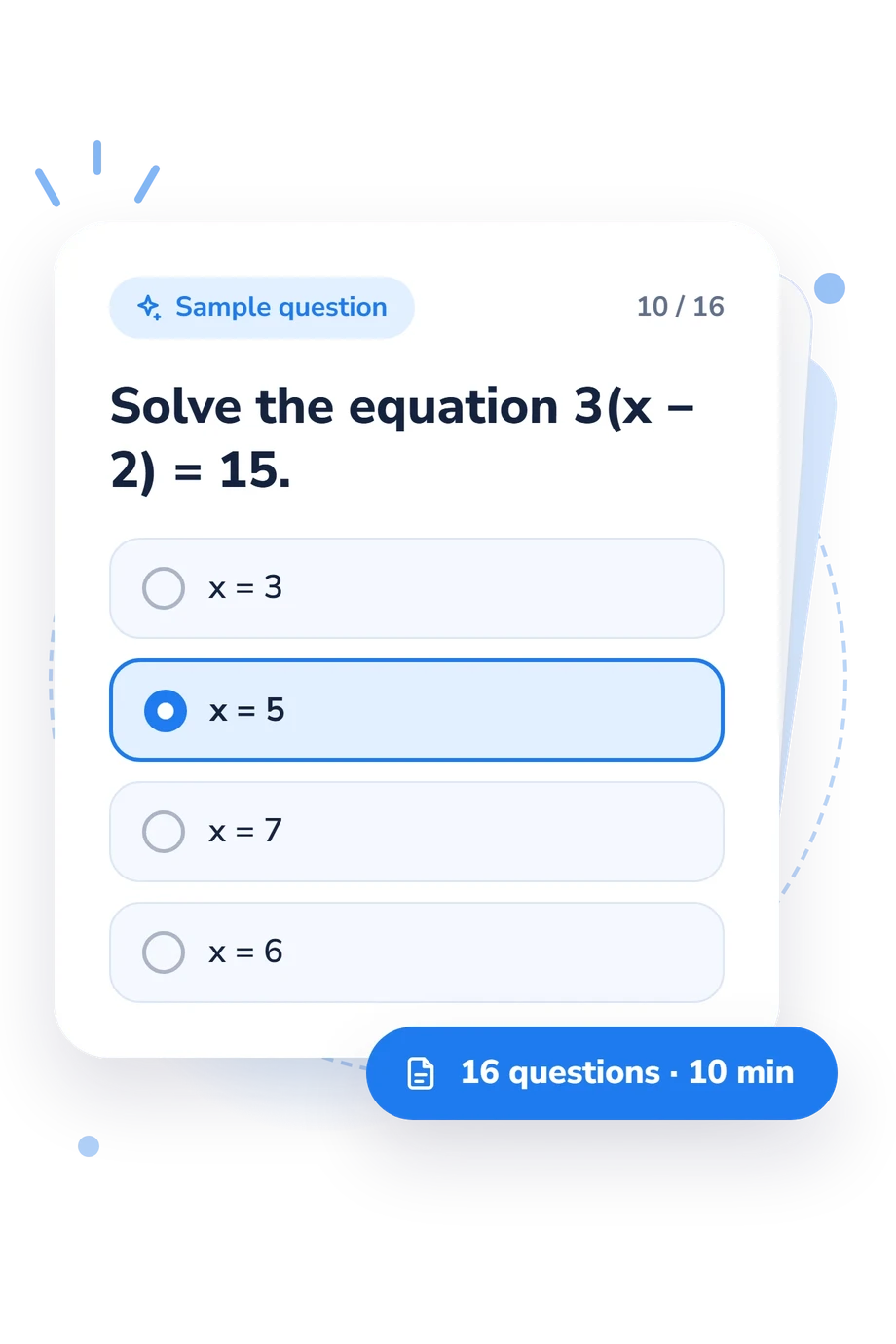
Example Questions From the Test
- The old gate creaked loudly in the wind.
- The clouds looked like ships on the horizon.
- The leaves fluttered as lightly as feathers.
- Her voice was a warm blanket on a difficult day.
- $20
- $55
- $65
- $60
- A widespread shift from cities to isolated farms
- Rapid urban growth as workers moved toward factory jobs
- A general replacement of machines with hand tools
- The disappearance of international trade
Education Level Quiz - Description and methodology of the test
People who want a concise snapshot of school subject knowledge can use this education level quiz to see how they handle familiar academic problems. It suits learners, adults reviewing foundations, and anyone planning what to revisit next. Used as a self-reflection quiz, it can help identify topics to review. The result reflects performance on this question set rather than completed schooling or a formal education level.
What This Assessment Explores
Rather than estimating a diploma or age, the questionnaire samples school subject knowledge through short problems in comprehension, calculation, science, history, and evidence-based reasoning. Its overall score indicates performance across the sampled material, while individual questions may suggest concepts a reader could revisit. As an academic knowledge test, it describes performance on sampled tasks, not completed schooling.
The main question groups cover these areas:
- Language tests metaphor, punctuation, and evidence supporting a written claim.
- Mathematics checks percentages, equations, fractions, and rates.
- Science examines cells, physical change, and controlled experiments.
- History, geography, and reasoning address sources, seasons, data, and evidence.
These areas feed one displayed result, Education Level Knowledge (0-16). Foundations to build (0-6) suggests reviewing core concepts; Developing knowledge (7-12) reflects many correct answers with some concepts to revisit; Strong knowledge (13-16) indicates strong command of the sampled material. It describes this question set only.
Methodology and Scientific Basis
Each item uses a multiple-choice format with four answer options. The respondent selects the best answer for a calculation, concept, interpretation, or conclusion. Scoring is a raw correct-answer total: each correct response adds one point, and the displayed bands translate that total into a descriptive result.
Rolfhus and Ackerman (1999) provide a useful comparison: their work separates knowledge from intelligence and examines how knowledge relates to cognitive traits. Rusche and Ziegler (2023) emphasize measuring knowledge within defined domains, while Pellegrino, Chudowsky, and Glaser (2001) explain how assessment tasks should support sound interpretations. This questionnaire is consistent with these ideas; it is not an adaptation or validated administration of those works.
That distinction matters. The questionnaire is not presented with population norms, reliability estimates, or evidence that its result can place someone academically. It is better treated as an informal educational assessment and self-review aid.
Scores can reflect current study habits, language familiarity, attention, guessing, and comfort with mixed subjects. A strong or weak result should guide reflection on specific topics rather than be treated as a diagnosis or formal qualification.
- Rolfhus, Eric L., and Phillip L. Ackerman. 1999. Assessing Individual Differences in Knowledge: Knowledge, Intelligence, and Related Traits. Journal of Educational Psychology 91(3): 511-526. 10.1037/0022-0663.91.3.511
- Rusche, Marianna Massimilla, and Matthias Ziegler. 2023. Measuring Domain-Specific Knowledge: From Bach to Fibonacci. Journal of Intelligence 11(3): 47. 10.3390/jintelligence11030047
- Pellegrino, James W., Naomi Chudowsky, and Robert Glaser, eds. 2001. Knowing What Students Know: The Science and Design of Educational Assessment. Washington, DC: National Academy Press. 10.17226/10019
Updated: