
What Is My Destiny Quiz
How the Scales are Structured
Who Usually Takes This Test?
See How You Compare
Below is a preview of how scores are typically distributed across each scale.
Example Questions From the Test
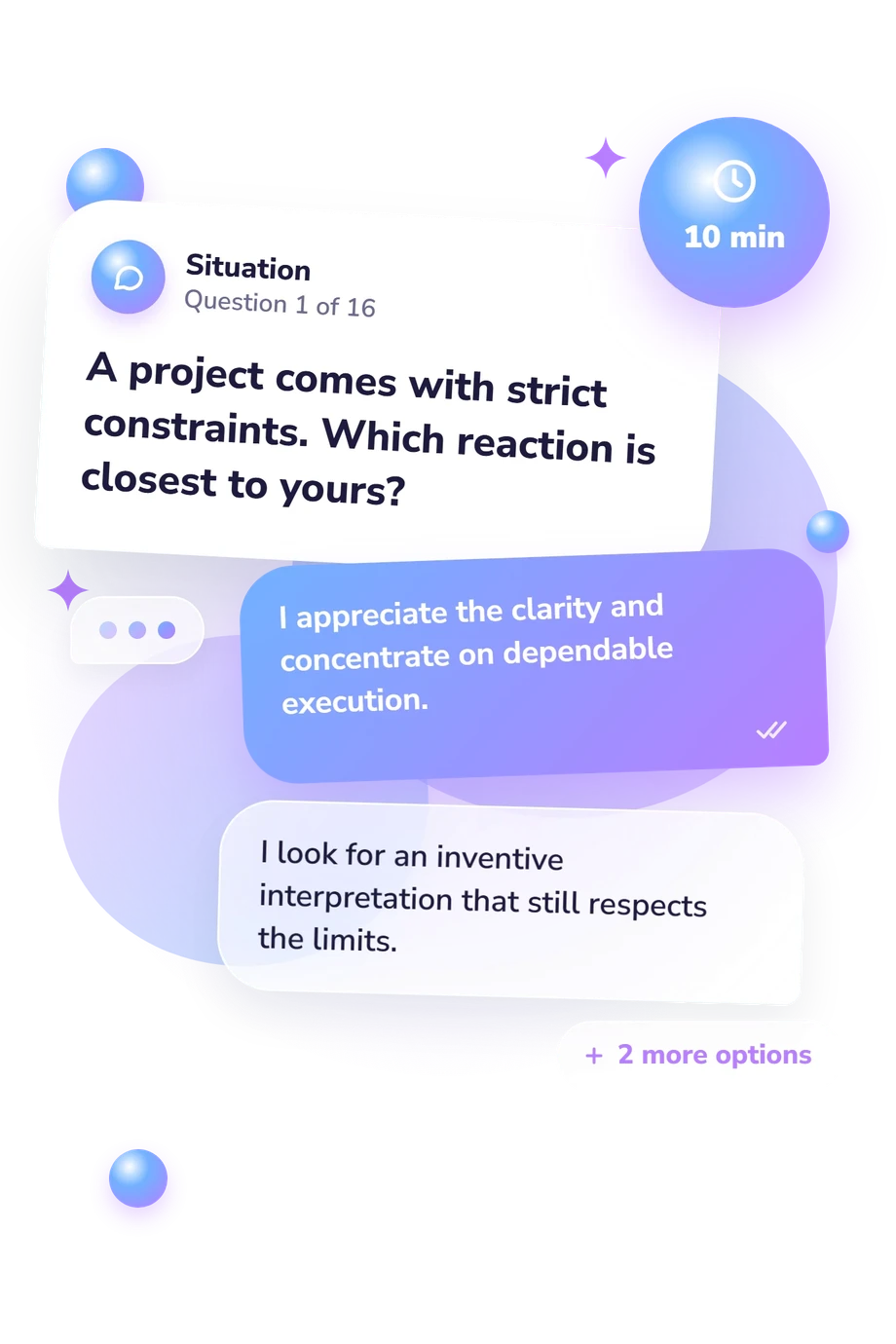
- I appreciate the clarity and concentrate on dependable execution.
- I look for an inventive interpretation that still respects the limits.
- I ask how the constraints affect the people involved.
- I test the edges to discover which limits are genuinely flexible.
- Finding a fresh direction after leaving familiar territory.
- Helping someone recognize what they want to do next.
- Transforming a rough concept into an original finished piece.
- Making a useful process steadily more dependable.
- I opened doors for people who needed direction or encouragement.
- I built something useful that continued to work and grow.
- I followed opportunities that expanded my view of the world.
- I expressed ideas in a form that felt unmistakably mine.
What Is My Destiny Quiz - Description and methodology of the test
People weighing a change in direction, a meaningful project, or a clearer sense of purpose may use the What Is My Destiny Quiz when they want to examine which kind of contribution feels most natural. It is designed for self-exploration rather than prediction. Because each situation offers four choices, this questionnaire turns what's your destiny quiz into a comparison of possible directions instead of forcing one life answer.
What This Assessment Explores
Situations involving constraints, routines, uncertainty, tension, opportunities, and helping others examine four expressions of purpose.
The result frames what is my fate quiz around purpose and direction, mapping motivations rather than forecasting events. It shows:
- Builder (0-12) reflects structure, practical progress, lasting results; Supporting Theme 0-4 makes stability secondary, Active Theme 5-8 makes construction meaningful, and Leading Theme 9-12 makes foundations central.
- Creator (0-12) reflects original expression; Supporting Theme 0-4 makes creativity secondary, Active Theme 5-8 makes reimagining meaningful, and Leading Theme 9-12 makes originality central.
- Explorer (0-12) reflects discovery and autonomy; Supporting Theme 0-4 keeps novelty secondary, Active Theme 5-8 makes experiences influential, and Leading Theme 9-12 makes expansion central.
- Guide (0-12) reflects listening, growth, connection, and perspective; Supporting Theme 0-4 keeps guidance secondary, Active Theme 5-8 makes helping recurring, and Leading Theme 9-12 makes it central.
Methodology and Scientific Basis
Each item presents a situation and four response choices. The options represent different priorities, so the closest honest answer is more useful than the most admirable one.
The result compares four separate thematic scores. Because the questionnaire does not state how many points each answer contributes, displayed numbers are profile indicators rather than a manually reconstructed scoring rule. Scores within one point indicate a blend.
The questionnaire’s broader focus on meaning sources is conceptually consistent with SoMe, but it is not an adaptation of that instrument, and its four themes are not validated SoMe subscales. The Meaning in Life Questionnaire separates meaning’s presence from searching, while the Life Engagement Test links purpose with valued aims. These instruments provide context, not a scoring key; this questionnaire uses its displayed thematic bands for interpretation.
The results from this destiny test help you notice motivational patterns and consider environments that may sustain them. Current circumstances, interpretation, and self-awareness can shape self-report, and the result is not a clinical diagnosis.
- Schnell, Tatjana. (2009). The Sources of Meaning and Meaning in Life Questionnaire (SoMe): Relations to demographics and well-being. The Journal of Positive Psychology, 4(6), 483-499. 10.1080/17439760903271074
- Steger, Michael F., Patricia A. Frazier, Matthew Kaler, and Shigehiro Oishi. (2006). The meaning in life questionnaire: Assessing the presence of and search for meaning in life. Journal of Counseling Psychology, 53(1), 80-93. 10.1037/0022-0167.53.1.80
- Scheier, Michael F., Carsten Wrosch, Andrew Baum, Sheldon Cohen, Lynn M. Martire, Karen A. Matthews, Richard Schulz, and Bozena Zdaniuk. (2006). The Life Engagement Test: Assessing purpose in life. Journal of Behavioral Medicine, 29(3), 291-298. 10.1007/s10865-005-9044-1
Updated: