
HACCP Quiz
How the Scales are Structured
Who Usually Takes This Test?
See How You Compare
Below is a preview of how scores are typically distributed across each scale.
Example Questions From the Test
- As a critical control point
- As a quality checkpoint only
- As a traceability exercise
- As a prerequisite program unrelated to the hazard analysis
- Conducting a hazard analysis
- Establishing corrective actions for each deviation
- Creating finished-product quality specifications
- Verifying every monitoring record
- Approve it solely from the equipment supplier's manual
- Set every processing step as a CCP
- Replace the hazard analysis with the flow diagram
- Walk through the operation and verify the flow diagram on site
HACCP Quiz - Description and methodology of the test
People involved in vegetable processing, food-safety study, or workplace review can use this assessment to examine how HACCP decisions are applied in realistic situations. This HACCP Quiz focuses on recognizing hazards, selecting appropriate controls, and responding when monitoring reveals a problem. Reviewing HACCP assessment answers can help learners and food-safety personnel identify topics for discussion, refresher study, or supervised practice.
What This Assessment Explores
The questionnaire examines whether a respondent can apply HACCP principles to vegetable-processing decisions. Its HACCP assessment questions involve biological, chemical, physical, and allergen hazards; critical control points and limits; monitoring records; deviations; sanitation prerequisites; supplier controls; process changes; validation; verification; and flow-diagram confirmation.
In practical terms, questions in this HACCP assessment ask the respondent to choose the action or classification that best protects food safety. The result places overall HACCP knowledge in an educational band and does not report separate scores for each theme.
The questions group into these practical themes:
- Hazard and process analysis covers how risks are identified and controls are selected.
- Response judgment examines how deviations, records, and corrective actions are handled.
- System maintenance addresses sanitation, calibration, validation, verification, and reassessment.
HACCP Knowledge runs from 0-16: Foundation to build (0-6), Developing knowledge (7-12), and Strong knowledge (13-16).
Methodology and Scientific Basis
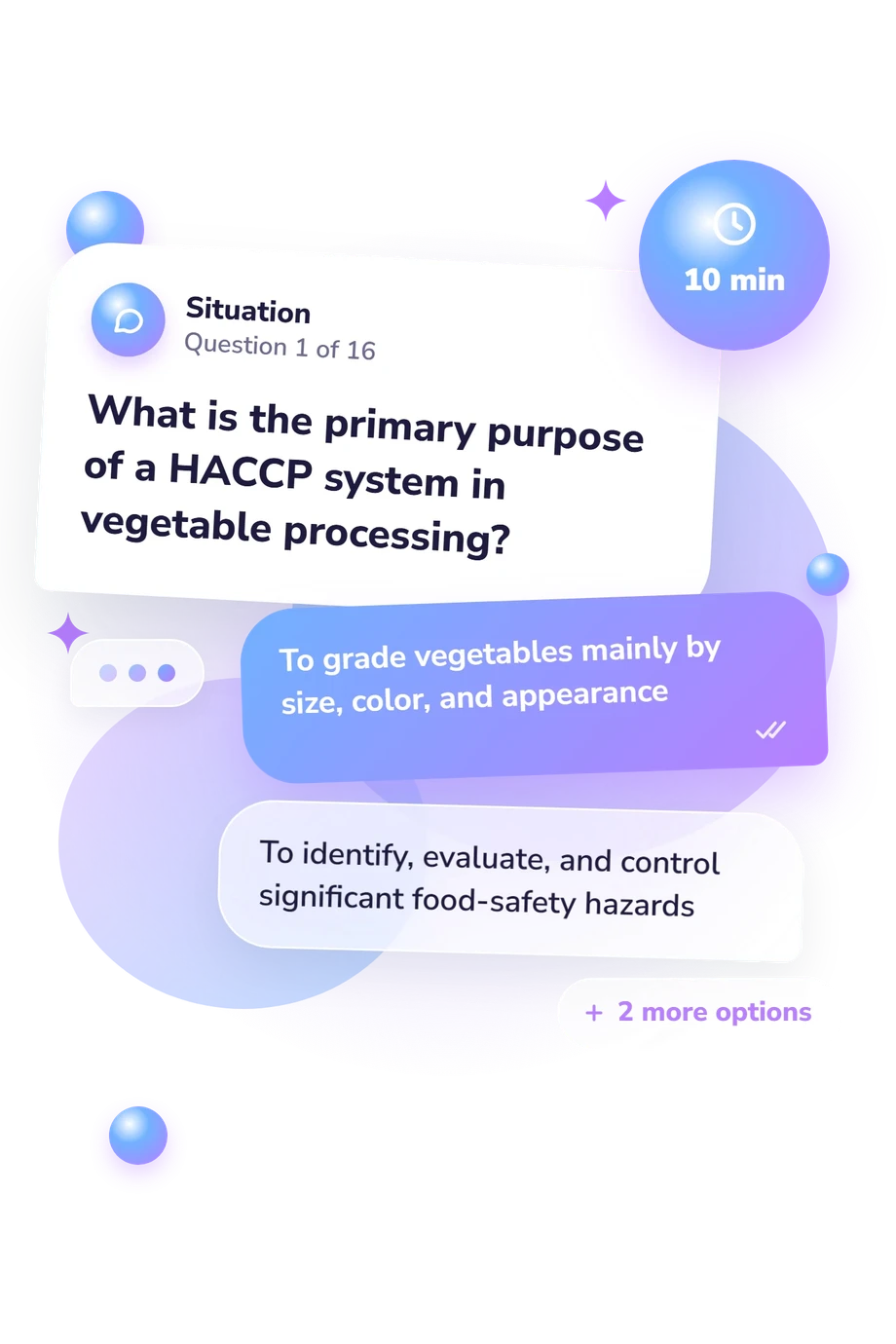
Methodologically, this is a scenario-based multiple-choice HACCP knowledge assessment. Each item presents a food-safety situation with four answer choices and asks for the response that best fits HACCP practice. The scenarios cover hazard analysis, critical limits, monitoring, corrective action, verification, validation, records, prerequisite programs, and change control.
The displayed score is a single knowledge result, and no separate weighting system or norm group is stated. The bands are educational descriptions rather than population-based cutoffs: they organize review priorities but do not demonstrate that a facility’s plan is adequate, and an answer may not transfer unchanged to a different processing environment.
For refresher learning, this format can function as an HACCP training quiz, while performance depends on prior knowledge, experience, and process context.
The questionnaire is conceptually consistent with HACCP applications discussed by Varzakas and Arvanitoyannis (2008) and with the HACCP principles described by NACMCF (1998) and Codex Alimentarius Commission (2022), but it is not presented as an adaptation of those sources.
- Varzakas, T. H., & Arvanitoyannis, I. S. (2008). Application of ISO22000 and comparison to HACCP for processing of ready to eat vegetables: Part I. International Journal of Food Science & Technology, 43(10), 1729-1741. 10.1111/j.1365-2621.2007.01675.x
- National Advisory Committee on Microbiological Criteria for Foods. (1998). Hazard analysis and critical control point principles and application guidelines. Adopted August 14, 1997. Journal of Food Protection, 61(9), 1246-1259. 10.4315/0362-028X-61.9.1246
- Codex Alimentarius Commission. (2022). General Principles of Food Hygiene CXC 1-1969. Rome: FAO and WHO.
Updated: