
Sagittarius Quiz
How the Scales are Structured
Who Usually Takes This Test?
See How You Compare
Below is a preview of how scores are typically distributed across each scale.
Example Questions From the Test
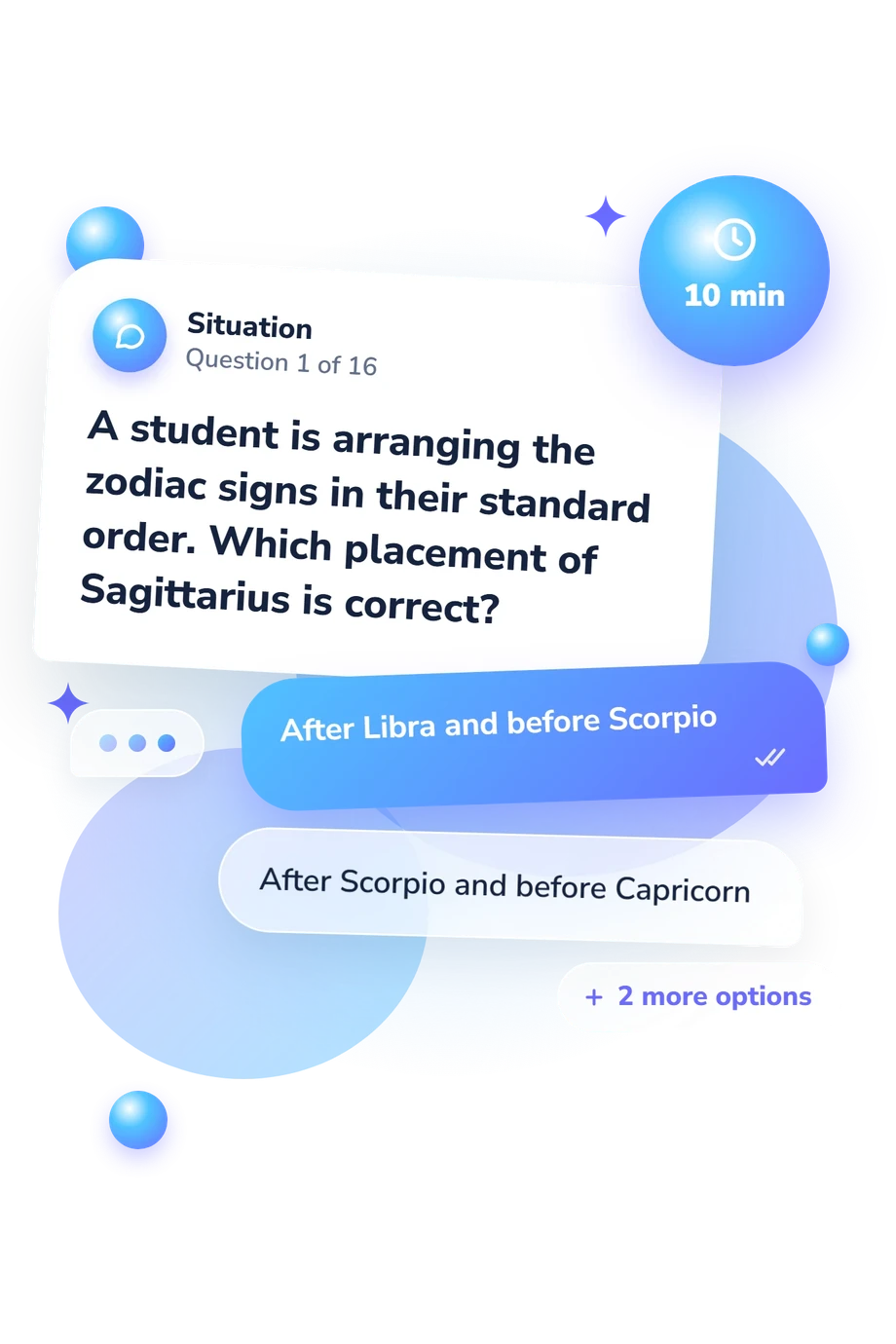
- After Libra and before Scorpio
- After Scorpio and before Capricorn
- After Capricorn and before Aquarius
- After Leo and before Virgo
- Taurus
- Pisces
- Virgo
- Gemini
- Restriction, duty, and consolidation
- Expansion, meaning, and broad horizons
- Secrecy, crisis, and underworld transformation
- Precision, routine, and detailed analysis
Sagittarius Quiz - Description and methodology of the test
Readers who want to check their understanding of astrological symbolism can use the Sagittarius Quiz as a focused knowledge exercise. It suits beginners, astrology learners, and curious visitors who want to separate chart terminology from popular sign descriptions. The assessment offers a Sagittarius knowledge check by showing how accurately you recognize the sign’s place in zodiac structure, traditional symbolism, and basic interpretive language.
What This Assessment Measures
The test checks knowledge of Sagittarius in astrology. You place it in zodiac order, distinguish a sign from its constellation, identify its fire element, mutable modality, and Jupiter rulership, and connect the Archer with imagery.
For chart vocabulary and traditional associations, this questionnaire works as a Sagittarius astrology quiz focused on established terms and distinctions. Its score reflects accuracy across tested material.
The question themes contributing to the displayed score are:
- Sagittarius Knowledge (0-16) counts correct answers: Foundations to Explore (0-6) indicates basic ideas need work; Developing Knowledge (7-12) indicates growing command; Strong Knowledge (13-16) indicates a well-rounded grasp.
- Zodiac questions test whether you order signs and distinguish tropical from sidereal frameworks.
- Chart interpretation questions test whether you separate Sun signs, planetary placements, and full charts.
- Symbolic tradition questions test recognition of Sagittarius’s element, modality, ruler, and image.
Methodology and Evidence Base
Each item presents four answer options. Questions cover definitions, zodiac order, chart notation, symbolic associations, and distinctions between astrological and astronomical concepts. The total reflects the number of correct responses, while the displayed band explains the level of knowledge represented.
The conceptual reference point is Ptolemy's Tetrabiblos, which describes traditional categories involving signs, planets, elements, qualities, and rulerships. The questionnaire is conceptually consistent with that framework, but it is a separate educational knowledge assessment rather than an adaptation of the work.
For learners, this questionnaire also works as a Sagittarius zodiac quiz, checking familiarity with traditional astrological vocabulary. Carlson's 1985 double-blind research and Wyman and Vyse's 2008 study examined whether astrological charts could support personality claims; those studies address astrology's broader evidence base rather than the factual knowledge tested here.
Performance can vary with prior reading, the tradition encountered, and confusion between tropical and sidereal frameworks. The score describes success on these questions at completion, and the educational bands indicate the level of knowledge reflected by that score.
- Ptolemy. Tetrabiblos. Edited and translated by Frank Egleston Robbins. Loeb Classical Library 435. Cambridge, MA: Harvard University Press; London: William Heinemann, 1940.
- Wyman, Alyssa Jayne, and Stuart Vyse. Science versus the stars: a double-blind test of the validity of the NEO Five-Factor Inventory and computer-generated astrological natal charts. The Journal of General Psychology. 2008;135(3):287-300. 10.3200/GENP.135.3.287-300.
- Carlson, Shawn. A double-blind test of astrology. Nature. 1985;318:419-425. 10.1038/318419a0
Updated: