
Weather and Climate Quiz
How the Scales are Structured
Who Usually Takes This Test?
See How You Compare
Below is a preview of how scores are typically distributed across each scale.
Example Questions From the Test
- A single weather event can occur within a long-term climate trend; both should be assessed on their appropriate timescales.
- The cold day disproves the regional warming trend.
- The warming trend must be false unless every day is warmer than the historical average.
- Daily temperature and long-term climate are unrelated and should never be compared.
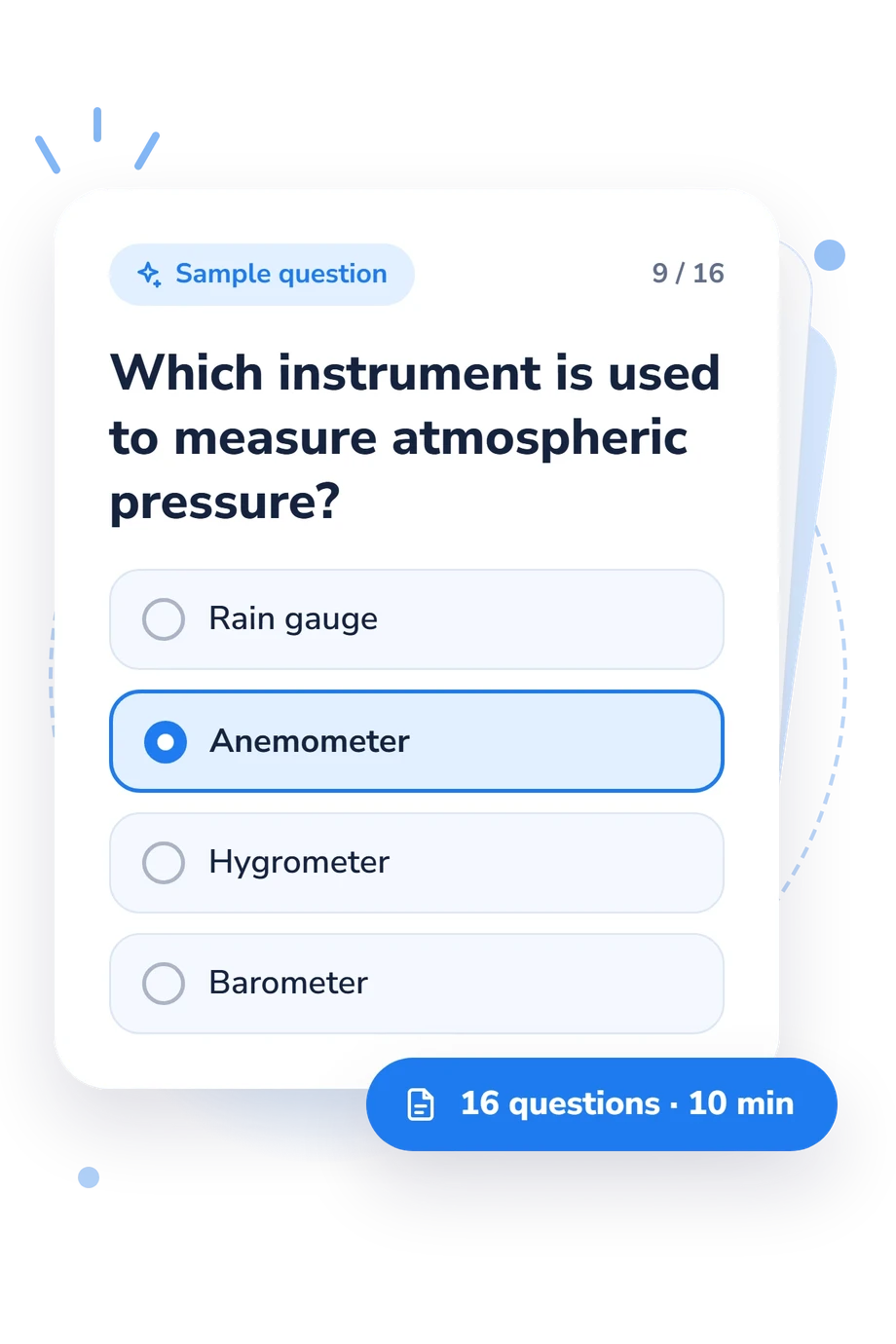
- Rain gauge
- Anemometer
- Hygrometer
- Barometer
- Transpiration
- Evaporation
- Infiltration
- Condensation
Weather and Climate Quiz - Description and methodology of the test
For readers who want to distinguish a passing forecast from a broader climate pattern, the weather and climate quiz offers a focused check of core understanding. This weather-and-climate quiz helps learners, teachers, and curious adults connect observations with atmospheric processes. The result indicates current knowledge from correct answers and points to ideas that may deserve another look.
What This Assessment Explores
Weather changes across short periods and locations, while climate describes longer-term patterns, variability, and evidence collected over time. The questions connect that distinction with fronts, pressure, humidity, condensation, winds, ocean influence, urban heating, feedbacks, flooding, mitigation, and adaptation. Scenario-based items ask for the best interpretation, so the result reflects applied understanding as well as definitions.
The result uses one displayed scale:
- Weather and Climate Knowledge (0-16) counts correct answers and places the result in Building Foundations (0-6), Developing Knowledge (7-12), or Strong Knowledge (13-16). These bands indicate foundational review, developing command of interacting ideas, or a well-developed grasp of evidence and practical applications.
The place-based scenarios let this assessment function as a geography quiz about weather and climate for classroom review or personal learning. It is intended for people building general knowledge, not for measuring personality, motivation, or professional forecasting skill.
Methodology and Evidence Base
Each item presents four answer choices and asks for the best interpretation. Questions and answers in this weather-and-climate quiz cover instruments, atmospheric processes, timescales, urban heating, and flood planning. The reported result reflects overall performance and does not identify a specific weakness.
The method is criterion-scored multiple choice rather than a self-report trait measure: one point is awarded for each correct answer, and the total is reported through the bands. Conceptually, the questionnaire is closest to the Fundamentals in Meteorology Inventory (Davenport & French, 2020). Its weather-literacy and climate-knowledge themes also overlap with work by Fleischhut, Herzog, and Hertwig (2020), and with MACK-12 by Labonté and Champagne St-Arnaud (2025). The questionnaire is conceptually consistent with these sources in its focus on weather processes, climate knowledge, evidence, and practical responses.
Published norms specific to this online questionnaire are not established. Performance may reflect prior instruction, terminology familiarity, guessing, and the context in which a respondent takes it, so the score is best used as a learning snapshot that guides review rather than as a judgment of ability.
- Davenport, Casey E., and Adam J. French. The Fundamentals in Meteorology Inventory: Validation of a Tool Assessing Basic Meteorological Conceptual Understanding. Journal of Geoscience Education 68, no. 2 (2020): 152-167. 10.1080/10899995.2019.1629193
- Fleischhut, Nadine, Stefan M. Herzog, and Ralph Hertwig. Weather Literacy in Times of Climate Change. Weather, Climate, and Society 12, no. 3 (2020): 435-452. 10.1175/WCAS-D-19-0043.1
- Labonté, Katherine, and Valériane Champagne St-Arnaud. Development and validation of MACK-12: A short multidimensional climate knowledge scale. PLOS Climate 4, no. 11 (2025): e0000600. 10.1371/journal.pclm.0000600
Updated: