
Radiation Safety Quiz
How the Scales are Structured
Who Usually Takes This Test?
See How You Compare
Below is a preview of how scores are typically distributed across each scale.
Example Questions From the Test
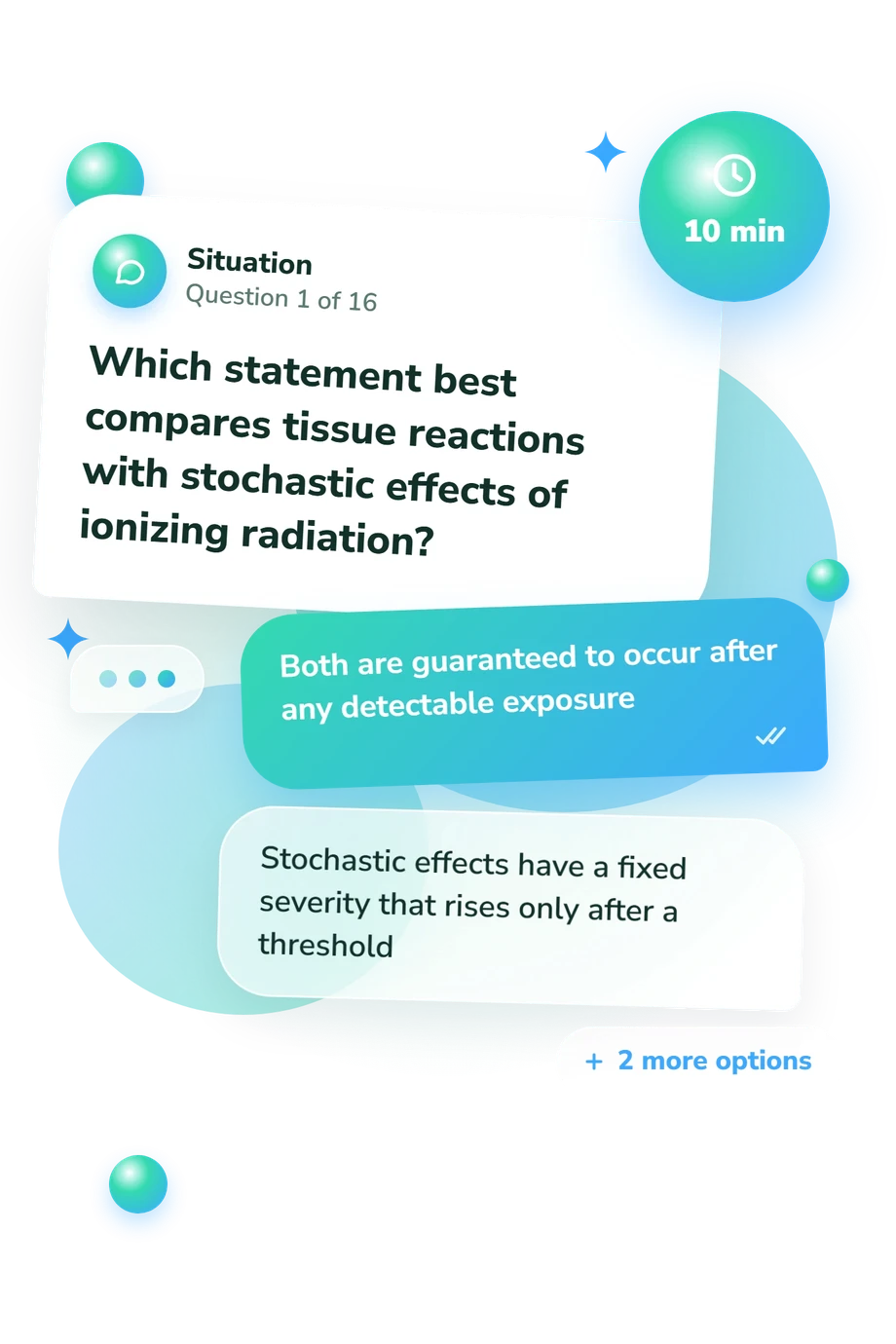
- Both are guaranteed to occur after any detectable exposure
- Stochastic effects have a fixed severity that rises only after a threshold
- Tissue reactions occur only through radioactive contamination
- Tissue reactions generally have dose thresholds, while stochastic-effect probability is treated as increasing with dose
- Inhalation, ingestion, and entry through a wound
- External irradiation, sound transmission, and skin temperature
- Distance, shielding, and exposure time
- Reflection, refraction, and diffraction
- A sheet of paper
- A thin cotton layer
- An open air gap of a few millimetres
- A suitably designed thickness of lead or concrete
Radiation Safety Quiz - Description and methodology of the test
For workers, students, and anyone revising core radiation-protection practice, this radiation safety quiz provides a focused check of knowledge needed for safer decisions. Its questions and answers in this quiz on radiation safety place technical ideas in practical situations, from contamination control to missing-source response. The result helps identify concepts that deserve review before routine work or supervised duties.
What This Assessment Explores
This questionnaire checks practical radiation-protection knowledge rather than attitudes, symptoms, or exposure history. Its items distinguish tissue reactions from stochastic effects, separate exposure from contamination, apply ALARA, test dosimetry and half-life, address shielding, and present spills, missing sources, or suspected contamination. These situations reflect decisions relevant to laboratory, healthcare, and technical work.
The single displayed scale, Radiation Safety Knowledge (0-16), summarizes performance across those concepts. Answers from this radiation-safety quiz are most useful when the band directs attention to topics needing review rather than encouraging rote recall.
The result bands describe the following levels:
- Foundations to build (0-6) indicates that core ideas such as exposure versus contamination, ALARA, shielding, and incident reporting need review.
- Developing knowledge (7-12) indicates understanding of many principles with benefit from targeted training before independent application.
- Strong knowledge (13-16) indicates solid conceptual understanding, but not certification or proof of practical competence.
Methodology and Evidence Base
Each item uses a single best answer with several alternatives, asking the respondent to identify the most accurate radiation-protection principle or action. The set combines conceptual distinctions, simple calculations, dosimetry practice, biological effects, shielding, and incident response. Selected responses are aggregated into the displayed result; no separate subscore for each topic is stated.
Methodologically, the content is conceptually consistent with Jones and Mathieson (2016) and with knowledge domains examined by Schroderus-Salo and colleagues (2019). It also reflects the IAEA Basic Safety Standards and ICRP Publication 103 on dose concepts, optimization through ALARA, contamination control, shielding, and emergency response. This describes alignment, not adaptation: the online questionnaire is not presented as either published instrument.
As a training quiz on radiation safety, it can support refresher learning and identify gaps before supervised work. The questionnaire has no stated norm group or reliability evidence, and performance may vary with memory, wording, and familiarity with safety language; any actual incident still calls for local procedures and the radiation-safety officer or appropriate emergency support.
- Jones, Eric, and Kathleen Mathieson. "Radiation Safety among Workers in Health Services." Health Physics 110, no. 5 Suppl 2 (2016): S52-S58. 10.1097/HP.0000000000000485
- Schroderus-Salo, Tanja, Lassi Hirvonen, Anja Henner, Sanna Ahonen, Maria Kääriäinen, Jouko Miettunen, and Kristina Mikkonen. "Development and validation of a psychometric scale for assessing healthcare professionals’ knowledge in radiation protection." Radiography 25, no. 2 (2019): 136-142. 10.1016/j.radi.2018.12.010
- International Atomic Energy Agency. Radiation Protection and Safety of Radiation Sources: International Basic Safety Standards. General Safety Requirements Part 3. Vienna: IAEA, 2014.
- International Commission on Radiological Protection. The 2007 Recommendations of the International Commission on Radiological Protection. ICRP Publication 103. Annals of the ICRP 37, nos. 2-4 (2007): 1-332. 10.1016/j.icrp.2007.10.003
Updated: